

If you are looking for seeds for a greenhouse, the short answer is this: choose genetics that cope well with humidity and temperature changes, that don’t shoot up in height and that adapt to the natural light in your area. For most growers in Spain, that means deciding between photoperiod feminised seeds, which give more size and yield, and autoflowering ones, which flower by age and are faster. Here we explain how to decide, what to watch for inside the greenhouse and what to bear in mind before you start.
In short
- A greenhouse gives you sunlight and protection from rain, wind and cold, but it traps heat and humidity: ventilation matters as much as genetics.
- Photoperiod feminised plants yield more and require you to control the light cycle; autoflowering plants flower on their own and are ideal if you want to harvest early or have little space.
- Light response changes from one variety to another, so test on a small scale before betting the whole greenhouse on a single genetic.
- In Spain, growing cannabis is subject to a strict legal framework: check the regulations before sowing.
Why the greenhouse changes the rules of the game
A greenhouse is neither an indoor grow tent nor an open-air bed. It has a bit of both, and that’s why choosing seeds can’t be settled with the list of “best varieties” you see everywhere.
What you gain: free natural light, bigger plants than indoors and protection from hail, heavy rain and early frosts. What you risk: heat spikes in summer, built-up humidity when the cover doesn’t ventilate and, in autumn, condensation on the flowers, which is exactly what dense buds hate.
That’s why, for a greenhouse, three things matter more than the trendy name:
- Flowering time, so that the harvest falls before the rains and the cold.
- Plant structure: better branched and open than very compact buds that retain water.
- Tolerance to heat and humidity, which depends a lot on the genetics and on how you manage the plant.
If you want to understand the background to the different plant types, our guide to the differences between indica, sativa and hybrids gives you the vocabulary to read any variety sheet.
Feminised or autoflowering: the main decision
It’s the first question and it shapes everything else.
Feminised photoperiod seeds
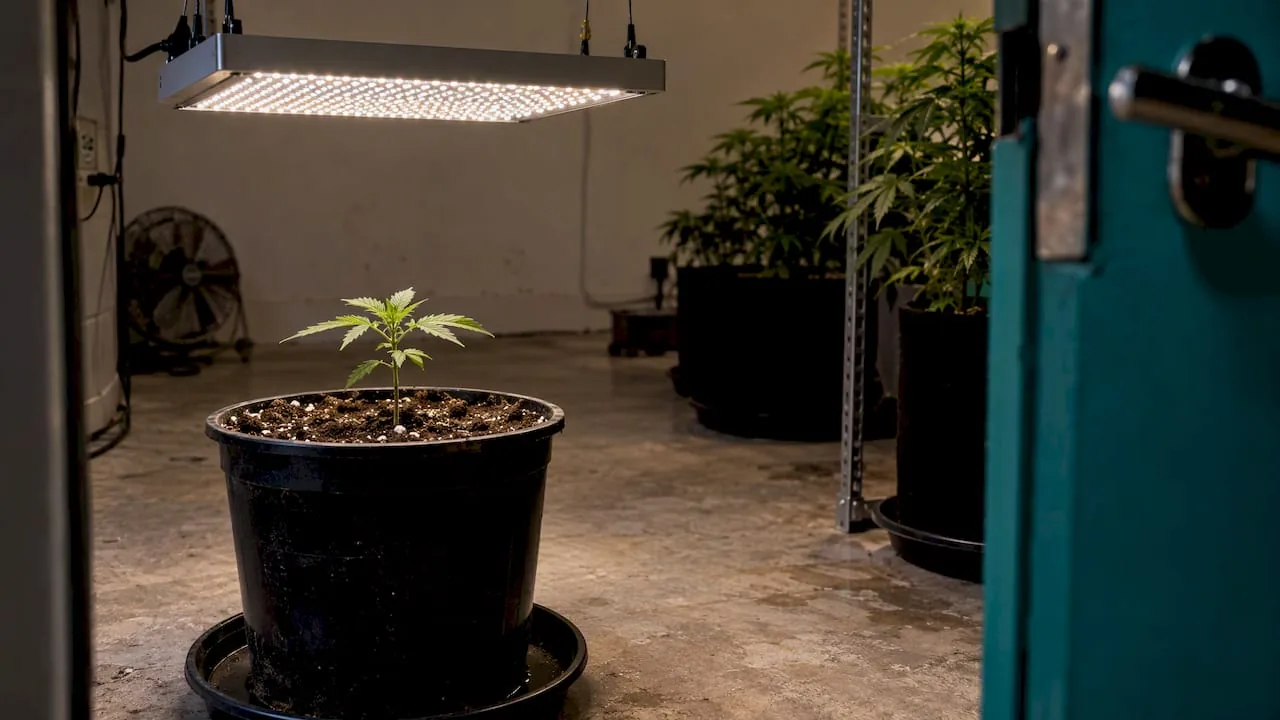
They flower when the days get shorter, either naturally or by force. In a greenhouse you have some leeway: you can let them grow in the vegetative stage while the days are long and let flowering start with the light of late summer. In return, you need to respect the darkness: an emergency light at night or a nearby street lamp can confuse the plant.
They are the choice if you want big plants, good yields and control over when flowering starts. You can see them in our feminised seeds category.
Autoflowering
They flower by age, regardless of photoperiod. In a greenhouse this means short cycles and the possibility of fitting in more than one harvest in a season, or of sowing at times of year when a photoperiod plant would make no sense. They tend to stay more compact, which helps if the roof is low.
If that path tempts you, take a look at our autoflowering seeds and the guide to the advantages of autoflowering for beginners.
And regular seeds
Regular seeds produce males and females. They make sense if you want to select or breed, but in a small greenhouse they take up space with plants you’ll later discard. If you’re torn between the two, we go over the comparison of feminised and regular seeds.
| Criterion | Photoperiod feminised | Autoflowering |
|---|---|---|
| Start of flowering | Depends on day length | By plant age |
| Usual size | Larger, with more room to grow | More compact |
| Yield per plant | Usually higher | Usually more moderate |
| Cycle | Longer, depending on the season | Short and fast |
| Light control | Important in the greenhouse | Of little relevance |
| Ideal for | Growers with space and patience | Beginners, low ceilings, quick harvests |
What to compare on a product page before buying
A seed sheet says a lot if you know how to read it. These are the details that matter most in a greenhouse.
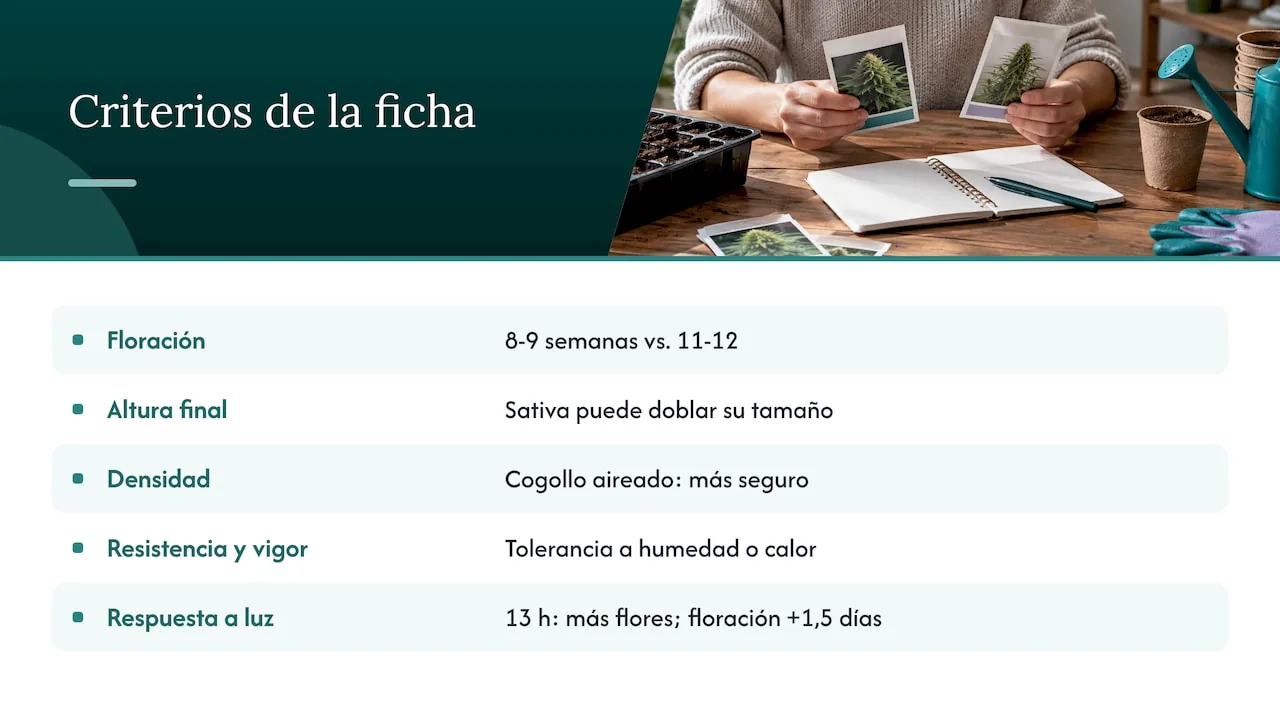
Flowering days. A strain that takes 8 to 9 weeks lets you finish the cycle more safely than one that takes 11 or 12 if your autumn is damp. If that is precisely your priority, take a look at our guide to fast-flowering seeds and the Fast version category.
Final height. Measure your growing space properly, and subtract whatever the plant grows in the first weeks of flowering. A very sativa variety can double in size after the change of phase. Official fact sheets describe the sativa subspecies as large and indica as smaller, according to the Spanish inventory of traditional knowledge about hemp, and in practice modern hybrids distribute those traits in very different ways.
Bud density. The more compact it is, the harder it is for the inside to dry out after a damp night. In a greenhouse, an airy bud is a safeguard.
Resilience and vigour. Look for descriptions that mention tolerance to humidity or heat. If you grow in coastal or hot areas, our guide to growing cannabis in a Mediterranean climate will help you fine-tune.
Response to light. Here is a catch. A peer-reviewed study published in Plants in 2024 compared indoor photoperiods: Gorilla Glue and Incredible Milk produced more inflorescence with 13 hours of light than with 12, but Incredible Milk started flowering about a day and a half later. The authors’ conclusion is that the response depends on the cultivar and that each grower should investigate the response of their own plants. Translated to the greenhouse: what works for your neighbour with a different variety may not work for you.
A small trial before betting the whole greenhouse
The temptation is to fill the greenhouse with the genetics you like most. Bad idea the first time.
Variety trial guides for farmers, such as the one from the Organic Seed Alliance, recommend testing varieties you haven’t grown before on a small scale for two or three years, and present these trials as part of the annual plan for adapting to an increasingly unpredictable climate. It is aimed at agricultural holdings, but the logic works in any greenhouse.
A simple method:
- Choose two or three varieties with different cycles.
- Sow a few plants of each one, under the same conditions.
- Note down germination dates, the start of flowering, height, mould problems and harvest date.
- Next season, repeat what worked and discard the rest.
It’s less epic than filling the greenhouse all at once, but it saves you a lost season.
Germination and the first weeks in the greenhouse
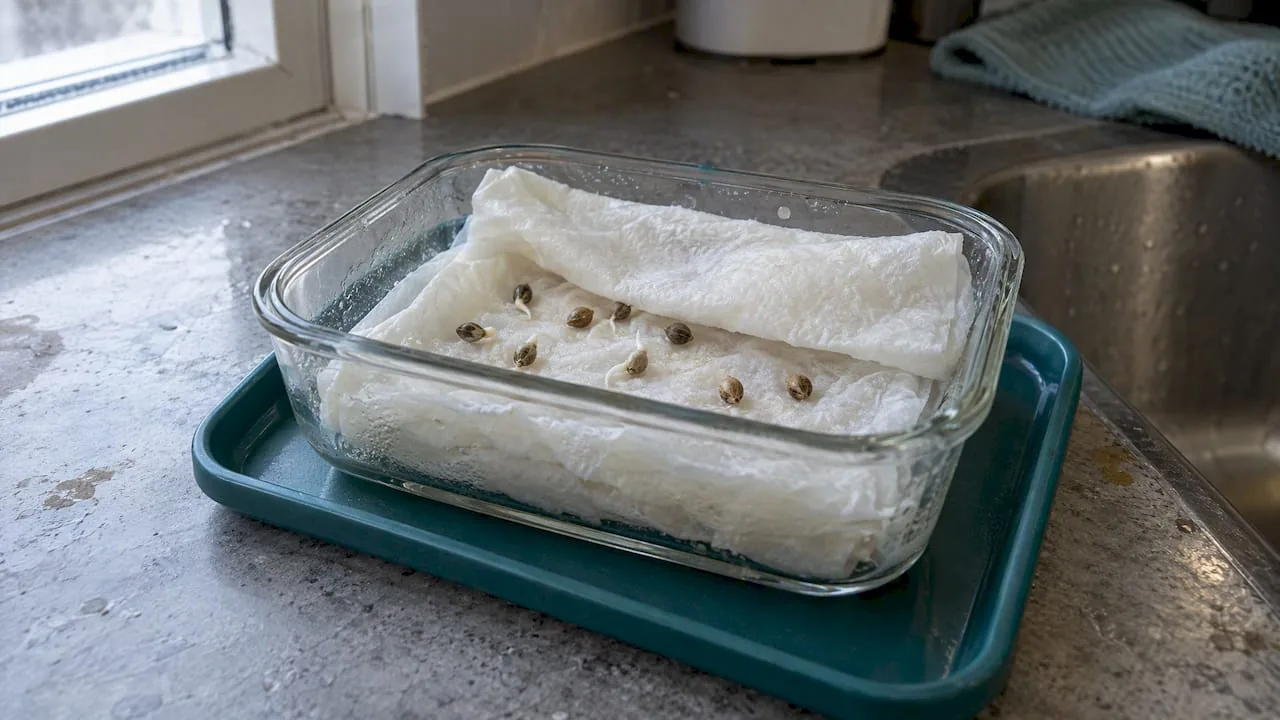
A greenhouse is a good place to start seedlings because it makes the most of the light and protects them from extremes, as long as you keep an eye on the temperature. The essentials of germination don’t change: moisture without waterlogging, oxygen and gentle, steady warmth. A greenhouse without shade can go from mild to oven-hot in a single spring morning, so don’t leave your seeds on the greenhouse floor without a thermometer.
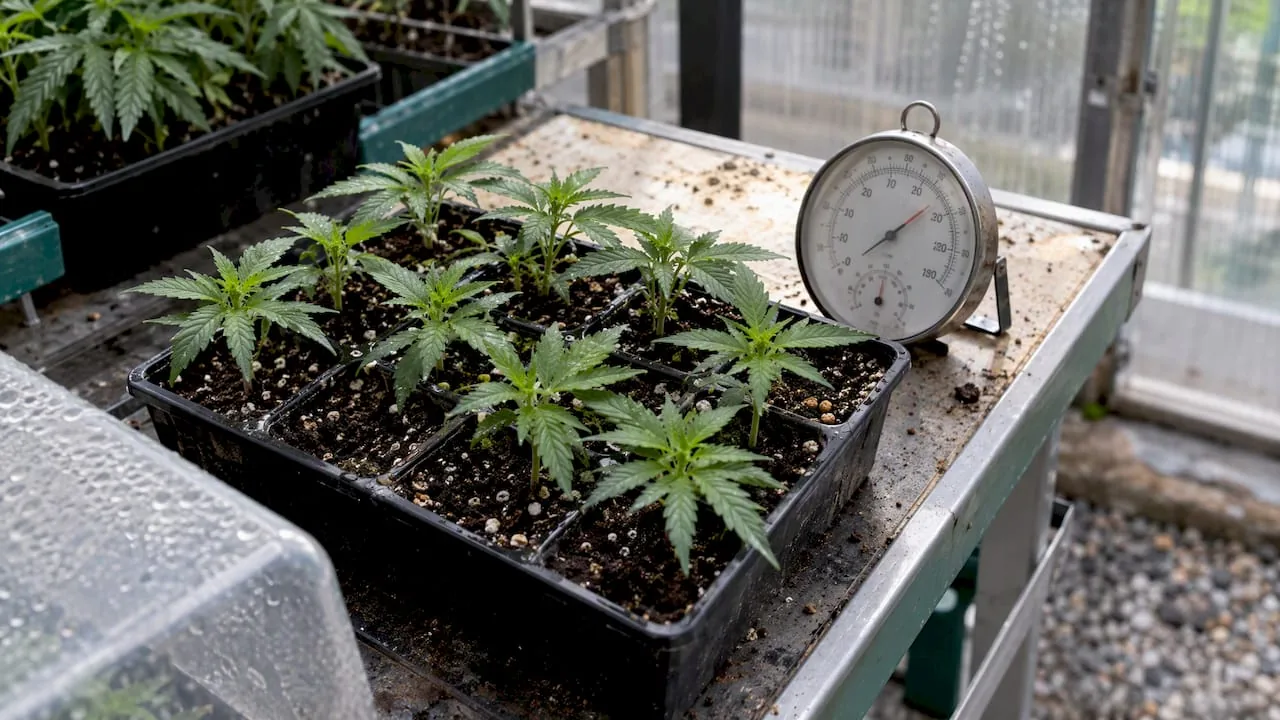
If you’ve never germinated before, you have two step-by-step guides: the complete guide to germinating cannabis seeds and the practical step-by-step germination version. If you prefer a controlled system, we go through how to set up a seed germinator.
Then come the first weeks of growing, which is where a good part of the harvest is decided: moderate watering, enough light and no sudden changes.
💡 Grower’s tip: always germinate a few extra seeds. A seedling that doesn’t get off to a good start in a warm greenhouse isn’t worth giving space to.
Ventilation, temperature and humidity: the real challenge
Genetics help, but what ruins the most harvests in a greenhouse is still air.
- Cross ventilation. Windows or sides facing each other, and an extractor or fan if the cover is not enough. Air needs to move between the plants, not just above them.
- Space between plants. A dense planting hinders circulation. The recommendations for high-humidity areas insist on spacing plants well and pruning unnecessary leaves to reduce damp spots.
- Be careful with watering in the afternoon. Watering late leaves the substrate and the environment damp overnight. It is better in the morning.
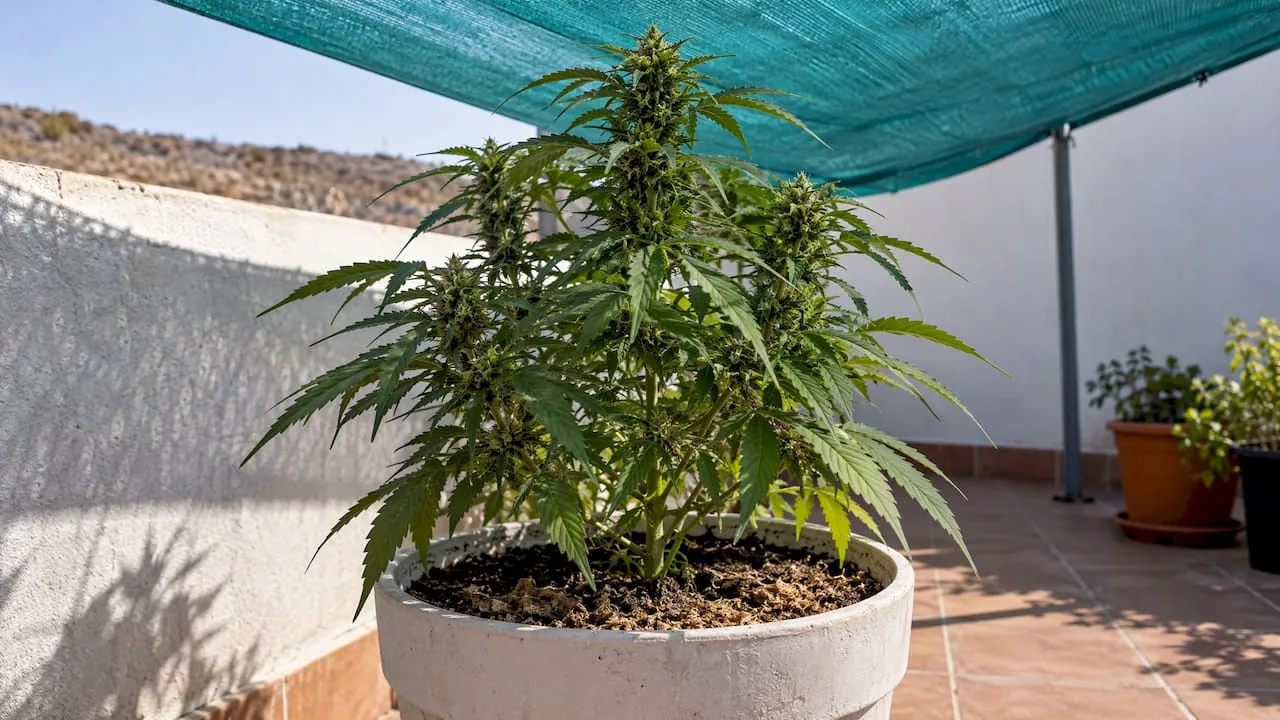
- Shading in summer. A shade net or shading paint prevents heat peaks that stunt growth and stress the plant.
- Daily checks during flowering. Look inside the buds. A bud with brown, soft patches needs to be removed as soon as possible, before the mould spreads.
A thermometer with a hygrometer, the kind that records maximums and minimums, costs little and gives you more information than any hunch. Place it at plant height, not near the ceiling.
An approach for each type of greenhouse
A plastic tunnel is not the same as a rigid greenhouse with roof ventilation.
- Simple plastic tunnel: autoflowering or short-flowering photoperiod plants, because ventilation is limited and the heat rises quickly.
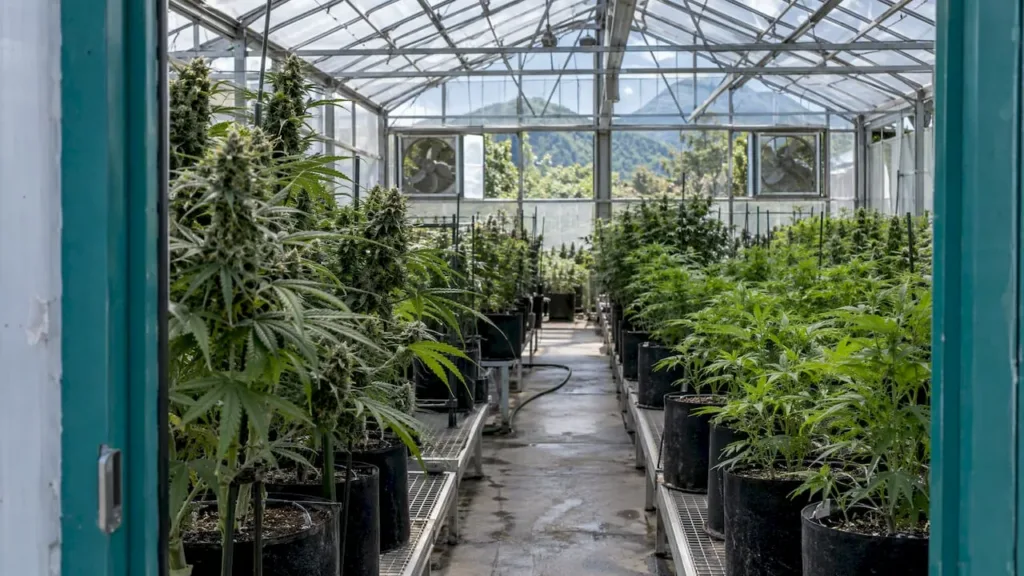
- Greenhouse with roof and side vents: accommodates larger photoperiod plants, always with aeration pruning.
- Small balcony or terrace greenhouse: compact autoflowering plants, and if you can, a single well-cared-for plant rather than three crammed together.
If your climate is dry and hot, humidity takes a back seat and heat and pests rule. We have a guide on drought-resistant seeds that you can use as a reference.
Our opinion: what we would do
After watching many growers move from indoor to greenhouse, our advice is unglamorous: don’t start with the most exotic variety, start with a stable genetic that you can control.
If it is your first greenhouse, we would go for an autoflowering or a feminised plant with short flowering, and save the tall, late sativa for when you know the microclimate of your space. A plant that finishes on time with air between the branches is worth more than a great promise that rots in October.
We’d also tell you to write everything down. Memory fails, and in a year’s time you’ll want to know which day each plant flowered and what happened with the humidity that week. That notebook is your best selection tool.
And if you’re in doubt, write to us: part of what we do is guide your choice according to your space and experience.
What the law says in Spain
Care is needed here. According to the Ministry of Agriculture’s information note on hemp growing, growing cannabis requires prior authorisation from the AEMPS, except for industrial cultivation intended exclusively for fibre, grain or seed that lacks the narcotic substance. For that industrial cultivation, certified seeds of varieties listed in the EU common catalogue are required, with a THC content of 0.3 % or less.
In other words: a cannabis plantation in a greenhouse is no minor matter, and it is not governed by what the forums say. Before sowing, find out what applies to your situation in your autonomous community and, if you have specific doubts, consult a lawyer who specialises in the subject. The seeds we sell are for collecting, and each customer is responsible for complying with the law where they live.
Where to find seeds for your greenhouse
In our shop you will find feminised, autoflowering, regular, CBD and fast-flowering cannabis seeds from well-known seed banks, with discreet shipping, order tracking and personalised support. You can explore the whole seed catalogue and filter by type according to the cycle you need. Shipping costs and current promotions are shown on the website before you pay.
If you arrive not knowing what to choose, start with our guide to seeds for your first grow or the one on seeds for indoor beginners, whose criteria also apply in a greenhouse.
Frequently Asked Questions
Which seeds are best for a greenhouse?
Those with short or medium flowering, a manageable size and good tolerance to humidity. Autoflowering plants are the easiest option to start with; photoperiod feminised plants yield more if you have height, ventilation and control over the light cycle.
Can I germinate the seeds directly in the greenhouse?
Yes, if the environment is stable: moisture without waterlogging, oxygen and gentle warmth. The safest approach is to germinate in a small container inside the greenhouse, with a thermometer nearby, and transplant once the seedling is established.
Autoflowering or photoperiod for a small greenhouse?
For a small space, an autoflowering plant usually fits better: it stays more compact and does not depend on day length. A photoperiod plant makes sense when height is not a problem and you want more yield per plant.
Where can you get free seeds?
It’s best not to trust free seeds of doubtful origin: you know neither the genetics nor the quality. It’s more reliable to buy from a seller with guarantees, and to check the current promotions, which sometimes include free seeds with your order.
Is it legal to grow cannabis in a greenhouse in Spain?
Growing cannabis requires prior authorisation from the AEMPS, with the exception of industrial hemp that meets the variety and THC requirements. Check the regulations that apply in your case before sowing.
To start with: two options we recommend
If your greenhouse is small or it’s your first season, start with a variety from our autoflowering category: short cycle, controlled size and less risk from the weather. And if you have the height and want to make the most of natural light, choose one of the feminised varieties with medium flowering and let the greenhouse do its job. And remember, both need plenty of ventilation.
Sources
- Spanish inventory of traditional knowledge: hemp factsheet (MAPA, 2022)
- Information note on hemp growing (MAPA)
- Longer Photoperiod Substantially Increases Indoor-Grown Cannabis (Plants, 2024)
- The Grower’s Guide to Conducting On-farm Variety Trials (Organic Seed Alliance, 2018)
- How to protect a cannabis crop in high-humidity areas