

Growing with 12/12 from seed means putting a photoperiod variety under 12 hours of light and 12 hours of uninterrupted darkness from the day it germinates, without going through a vegetative phase at 18/6. It’s not a magic shortcut: the plant doesn’t flower instantly, because it first has to get through its juvenile phase. What you do get is weeks saved on the cycle, smaller plants and a grow tent that’s easier to manage, in exchange for a lower yield per plant. Here I explain how to do it step by step, which seeds to choose and which mistakes ruin your harvest.
In short
- 12/12 from seed is a technique for photoperiod varieties. Autoflowering plants flower by age, not by hours of light.
- The plant doesn’t flower from day one: it grows for a few weeks in the juvenile phase and then enters flowering on its own.
- What you gain is time and compact size. What you lose is yield per plant, which you make up for with more plants per square metre.
- Use feminised seeds: with 12/12 there is no long vegetative phase in which to calmly weed out males.
- The number one enemy is a light leak during the 12 hours of darkness. Check your tent before you start.
What 12/12 from seed really is
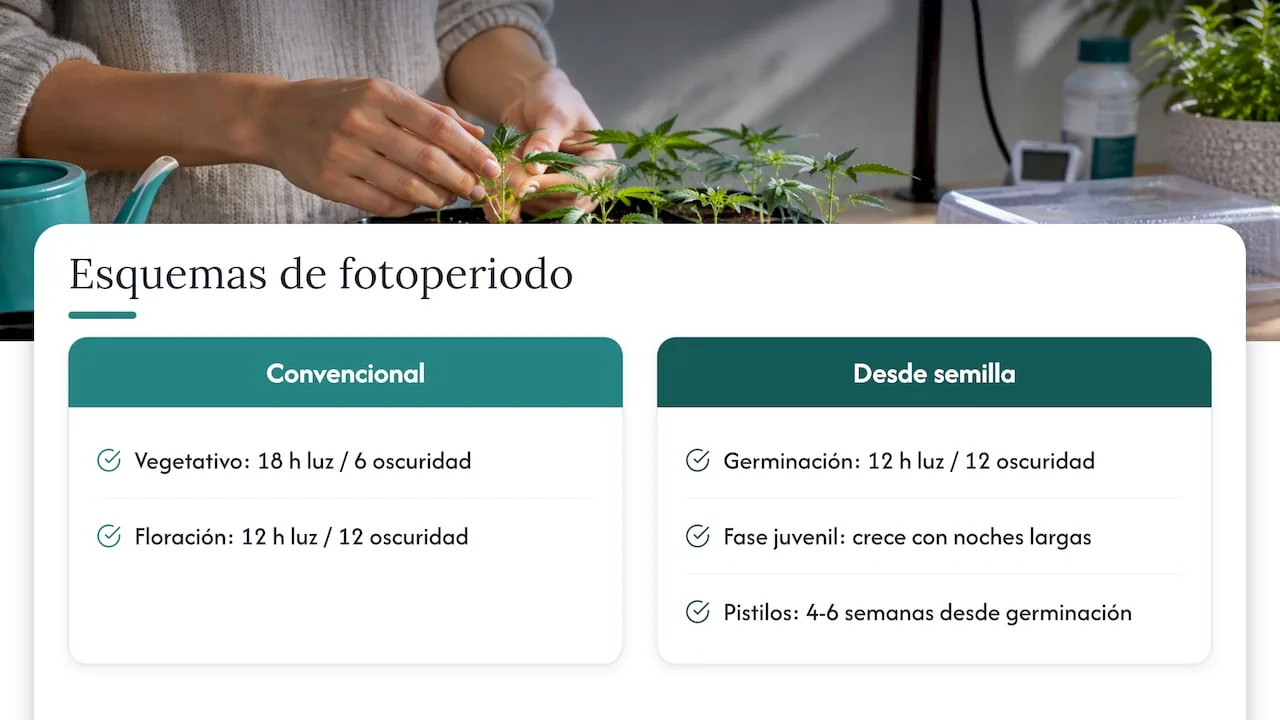
In classic indoor growing, a cycle of 18 hours of light and 6 of darkness is used for growth, and then you switch to 12/12 for flowering. This is the scheme set out in guides such as Canpark’s guide to optimal lighting: 18/6 in the vegetative stage and 12/12 in flowering, with 12 hours of light and 12 of darkness.
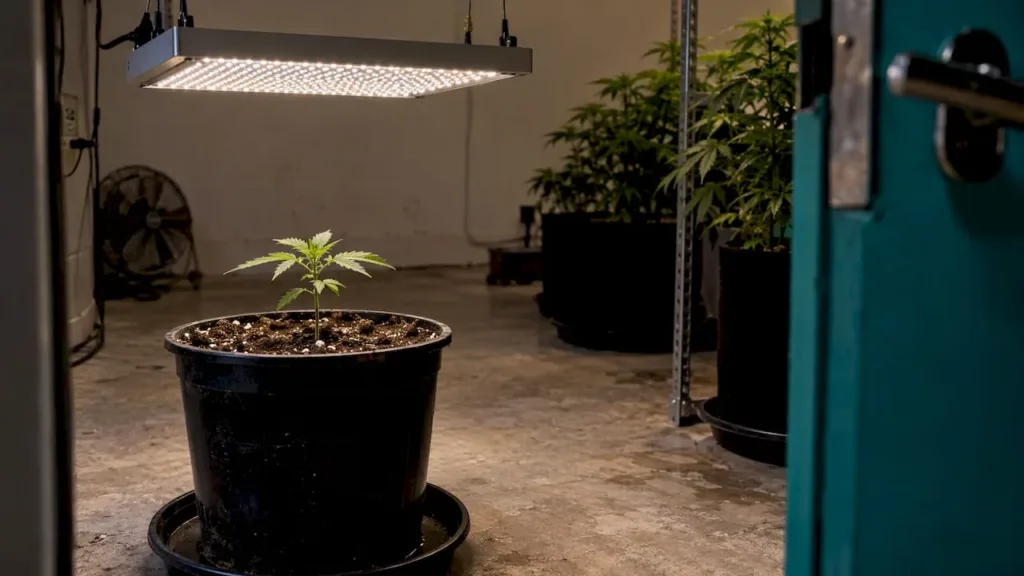
The method we are looking at skips the first half. You apply 12/12 from the moment of germination, so the plant never receives days long enough to stay in prolonged vegetative growth. Put another way: you don’t give it the order to flower, you simply don’t give it the order to keep growing.
Here is the nuance that confuses beginners the most. A seedling is not ready to flower. It needs to develop roots, a stem and several nodes, which is known as the juvenile phase. During this period it grows even if the nights are long. When it reaches sexual maturity, 12-hour nights do their job and the first pistils appear. According to a grower who documents this cycle, flowering begins after about 4 to 6 weeks, depending on the variety. Take it as a reference from one specific experience, not as an exact clock: every strain has its own rhythm.
12/12 from seed is not the same as an autoflowering plant
Autoflowering plants start flowering based on their own age, regardless of the hours of light. That’s why some people grow them on 18/6 or even 20/4 with no problem. 12/12 from seed, on the other hand, depends on the photoperiod: the signal of long nights is what triggers flowering. If you’re after a short, hassle-free cycle, there’s a guide to the advantages of autoflowering plants for beginners where we compare both approaches. If you’re drawn to photoperiod genetics (more variety, more complex aroma profiles, the possibility of taking cuttings), 12/12 from seed is a way of shortening the process without giving that up.
Pros and cons, no frills
Before setting anything up, it’s worth being clear about what you change and why.
| Appearance | 12/12 from seed | Vegetative 18/6, then 12/12 |
|---|---|---|
| Total growing time | Shortest | Longest |
| Plant height | Small and compact | Much more variable, you decide |
| Yield per plant | Lower | Elderly |
| Production per m² | Depends on the density you choose | Depends on the size you reach |
| Control over structure | Little room for training | Plenty of room to work (pruning, tying down, defoliation) |
| Electricity consumption of the vegetative cycle | Almost none | Notable |
| Difficulty | Medium, requires consistent light | Medium |
The clearest advantage is space and time. Without a long vegetative stage, there is no need to manage a plant that shoots up in height, and you can run harvests back to back more often. The downside is the opposite: with less prior development, each plant yields less. That is why this method is approached with more, smaller plants instead of a few big ones, something that suits 60×60 or 80×80 cm tents well.
Which seeds to choose for 12/12 from seed
Choosing your genetics matters more here than in conventional growing. Three criteria will save you some headaches.
1. Photoperiod and feminised
You need varieties that respond to the photoperiod, in other words, not autoflowering. And preferably feminised: with regular seeds you would have to identify and remove the males just as the plant is already entering flowering, without the margin that a long vegetative stage gives. If you are unsure between the two types, take a look at our practical guide to feminised versus regular seeds. To choose well among photoperiod varieties, how to choose feminised photoperiod seeds will also help.
2. Short flowering and compact structure
Fast-flowering varieties, or those with an indica hybrid character, tend to cope better with this system: it is recommended to choose genetics that adapt easily and avoid those with very long development. A sativa with a 12-week flowering time that also stretches relentlessly is a poor candidate. In our catalogue you’ll find an entire section of fast version varieties designed for shorter cycles, which are a good starting point.
3. Your level of experience
If this is your first grow, don’t start with the method that’s most demanding on light. An autoflowering plant is more forgiving. If you’ve already done a full cycle and want to experiment, go for it. To help you decide, there’s the guide how to choose cannabis seeds according to your experience.
Step by step: from germination to flowering
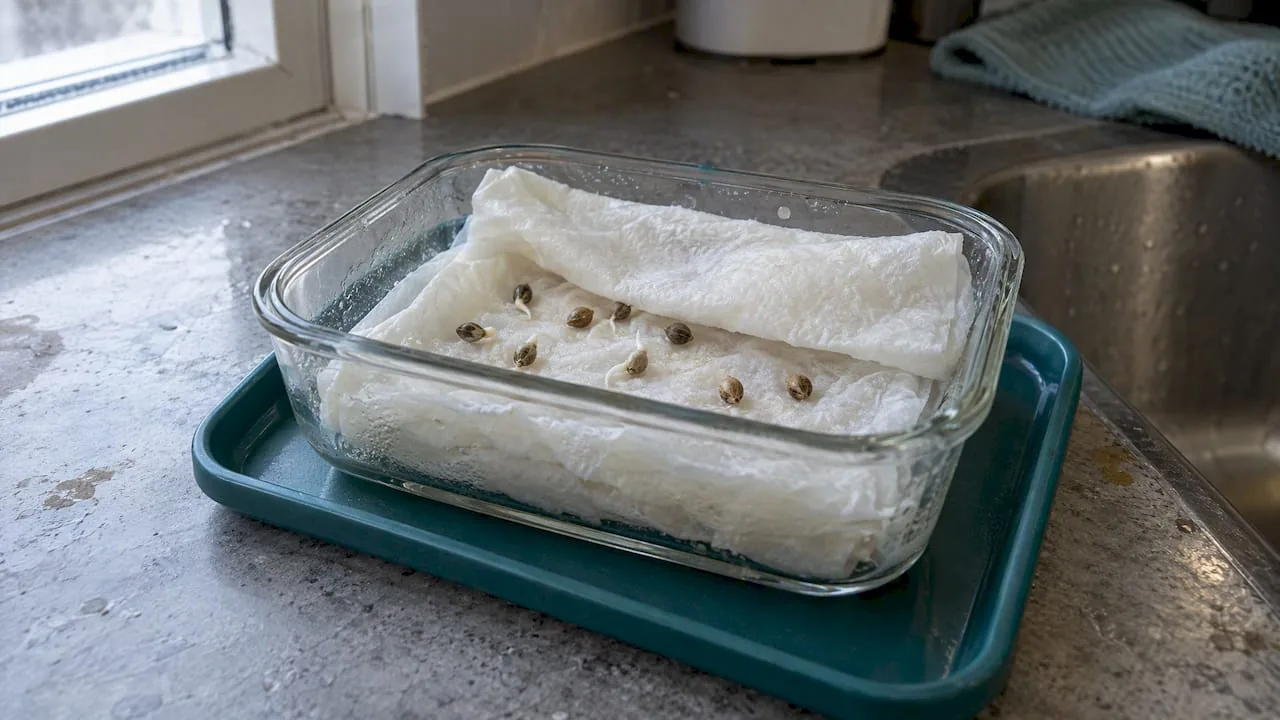
- Germinate with care. Damp kitchen paper, darkness and gentle warmth. A resource such as our complete guide to germinating seeds details each stage. Industry guides indicate that the root appears between two and five days at 22 to 25 degrees, although you should always check against your own variety.
- Transplant straight into the final pot. With short cycles, losing a week to a transplant hurts. A 7 to 11 litre pot is usually enough for plants of this type.
- Set the timer to 12/12 from day one. A fixed light at the same time, always. A cheap analogue timer works, but a digital one with battery backup is better.
- Keep it completely dark. It’s the critical point, and we go into it further below.
- Watch the juvenile phase. In the first weeks the plant grows leaves and nodes. Don’t be impatient and don’t change its cycle: it’s normal not to see flowers.
- Recognise the start of flowering. White pistils appear at the nodes. From there, the plant follows its cycle. As a guide, in conventional photoperiod plants the first sign of flower appears between one and three weeks after switching to 12/12, but when growing from seed, the plant’s maturity sets the clock.
- Adjust nutrients and humidity. Less nitrogen when the pistils appear, more phosphorus and potassium. Gradually lower the relative humidity to protect the buds from mould.
💡 Grower’s trick: write down in a notebook the day of germination and the day you see the first pistils. By the second harvest you’ll know how many days your particular variety needs, and that figure is worth more than any generic chart.
Darkness is sacred: light mistakes that ruin the cycle
On 12/12 from seed, the plant always lives on the edge of the photoperiod. That makes it very sensitive to any interruption. According to this guide to light cycles, a light leak during the dark phase is one of the main causes of stress, hermaphroditism and stalled flowering. It’s the reason many growers learn to keep an eye on the tent before they learn to fine-tune nutrients.
The usual sources of leaks are:
- Standby LEDs on power strips, fans or metres.
- Cabinet zips and seals that don’t close properly.
- Extraction or intake inlets without a light trap.
- Gaps around the room door, if the grow isn’t in a closed cabinet.
- Phone screens that you switch on “just for a second” to look at the plants.
The routine experienced growers recommend is a total darkness check before you start: close the tent with the lights off, stay inside for a few minutes until your eyes adjust, and look for any point of light. If you can see it, the plant can too. Cover it with matt black tape or opaque covers and repeat the test.
If you need to go in during the night, use a low-intensity green light only when it’s essential, and even better: schedule watering tasks for the light period.
Intensity and spectrum: the other half of the strategy
The photoperiod is only part of the picture. In a cycle without a long vegetative stage, the light the plant receives matters a great deal from the very beginning. Industry references put flowering intensity at 700 to 900 µmol/m²/s, but a seedling that has just emerged doesn’t need that much power. Start with a low intensity, or raise the lamp, and increase it gradually as the plant gains leaf mass.
The spectrum matters too. A home growing handbook explains that blue-rich light promotes a robust structure in the vegetative stage, while warm and red tones help with bud density and trichomes during flowering. With 12/12 from seed, your plant goes through both stages at the same time, so a full-spectrum, dimmable lamp is the most convenient option. If your light lets you change the spectrum, make the most of it: more blue at the start, warmer later.
What if 12/12 isn’t the exact number? What the research says
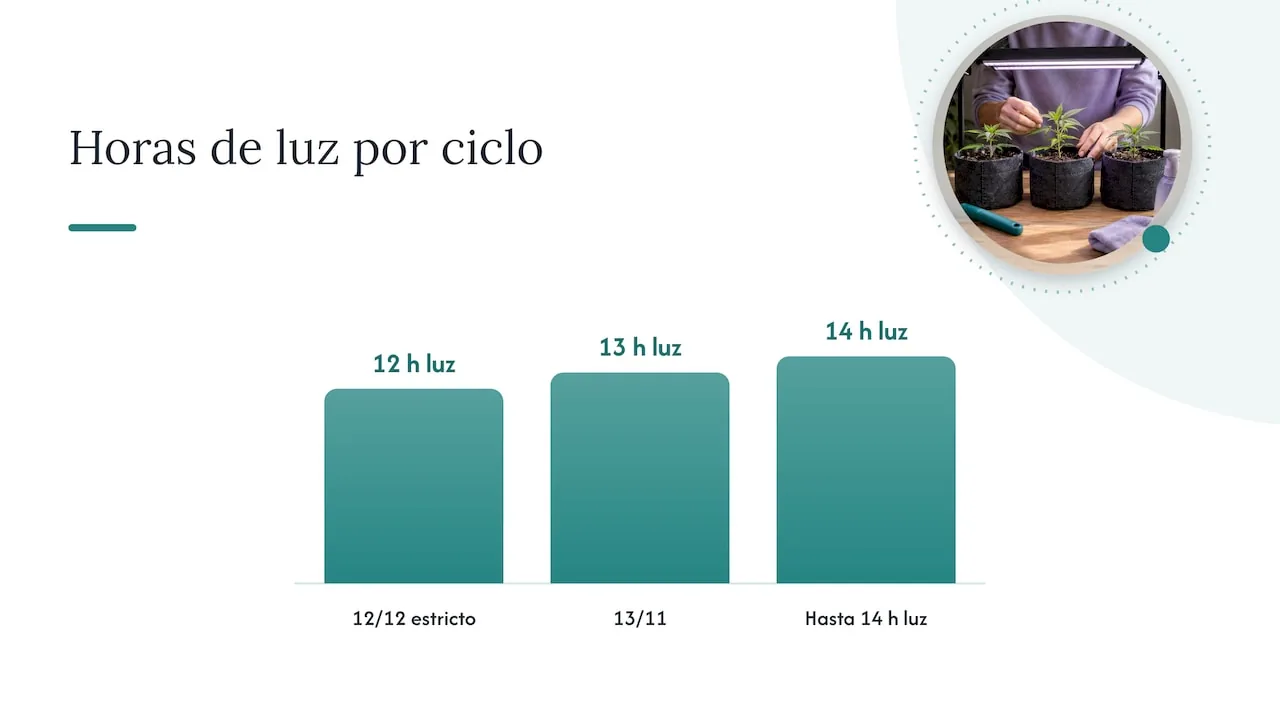
One fact that surprises many people: 12 hours is not a rigid threshold. A study published in 2023 on whether twelve hours is really the optimal photoperiod points out that the vast majority of indoor growers use 12/12 out of habit, and that many modern cultivars can start flowering with light periods of up to 14 hours. The authors and the growers who have tried it report yield increases with 13 or 14 hours of light compared with strict 12/12, although the response varies greatly depending on the genetic origin of each variety.
Put into practice: if you have already mastered 12/12 and want to squeeze out more, you can try 13/11 with a single control plant. Don’t do it with the whole harvest, and don’t do it in your first cycle. Note down the results and compare. Some equatorial or very sativa varieties are more demanding about night length, so 13/11 may delay flowering rather than improve it.
When it pays off and when it doesn’t
It’s worth it if:
- You have a low cabinet or limited ceiling height and can’t let the plants stretch.
- You want to chain harvests quickly.
- You prefer several small plants instead of one big one.
- You want to try a photoperiod strain without the time of a long vegetative stage.
Not worth it if:
- You are looking for maximum yield per plant. A plant with a well-managed vegetative stage and training yields more.
- You want to take cuttings or keep a mother plant: that requires keeping the plant in the vegetative stage.
- Your space is not 100 % dark at night and you can’t control it.
- It’s your first grow and you don’t want to complicate things. In that case, an autoflowering plant is more forgiving; if you’re worried about height, see how to control the height of autoflowering plants.
Our view: what we have learned from this method
At Bluedog Genetics we work with a curated selection of feminised, autoflowering, regular, CBD and Fast version varieties, and what growers ask us most is whether they can “skip” the vegetative stage. Our answer is an honest one: yes, but it’s not a free trick.
We believe 12/12 from seed is an excellent tool for anyone with little space who already knows how to control the environment. We also believe most failures don’t come from the genetics or the nutrients, but from light: leaks, badly set timers, schedule changes. Before buying more expensive seeds, invest in a good timer and some opaque tape.
If you are a beginner, our advice is to start with something that forgives mistakes, and to switch to 12/12 from seed in your second or third grow, once you know your tent. And if you choose a photoperiod plant, go for feminised seeds and short-flowering varieties. Every seed we offer comes with order tracking and discreet shipping, and our team will guide you if you are not sure which variety suits your space.
Where to find suitable seeds
If you want to set up your first 12/12 from seed, start with our feminised seeds category, where you’ll find photoperiod varieties from a range of well-known seed banks. If you prefer short cycles, take a look at the Fast version seeds. Shipping is discreet and you can track your order at every step. Current prices and promotions are shown directly in the shop.
Frequently Asked Questions
Does a cannabis seed flower straight away on 12/12?
No. The seedling first goes through a juvenile phase in which it grows even with long nights. Once it reaches maturity, 12 hours of darkness trigger flowering. How long this takes depends on the variety.
Can I use autoflowering plants on 12/12 from seed?
You can grow them on 12/12, but it makes no sense as a technique. Autoflowering plants flower with age and usually yield better with more hours of light, such as 18/6 or more. 12/12 from seed is designed for photoperiod plants.
How many hours of light does a flowering plant need?
The indoor standard is 12 hours of light and 12 hours of uninterrupted darkness. Some research suggests that certain varieties tolerate up to 14 hours, but that is an experiment for experienced growers, not a general rule.
How long does a photoperiod plant take to flower?
With the classic method, the first signs appear between one and three weeks after switching to 12/12, and full flowering lasts quite a few more weeks depending on the genetics. With 12/12 from seed, you also need to add the time of the juvenile phase. If you want a realistic timetable, see our guide to real flowering times.
What happens if there is a light leak during the dark phase?
It can stress the plant, delay flowering or cause hermaphroditism. Do a full darkness check before you start and seal any point of light with opaque tape.
To finish: two varieties to start with
For your first 12/12 from seed, look for a fast-flowering feminised plant in our feminised section and an option from the fast version range to compare flowering speeds in the same tent. With two different genetics and your notebook, in a single cycle you will know more than from reading ten guides.
Sources
- Canpark: Optimale Beleuchtung
- Revista THC: 12/12 photoperiod, harvesting cannabis fast
- Red Yerba: 12/12 growing from seed
- Highcovery: Growing Cannabis, Grow Guide
- Growland: 18/6 vs. 20/4 vs. 12/12
- Weed.de: Lichtzyklen
- Homegrower Handbook (Flow Inc.)
- PMC: Is Twelve Hours Really the Optimum Photoperiod?