


If you’ve been wondering which type of seed to choose for your next grow, you’re not alone. The comparison between feminised vs regular cannabis seeds causes more confusion than it seems, and the quick answer of “feminised are always better” doesn’t do justice to either type. Your choice directly affects the space you need, the time you invest, the results you get and the genetics you preserve. This guide gives you the technical and practical criteria to decide wisely, whether you’re a beginner or have been growing for years.
Key points
| Point | Details |
|---|---|
| Feminised doesn’t mean perfect | Feminised seeds produce almost 99% females but can become hermaphrodites under conditions of extreme stress. |
| Regular seeds preserve genetics | Regular seeds are the preferred tool of growers who work with their own genetic lines and crosses. |
| The seed bank matters as much as the type | The supplier’s genetic stability determines the real result, regardless of whether the seed is feminised or regular. |
| Your environment dictates the best option | A controlled indoor growing setup favours feminised seeds; a breeding or genetic selection programme requires regular ones. |
| Always plan with a margin | Even with feminised seeds, experienced growers schedule inspections and isolation to keep males and hermaphrodites under control. |
What are feminised vs regular cannabis seeds
Before comparing yields and strategies, you need to be clear about what each term means from a genetic point of view. Think of it like this: the genotype is the construction blueprint, and the phenotype is the building that gets constructed according to that blueprint plus the environment. The type of seed determines what genetic information you bring to your grow.
Regular seeds: the natural genetic base
Regular seeds are the result of natural pollination between a male plant and a female plant. They produce mixed offspring, with roughly a 50% chance of males and a 50% chance of females. This ratio is not exact in every batch, but it is the general statistical expectation.

The real advantage of regular cannabis seeds lies in their more natural genetic stability. They are the indispensable tool for those who want to maintain their own genetic lines, select high-quality mother plants or cross varieties to obtain new phenotypes. If your goal goes beyond harvesting and you want to work with genetics, regular seeds are the right starting point.
Feminised seeds: designed for harvest
Feminised seeds come from an artificial process of selective pollination. Seed banks reverse female plants so that they produce viable pollen, usually with compounds such as colloidal silver, and then pollinate other females with that pollen. The result is seeds with a high probability of being female, close to 99%.
This process requires rigorous environmental control to guarantee quality and avoid cross-contamination between plants. When it is carried out well, it offers a consistency that regular seeds cannot match in terms of flower production. Feminised cannabis seeds remove the need to identify and remove males, which simplifies the process enormously, especially in indoor growing with limited space.
The main differences between cannabis seeds of both types can be summed up in these points:
- Sex ratio: Regular seeds produce males and females; feminised seeds produce almost exclusively females.
- Genetic use: Regular seeds let you preserve and cross lines; feminised seeds are optimised for direct flower production.
- Stability under stress: Feminised plants can turn hermaphrodite under climate stress in borderline conditions such as cold autumns or irregular lighting changes.
- Management complexity: Regular seeds require more monitoring work; feminised seeds simplify growing logistics.
The real pros and cons of each type
This is where most articles fall short. They give you the list of pros and cons but don’t tell you when each drawback stops mattering and when it becomes a real problem.

| Characteristic | Feminized seeds | Regular seeds |
|---|---|---|
| Percentage of female plants | ~99% | ~50% |
| Risk of hermaphroditism | Higher under stress | Lower under stable conditions |
| Production of your own seeds | Difficult without advanced techniques | Natural and simple |
| Space and efficiency | High space efficiency | Requires planning for males |
| Use in breeding programmes | Limited | Optimal |
| Management for novice growers | Simpler | Requires more experience |
| Genetic stability | Depends on the seed bank | Generally more stable |
The advantages of feminised seeds are especially relevant in indoor growing or in spaces where every square metre counts. If you have a grow cabinet or a 1.2 x 1.2 metre tent, you can’t afford to lose half your space to male plants that you will have to remove before flowering.
The limitation that few people mention is that hermaphroditism in feminised plants is not rare when the plants are stressed. An interrupted photoperiod, a heat shock, a damaged root or simply a poorly stabilised genetic cross can cause the plant to develop pollen sacs alongside the pistils. A single hermaphrodite plant in an enclosed grow can pollinate all the others and ruin the harvest.
💡 Pro tip: If you grow feminised seeds outdoors, choose varieties with a documented reputation for stress resistance. A feminised variety with stable genetics will cope better with autumn weather changes than an unstable line, regardless of what the packet label says.
Regular seeds, on the other hand, offer an advantage that is often underrated: careful selective pollination lets you keep high-value males to produce seeds without compromising the rest of the grow. This requires technique and physical separation, but it is perfectly manageable.
Planning your grow according to the type of seed
The choice between feminised and regular seeds doesn’t end at the purchase. It shapes how you organise your space, how you monitor your plants and which mistakes you can avoid from the start.
If you decide to work with regular seeds, follow these steps to minimise losses and make the most of the genetics:
- Germinate 20-30% more seeds than the plants you want to end up with. If you want 6 female plants, germinate between 8 and 10 seeds to compensate for the natural proportion of males.
- Identify the sex in the first weeks of flowering. Pre-flowers appear between weeks 1 and 3 of flowering. Males show sacs; females show white, hair-like pistils.
- Isolate any male immediately if you don’t need it for pollination. A single male plant can pollinate all the females within hours if it opens in the same space.
- If you want to keep a male, put it in a separate space with its own ventilation control to stop the pollen travelling to the main growing area.
- Record the phenotypes of each plant from the vegetative stage. The characteristics you see then, such as structure, colour and smell, will tell you which plants are worth keeping as mothers.
With feminised cannabis seeds, planning changes but does not disappear. Experienced growers do not trust the feminised label one hundred per cent and schedule regular inspections during flowering to spot pollen sacs as soon as they appear. A weekly check during the first four weeks of flowering is enough to act before pollination happens.
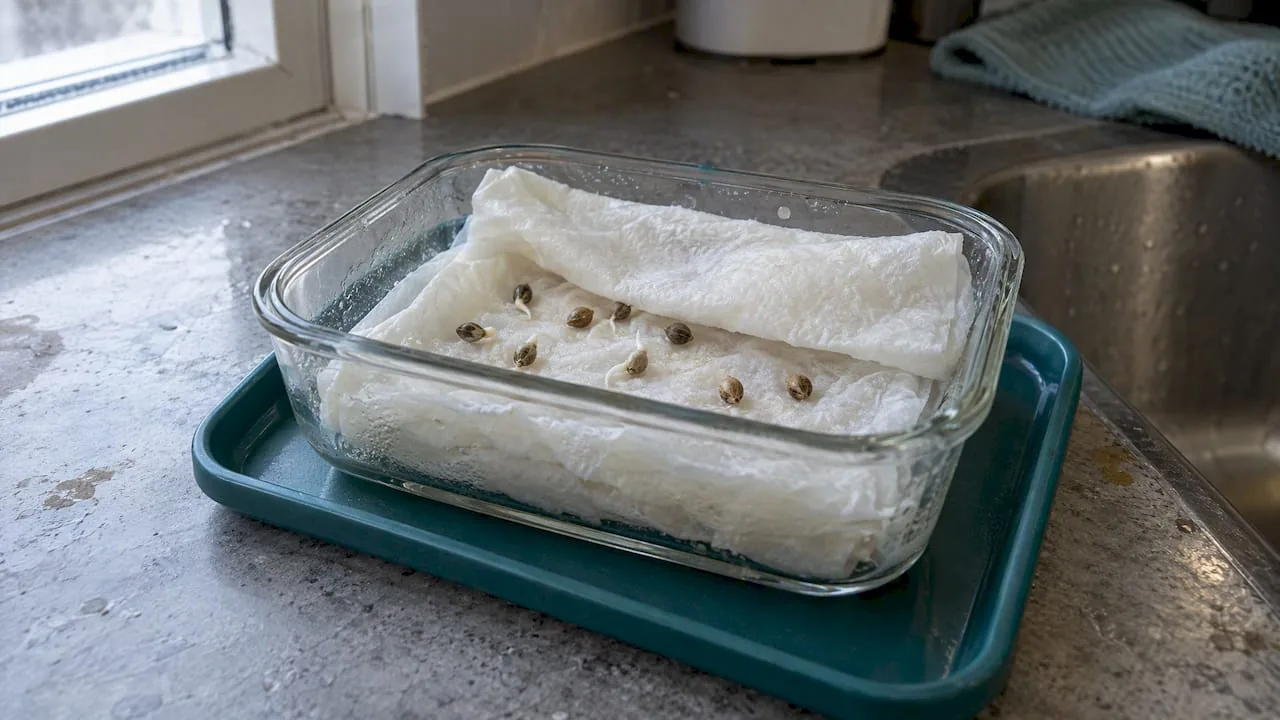
💡 Pro tip: Learn to germinate your seeds with the same care regardless of type. Careless germination stresses the plant from day one, and that early stress can affect sex stability in feminised plants.
Genetics and seed bank: the most underestimated factor
There is an uncomfortable truth in the world of cannabis seeds: the “feminised” label guarantees nothing on its own. The quality of the seed bank and its genetic stability are what determine whether the result will be good or disappointing.
Two feminised seeds of the same variety can behave in radically different ways if they come from seed banks with different processes. A seed bank that works with well-refined lines and carries out stability tests on its genetics will produce seeds that behave as you expect. A seed bank that simply buys and resells without quality control may offer you seeds with high variability, a tendency towards hermaphroditism and inconsistent phenotypes.
To assess a seed bank before buying, keep these indicators in mind:
- Technical information available: A reputable seed bank provides data on the genetic lineage, flowering time and cannabinoid and terpene profile of each variety.
- Consistency between batches: Stable premium genetics produce consistent results harvest after harvest, not just in the first germination.
- Reputation in grower communities: Specialist forums and growing communities are a source of real information on how specific varieties from specific seed banks behave.
- Customer service and guarantees: a supplier that backs its products with order tracking and personalised support shows confidence in what it sells.
Genetic stability translates directly into uniformity of aroma, potency and plant structure. This has nothing to do with whether the seed is feminised or regular. It has everything to do with the seed bank’s prior breeding work.
Type of growing and environment: match your situation to the best seed
Your growing environment is one of the most decisive factors when choosing between feminised and regular seeds. There is no universally better option, only options that suit each specific situation better.
Feminised cannabis seeds suit these situations best:
- Indoor growing with limited space, where every plant must produce flowers without exception.
- Growers who do one or two harvests a year and have no time to manage sex identification.
- Beginners who are learning the mechanics of growing without adding the variable of males.
- Urban or discreet growing where the number of plants is limited by regulations or physical space.
Regular cannabis seeds are the best choice in these situations:
- Breeding and genetic selection programmes, where you need quality males to create new lines.
- Growers who want to produce their own seeds for future seasons.
- Outdoors with plenty of space, where the cost of males doesn’t become a serious logistical problem.
- Experienced growers who want total control over the genetic material they work with.
Autoflowering seeds deserve a separate mention. Technically they are considered a category within feminised seeds, as most come feminised from the start. They flower without needing a change in photoperiod and complete multiple harvests in summer, which makes them especially useful for beginners and outdoor growing in climates with short summers.
| Grower profile | Recommended type | Main reason |
|---|---|---|
| Indoor beginner | Feminized | Simplifies the process and maximises space |
| Genetics expert | Regular | Allows selection and breeding of lines |
| Outdoor, short climate | Feminised autoflowering seeds | Fast cycles without dependence on the photoperiod |
| Production of your own seeds | Regular | Needs viable males for pollination |
| Indoor with limited space | Feminized | Maximum efficiency per plant |
My perspective after years of observing grows
I have reviewed hundreds of growing situations, and the most common mistake I see is not choosing the wrong type of seed. It is choosing based on what someone else recommends without considering your own environment and goal.
I know experienced growers who have spent years working only with regular seeds because their priority is genetics, not yield per square metre. And I know beginners who started with feminised seeds, made handling mistakes that caused hermaphroditism, and concluded that feminised seeds “don’t work”. Neither of them is absolutely right.
What I have learned is that the type of seed matters less than the quality of the seed bank that produces it. I have seen cheap feminised seeds of dubious origin turn into a field of hermaphrodites in the middle of flowering. And I have seen regular seeds from reputable seed banks produce exceptional, consistent phenotypes harvest after harvest.
My recommendation for beginners is to start with feminised seeds from a seed bank with a proven reputation, learn the mechanics of growing and then, if your interest grows towards genetics, move on to regular seeds with good judgement. For experienced growers, the most useful question is not feminised or regular. It is what specific goal you have this season and what type of seed brings you closest to that goal.
Find your ideal seed at Bluedoggenetics
At Bluedoggenetics you’ll find a curated catalogue of feminised and regular seeds from seed banks with a proven track record, selected specifically for growers who want consistency and real quality. Every variety in the catalogue goes through a selection process that prioritises genetic stability, aroma, potency and adaptability to different growing environments.
If you are just starting out, the Bluedoggenetics personalised support team can guide you towards the most suitable variety for your space and experience. If you already have grows under way and want to expand your genetic work with quality regular seeds, in the Bluedoggenetics shop you will find options from renowned seed banks with discreet shipping and guaranteed tracking. Your next harvest starts with a good seed. Make it the right one for you.
Frequently Asked Questions
Are feminised seeds always better than regular ones?
No. Feminised seeds are more efficient for flower production, but regular seeds are essential for creating genetic lines and producing your own seeds. The best option depends on your specific goal and your level of experience.
Can feminised seeds produce male plants?
Under normal conditions no, but under extreme stress such as sudden temperature changes, photoperiod interruptions or root damage, they can develop hermaphroditism and produce pollen sacs alongside the female pistils.
What is the difference between feminised and autoflowering seeds?
Autoflowering plants are a subcategory that generally comes feminised. Their main difference is that they flower automatically without needing a change in the light cycle, which makes them ideal for beginners and for outdoor growing in short seasons.
How do I know if a seed bank is reliable?
A reliable seed bank provides detailed technical information on every variety, shows consistency between batches and has documented backing in grower communities. Personal customer support and order tracking guarantees are also clear signs of a serious operation.
How many regular seeds should I germinate to get a specific number of females?
Germinate 20 to 30% more seeds than the number of females you want. If you are after 6 female plants, start with 8 to 10 seeds to compensate for the statistical proportion of males.