

Yes, many old seeds still germinate, but with less vigour and more slowly than a fresh seed. The way to settle your doubts without risking a harvest is to do a home germination test with a small sample, give them more time than usual and, if the result is weak, try a gentle soak in diluted hydrogen peroxide. Here I explain how to do it step by step, what percentage is reasonable to accept and when it’s time to accept that the packet has had its day.
In short
- An old seed loses vigour first (it germinates more slowly) and only later viability (it stops germinating altogether), so patience counts.
- A home test with 10 to 20 seeds, or with 50 or 100 if you have plenty, between damp paper and in a bag, tells you what percentage is alive before you sow anything in soil.
- In one study, 1% hydrogen peroxide improved the germination of cannabis seeds more than five years old; at 10% it proved toxic. The dose is everything.
- With 50% germination or less, the sensible thing is usually to discard the batch and start with fresh seeds.
- Stored dry, cool and in the dark, your seeds will last much better over the years.
What it really means for a seed to be “old”
There is no magic date on which a cannabis seed goes from good to useless. What there is, is a gradual deterioration that depends above all on how you have stored it. To understand it, it helps to separate two concepts that are often confused.
According to the information leaflet from the Ministerio de Agricultura, Pesca y Alimentación, the viability of a batch is the percentage of seeds able to germinate under optimal conditions, while vigour describes how quickly they do so, often measured by the time it takes for half the batch to germinate. Two batches can have the same viability and perform very differently in your grow tent.
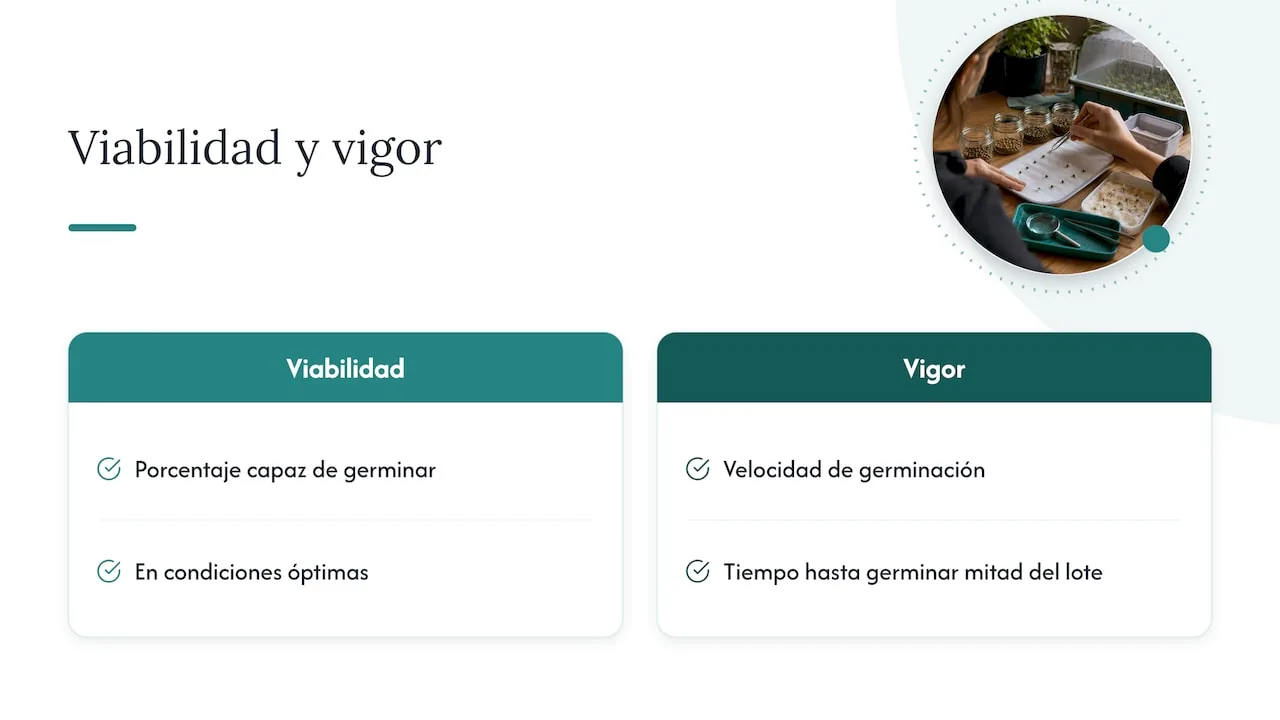
Research on seed ageing points in the same direction: deterioration first reduces vigour and, in the end, viability, and is associated with oxidative damage caused by reactive oxygen species. In real-life terms: a well-stored seed that is four or five years old can sprout without any problem but take a day or two longer, while a seed that has lived in a warm drawer can be dead at half that age.
The factors that matter most
- Humidity. Orthodox seeds, which are the majority, keep their ability to germinate if they are stored with low humidity and at a low temperature.
- Temperature. Heat speeds up deterioration. A packet forgotten in a glove box or next to a window suffers far more than one in a living room drawer.
- Light and air. A cool, dark and dry environment, with sealed glass jars, is the combination recommended by the University of Vermont.
- Quality at source. An immature, pale or badly cured seed was already at a disadvantage the day you bought it. If you want to go deeper, we have a guide on why bad seeds ruin your harvest.
Before you spend time: look at the seeds
A quick visual inspection rules out lost causes and saves you the test. Place the seeds on a white sheet of paper in good light.
- Good looking: hard shell, brown to grey with streaks or mottling, and it doesn’t crush when gently squeezed between your fingers.
- Bad signs: green or whitish seeds, cracked shells, seeds that crush easily or have mould dust.
The general rule given by agricultural extension services is that smooth, round, plump seeds tend to germinate better, and pitted or wrinkled ones tend to perform worse, although some species have naturally wrinkled seeds. Don’t take it as a verdict, but as a clue. The test is what decides.
Home germination test, step by step
The classic method is the damp paper towel in a bag. The University of Arkansas describes it for representative samples of 50 or 100 seeds, which makes sense with cheap agricultural seeds. With cannabis seeds, which are an expensive item, you can do it with a smaller sample and accept that the result is only indicative: with 10 seeds, each one accounts for 10% of the result.
- Count your sample. If you have a packet of 10 or 20 seeds, use half or a third and keep the rest. If you store many from the same batch, use more to get a reliable percentage.
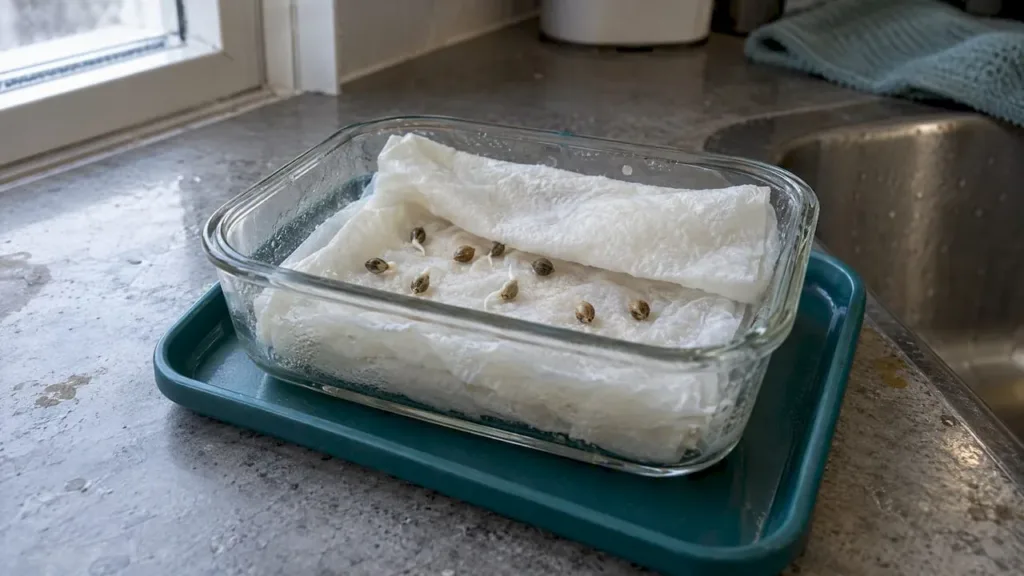
- Dampen a sheet of kitchen paper towel. It should be damp, not soaked. If it drips when you squeeze it, there’s too much water. Excess water makes it harder for oxygen to reach the embryo, and this is a classic reason for failure.
- Spread the seeds out with space between them and fold them inside the paper.
- Put everything in a resealable plastic bag or in a lidded container, so the moisture doesn’t evaporate.
- Put it somewhere warm and dark, and stable. On top of the fridge or in an interior cupboard works well. Avoid radiators and windows with direct sunlight.
- Check every day or every other day without touching the seeds with dirty fingers. If the paper dries out, moisten it with a spray bottle.
- Count the ones that have opened and put out a taproot.
How much to expect
The Arkansas reference indicates that most garden species germinate in 3 to 5 days, with some taking 7 to 10. With old seeds, allow a longer margin. A popular storage guide points out that old seeds take a little longer and may need patience, but as I can’t guarantee that figure for cannabis, my practical advice is this: don’t write off a seed before 7 to 10 days, and if there’s nothing after 14 days, the test is over.
How to calculate the percentage
The formula is simple: germinated seeds divided by the total sample, multiplied by one hundred. If 7 out of 10 seeds sprout, your batch is at 70%.
| Test result | What it usually means | What I would do |
|---|---|---|
| 80% or more | Batch in good condition | Sow as normal with a little margin |
| 60 a 79% | Acceptable, with expected losses | Sow extra to compensate |
| 51 a 59% | Doubtful | Sow only if you have no alternative |
| 50% or less | Batch sold out | Discard and replace |
The table is a guide only and is my own interpretation. What is backed up is that, for almost all species, a germination rate of 50% or lower is considered too low to justify using the batch, according to Iowa State University, which also notes that 70 to 80% may be acceptable depending on the species and that you need to balance the effort against the cost and what you hope to get out of it. In cannabis, where each plant takes up weeks of space and light, that equation weighs even more.
Grower’s tip: don’t throw away the paper with the germinated seeds. Move them with clean tweezers to their final medium when the root is between half a centimetre and one centimetre long, with the root pointing down, without touching it. A broken root on an old seed is a missed opportunity. You’ll find the detailed process in our practical guide to germinating cannabis seeds step by step.
Germinating seeds with hydrogen peroxide
It’s the most sought-after trick for seeds that won’t start, and it has a scientific basis, but with some small print. A study published in 2021 on standardising rapid cannabis germination compared several treatments. In seeds more than five years old, 1% hydrogen peroxide produced around 50% germination compared with around 10% with water alone. With a 10% concentration, however, there was no germination on the first day because of its toxic effect.
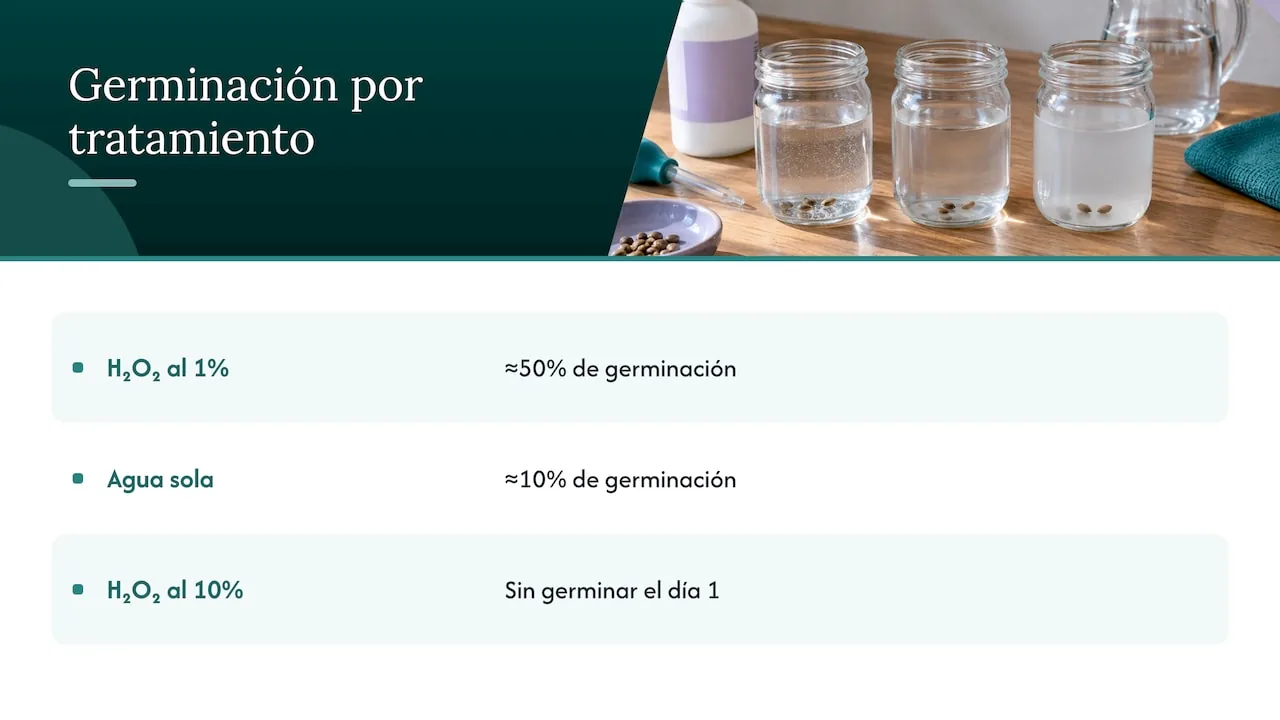
The practical takeaway is twofold: it helps, but only in the gentle range, and it doesn’t turn a dead seed into a live one. It’s similar to what has been observed in other species, where an H₂O₂ treatment improved the germination and vigour of aged seeds under stress conditions, although those are different crops and different doses.
How to use it without ruining your seeds
- Look at the label of the hydrogen peroxide you have. The kind sold in pharmacies is usually quite a bit more concentrated than that 1%, so it needs to be diluted with water before use. Work out the dilution calmly and, if you’re not sure, try it on a sacrificial seed.
- Use a clean glass and chlorine-free water (bottled or left to stand).
- Soak the seeds for a short time, just a few hours. Longer doesn’t mean a better result, and seeds left floating for days drown.
- Rinse them with clean water and move them to damp paper or your usual germination method.
- Keep the container out of the reach of children and do not mix hydrogen peroxide with other products.
If the untreated test gives 0%, hydrogen peroxide probably won’t change anything. If it gives 20 to 40%, it’s worth trying it on the rest of the sample. A 50% result with treatment, as in the study, is a real improvement, but it’s still a weak batch.
What to do if seeds don’t germinate
There are three causes unrelated to age that are worth ruling out before you throw the packet away.
- Too much water. Dripping paper, a glass with the seeds sunk for days or waterlogged substrate. Oxygen is lacking.
- Unstable temperature. Too cold slows the process down and too hot kills it. Find a constant spot.
- Hard coat. Some viable seeds have a shell that stops them absorbing water and germinating straight away. An old seed may have a harder coat. Giving it a few more days on the damp paper is usually enough. Don’t scratch or cut the shell if you don’t have experience.
Also understand what happens inside: germination begins with imbibition, the uptake of water, and ends with the start of radicle elongation, which breaks through the seed coat. If there isn’t enough water, it won’t get going. If there is too much and not enough air, it won’t either.
Once the radicle is showing, the next challenge is the start in the pot. For that stage, we have our guide to the first weeks of cannabis growing, where seedlings from old seeds usually need more care because they start out with less vigour: sparing watering, soft light and no feeding.
How to store seeds so they don’t age badly
The best old seed is the one that never deteriorated. The storage recommendations are simple.
- A cool, dark, dry place. The University of Vermont recommends sealed glass jars or metal containers, which also protect against moisture and rodents.
- Low, stable temperature. Around 4 °C (40 °F) is considered optimal for long-term storage, according to the same source. A domestic fridge comes close.
- Dry before storing. Storing seeds dry and at a low temperature is the general rule set out by the University of Nebraska, which also stresses that how long they last varies greatly depending on the species.
- Avoid freezing if you’re not sure. The ministry warns that freezing seeds with a high water content can cause irreversible damage. If you store them cold, make sure they are very dry and in an airtight container.
- Label with variety and date. It seems silly until you have four unnamed packets.
If you want to fine-tune your system, we have two complementary guides: seed storage, quality and preservation and one on seed packaging to keep them in good condition.
Our point of view
At Bluedog Genetics we see the same scene again and again: someone finds a forgotten packet of a variety they loved, sows it with excitement and loses everything for not having done a ten-minute test. Our advice is always the same: do the test before committing space, light and weeks. It is cheap, quick and spares you the worst moment of a grow, which is waiting three weeks for a plant that never arrived.
We also believe that old seeds are a good reason to keep a small, organised reserve. Storing part of your order in the right conditions and renewing it fairly often works out cheaper than chasing miracles with hydrogen peroxide. And one more thing: if a variety really matters to you, don’t gamble with your only copy. Run the test with half of the packet and leave the rest untouched. You will find more ideas in our article on reserve seeds in cannabis.
When it makes sense to start from scratch
There comes a point where persisting costs more than starting afresh. If your test comes in below 50%, if the seedlings that emerge are weak, deformed or stall, or if your batch is a variety you can easily get again, the most cost-effective option is to sow fresh seeds. A cannabis plant takes up months of your time; saving on a few seeds doesn’t make up for a lost cycle.
At Bluedog Genetics we work with a selection of varieties from well-known seed banks, with discreet shipping, order tracking and personal support to answer any questions before you buy. You can see the whole catalogue on the seeds page, and if you still need to decide between types, our guide to feminised versus regular seeds will help you choose.
Two options to start over
If you are at that point and want to get started with confidence, I recommend looking at two categories depending on your situation:
- If you want a short, manageable cycle, take a look at our autoflowering seeds. They work well both for anyone who has just lost a batch and for those just starting out, and you’ll find more information in our article on the advantages of autoflowering for beginners.
- If you prefer to control the light cycle and the height, feminised seeds give you plants that produce flower with no surprises about sex.
Frequently Asked Questions
How long can an ungerminated seed last?
It depends more on how they are stored than on their age. With low humidity, a low temperature and in the dark, seeds can keep their germination capacity for a long time, although the duration varies by species. If poorly stored, they can degrade within a few years. The reliable approach is to run a test before sowing.
What germination percentage is acceptable?
For almost all species, 50% or less is considered too low to make the batch worthwhile. Between 70 and 80% may be enough depending on the species and the cost of the seed. With cannabis, sow extra if you’re below 80%.
Does hydrogen peroxide help germinate old seeds?
It can help, but only when well diluted. In a study with cannabis seeds more than five years old, a 1% solution reached close to 50% germination compared with about 10% with water. At 10% it was toxic. Check the concentration of your product and dilute it before use.
How long do you have to wait in a home test?
Common species germinate in 3 to 5 days, and some take up to 7 to 10. With old seeds, give them a longer margin: a full week at the very least and around 14 days as a reasonable limit before calling the test over.
Sources
- Germinación de semillas, Ministerio de Agricultura, Pesca y Alimentación
- The Effects of Storage Conditions on Seed Deterioration, MDPI
- How to Conduct a Seed Germination Test at Home, University of Arkansas
- How to Store Seeds and Test Germination Rates, Iowa State University
- Development and Standardization of Rapid and Efficient Seed Germination
- Effect of Hydrogen Peroxide on Physiological Quality of Seeds
- Can Old Seeds Still Grow?, University of Vermont
- Vegetable Garden Seed Storage and Germination Requirements, University of Nebraska