

If you want to set up a hydroponic cannabis grow, the best choice is usually a feminised seed with stable genetics and proven vigour, or an autoflowering one if you are after speed and compact plants. There are no “hydroponic” seeds as such: what changes is how you manage the plant. Even so, some genetics are more forgiving, make better use of a nutrient solution and make your first soilless grow easier. In this guide we tell you how to choose them and how to get them off to a good start.
A clarification before we go on: if you’re searching for “seeds for hydroponics” and what you want is to grow lettuce or basil, this isn’t for you. Here we’re talking about cannabis seeds for adult growers in Spain.
What “hydroponic seed” really means
In hydroponics you don’t use soil: the roots receive water with dissolved nutrients, either in an inert medium (coco fibre, perlite, rockwool, expanded clay) or directly submerged, as in NFT, DWC or aeroponic systems. The general definition of hydroponics as any soilless production method, with a nutrient solution reaching the plant, appears for example in this KTBL technical publication on lettuce growing.
The seed itself is the same as the one you would plant in a pot. What changes is the context:
- The genotype is the blueprint and the phenotype is the finished building. In hydroponics the “building” goes up quickly, because the plant feeds effortlessly. A nervous genetic, or one that is very sensitive to salts, shows it straight away.
- There’s no soil to cushion your mistakes. A pH that’s off or an EC that’s too high results in burnt tips or lockouts within a few days.
- Vigour becomes an advantage. Plants with aggressive roots and explosive growth make better use of a system with available oxygen and nutrients.
So when someone asks which seed to buy for hydroponics, the honest answer is: the one with good vigour, stability and a moderate nutrition profile, and that suits your space and your experience.
Feminised, autoflowering or regular: which suits a soilless system
| Type | Advantages in hydroponics | Things to watch for | Who it’s for |
|---|---|---|---|
| Feminized | All plants flower, and you control the photoperiod and height with pruning and training | More weeks per cycle; you need two spaces or light phases | For those who want control and good yield per plant |
| Autoflowering | Short cycle, compact plants, ideal for small grow tents | They tolerate stress and high EC less well; there is less room to recover | Beginners and small spaces |
| Regular | More “natural” genetics, useful if you select or keep mother plants | You’ll have males to discard, and that complicates the first grow | Experienced growers |
| Fast version | Shorter flowering with photoperiod | Less time to correct mistakes | For those who want to rotate harvests |
Feminised: the safe bet for getting started
In a hydroponic system every slot counts. Setting up a system, preparing a solution and discovering in the sixth week that half of the plants are male is a bad deal. With feminised seeds you remove that risk. Look for genetics described as vigorous, with medium branching and predictable development, not the most extreme in potency.
Autoflowering: speed with a narrower margin
An autoflowering plant doesn’t depend on the photoperiod, so you can keep a continuous light cycle and harvest in just a few weeks. The trade-off is that it has no time to recover. If you’re interested in the subject, we have a guide on the advantages of autoflowering plants for beginners and another on fast-flowering seeds to help you understand what to expect from a 7 to 9 week cycle.
💡 Grower’s tip: in your first hydroponic grow, use a lower EC than the nutrient manufacturer recommends, especially with autoflowering plants. You can always raise it; flushing salts out of burnt roots is much slower.
How to choose your genetics: criteria that really matter
Before clicking “buy”, put any strain through this filter:
- Vigour and speed of start-up. A seedling that roots quickly makes use of the medium from the very first moment.
- Nutrient sensitivity. Descriptions usually indicate whether a variety is a “heavy feeder” or a “light feeder”. In hydroponics, those with a moderate appetite are easier.
- Final height. If your setup is a cabinet of 120 cm or less, rule out very stretchy sativas or consider pruning them early.
- Humidity tolerance. A hydroponic environment tends to be more humid, and that encourages mould in dense buds. If you grow on the Mediterranean coast, take a look at our guide to Mediterranean cannabis growing.
- Seed bank and traceability. A well-preserved seed from a reputable seed bank germinates more reliably. Here you can see the signs of elite seeds we pay attention to.
To measure the germination of a batch of hemp seeds, French certification laboratories follow specific protocols, such as the one from GEVES for hemp germination capacity. As a home grower you won’t be repeating it, but it reminds you that germination is a quality criterion that can be measured, not a marketing promise.
Germinating for a hydroponic system
Don’t sow the seed directly in the reservoir. The most reliable method is this:
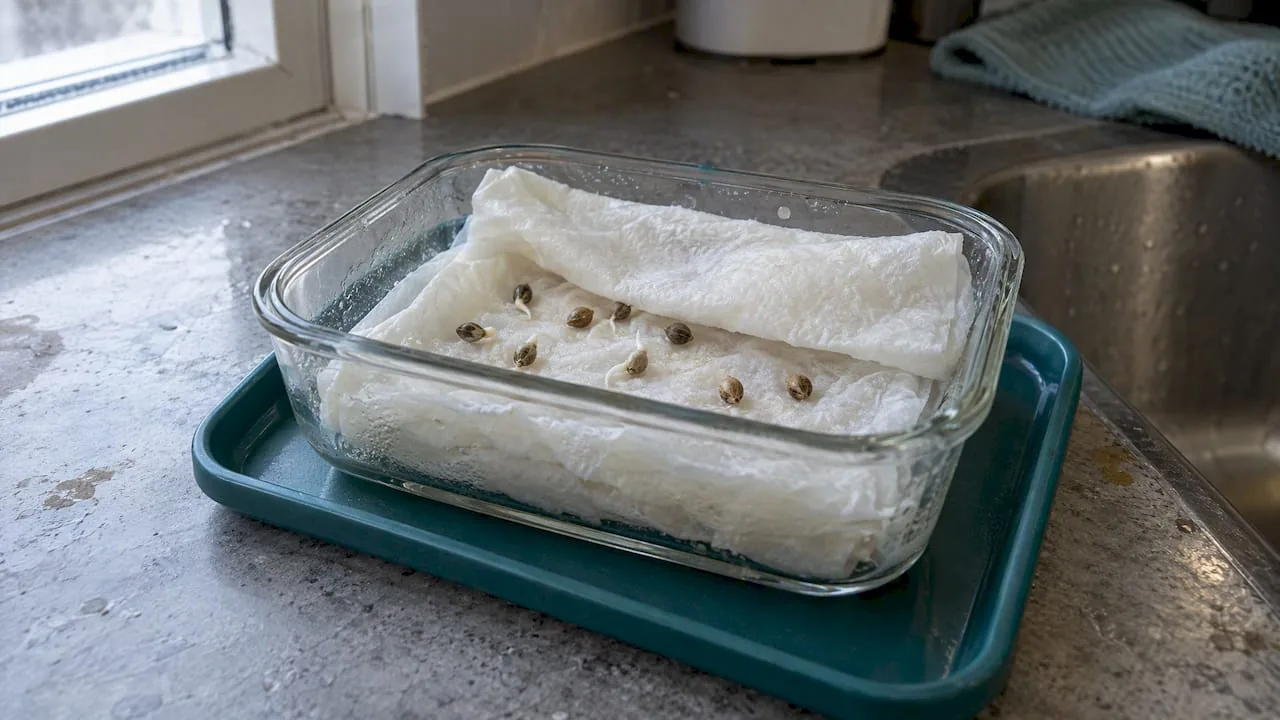
- Soak or moisten the seed in a clean medium (damp kitchen paper or directly the plug).
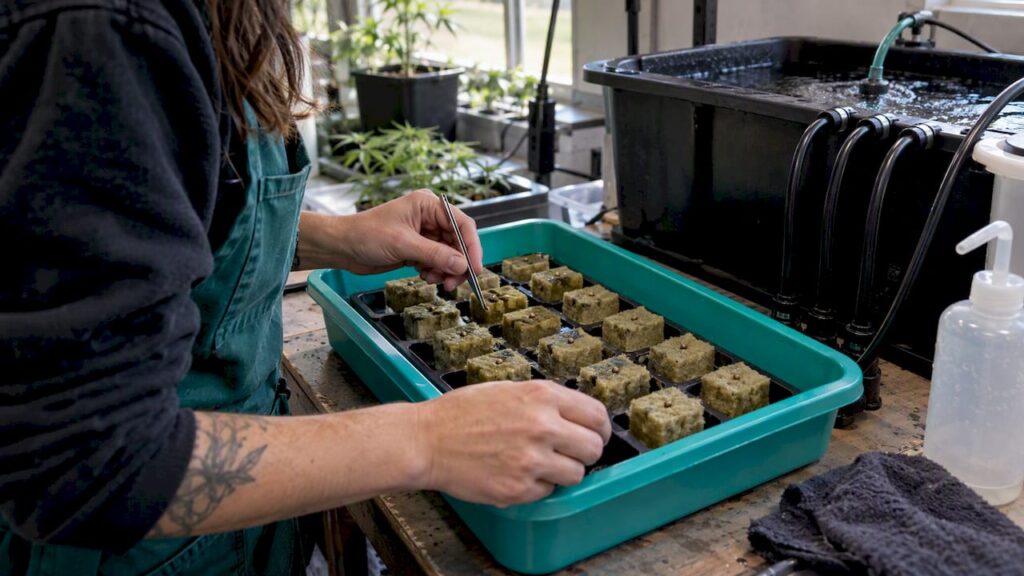
- Place the seed in a plug of rockwool, pressed coco fibre or sponge, with the root facing down.
- Keep it at 22 to 25 °C with high humidity, without waterlogging. The light can wait until the sprout appears.
- Transplant into the system when the root peeks out of the base of the plug.
- Start with a very mild solution and increase it over the weeks.
We have detailed guides if you want to dig deeper: how to germinate cannabis seeds step by step, the complete germination guide and another on germinators.
The first few days set the tone for the rest of the cycle. If you would like a recap of what happens right afterwards, read the first weeks of growing cannabis.
pH and EC: what decides whether your hydroponic setup works
In hydroponics, the nutrient solution is everything. pH affects the solubility and availability of nutrients, and it also fluctuates because the plant absorbs ions unevenly. A study published in the journal Horticulturae (2023) explains that pH drifts during growing and that small changes affect growth, although they worked with lettuce, not cannabis. It’s best to take this as a general principle, not as cannabis-specific data.
As a general guide in hydroponics, most crops operate at a pH between 5.5 and 6.5, according to a reference table covering 55 crops (again, vegetables and herbs). Many cannabis growers work in that same range in soilless systems, but always check your fertiliser’s instructions and observe the plant.
Practical rules to keep it simple
- Measure every day at the beginning, and then every two or three days. A reliable pH meter and EC meter are your best investment.
- Know your water. If your tap water contains a lot of dissolved salts, start from a high base EC. In areas with hard water, mixing with reverse osmosis water helps; a guide to hydroponics from Frankies Garten stresses knowing the EC of your mains water before preparing the solution.
- Change the solution regularly, instead of constantly topping it up. Salts build up unevenly.
- Raise the EC gradually. Seedling: very low. Vegetative: moderate. Flowering: the highest, with care.
- Look at the leaves. Burnt tips, very dark leaves or downward-curling claws usually indicate excess; general paleness, a deficiency.
For the flowering phase, our guide to fertiliser for cannabis flowering will help you.
Common mistakes with seeds in hydroponics
Choosing the variety for its potency rather than its ease of handling. High-potency genetics can be demanding. If they interest you, take a look at examples of high-potency hybrids, but save them for your second or third cycle.
Transplanting too early. A tiny root in a strong-flow system gets stressed. Wait until the plug is well rooted.
Forgetting the oxygen. In deep water systems, without enough aeration the roots rot. An air stone and an air pump cost little and prevent a lot.

Solution temperature. A warm solution holds less oxygen and encourages pathogens. Keep it cool.
Growing too many varieties at once. Each one needs different handling. Two or three well-chosen ones will teach you more than ten mixed together.

Perspective: how we see it at Bluedog Genetics
We don’t believe in the idea of a “miracle seed” for hydroponics. We believe in a curated selection: genetics from reputable seed banks, described honestly and understood by the people who buy them. When someone asks us what to choose for their first soil-free system, we first ask about their space, their light and how much time they can give it each day. Then we suggest an easy-going feminised seed, or an autoflowering one if they want a short cycle.
What we see most often is people who invest in equipment and skimp on genetics, or the other way round. The sensible approach is balance: a quality seed in a simple, well-measured setup beats extreme genetics in an improvised one. And if you have any doubts, write to us: personalised order tracking and customer service are part of how we work.
What the law says in Spain before setting up your grow
This point is important so that you don’t get any surprises. In Spain, private consumption is not penalised, and growing for personal use is not explicitly regulated, but the Citizen Security Law provides for penalties when plants are visible from the public highway. According to a specialist law firm, article 36.18 sets fines of 601 to 30,000 euros in that case. That is why indoor growing that is discreet and not visible from the street is the sensible choice. If you have specific questions about your case, consult a lawyer specialising in criminal and administrative law.
Regulation varies greatly from one country to another, so it’s best not to extrapolate. In Switzerland, for example, the sale of seeds is legal because they contain no THC, but growing cannabis with THC is prohibited, according to a Swiss industry website, and federal law confirms this on the Federal Office of Public Health page. If you’re interested in how legalisation has evolved in other countries and its effect on criminal records, there is an analysis of criminal records and marijuana legalisation in Canada. It applies only to that country.
Our seeds are sold as collectible and genetic conservation material; always find out about the regulations that apply where you live, and only grow if you are of legal age.
Where to find seeds for your first hydroponic grow
If you already know what type of plant you want, at Bluedog Genetics you will find a catalogue organised by type: feminised, autoflowering, regular, CBD and fast version. You can also browse the selection from our own seed bank. We offer discreet shipping, order tracking, regular promotions and quality guarantees. You will see the shipping costs when you place your order in the shop.
Frequently Asked Questions
Which cannabis seeds are best for hydroponics?
There is no single exclusive category, but feminised seeds with stable vigour are the safest option for a first grow, because all the plants flower. Autoflowering varieties also work well if you keep the EC low and avoid stress. Choose according to your space and experience, not just potency.
Can seeds be germinated directly in a hydroponic system?
It’s best to germinate in a rockwool cube, coco fibre or sponge, and move the seedling into the system once the root appears. That way you control humidity and temperature during the most delicate stage. Sowing directly in the reservoir increases the risk of the seed rotting.
What pH does a hydroponic grow need?
Most hydroponic crops sit between 5.5 and 6.5, according to general reference tables. For cannabis, follow your fertiliser’s instructions and adjust by observing the plant. Measure often, because pH changes on its own throughout the day.
What are the disadvantages of hydroponics?
It demands more control: pH, EC, temperature and oxygenation. A failure in the pump or the solution can affect the whole plant within a few days, and the equipment is an initial investment. In return, growth is fast and management is very precise.
How can I make seeds germinate faster?
Keep the temperature between 22 and 25 °C, with high humidity without waterlogging, and darkness until the sprout appears. Use fresh, well-stored seeds, because the quality of the batch matters more than any trick. If you want details, we have a step-by-step germination guide.
What we recommend to get started
If this is your first soil-free system and you want control, start with a variety from our feminised seeds category with a medium-vigour description and good behaviour. If you prefer a short cycle in a small space, take a look at the autoflowering seeds. With one or two well-measured plants you’ll learn more than with a cabinet full of them.
Sources
- KTBL: Salatanbau in hydroponischen Systemen
- GEVES: faculté germinative du chanvre
- MDPI Horticulturae: Precise Management of Hydroponic Nutrient Solution pH
- Rootless Farm: Hydroponik-Parameterreferenz
- Frankies Garten: Gemüseanbau in der Hydroponik
- EOM Equipo Jurídico: plantas de marihuana en casa
- Cannabisclub.ch: cannabis anbauen Schweiz
- BAG: Gesetzgebung Hanf- und Cannabisprodukte