

The cannabinoid profile is a plant’s chemical signature: it shows which cannabinoids it produces, in what proportions and, therefore, largely predicts its effect and use. Technically it is called the chemotype and is determined through laboratory analysis, either by high-performance liquid chromatography (HPLC) or gas chromatography (GC), as documented by the European Directorate for the Quality of Medicines. Before focusing on whether a variety is called “Sativa” or “Indica”, or chasing the highest THC percentage in the catalogue, the cannabinoid profile tells you what really matters: what to expect from that plant in your grow and in your body.
This article takes you through each of those steps with concrete examples and an actionable checklist at the end.
Pro tip: Prioritise the ratio and the full spectrum of cannabinoids over a single THC number. A variety with a moderate THC level and a rich terpene profile can beat one with higher THC but a poorer profile in terms of experience.
In short:
- The chemotype is the technical reference: it classifies plants by their actual chemical composition, not by morphology; it is quantifiable and reproducible.
- Terpenes change the experience: two varieties with the same THC produce different effects depending on their dominant terpene profile.
- The batch COA is essential: always ask for the COA of the exact batch, with the analytical method stated, the date and the full cannabinoid and terpene profile.
- Ph. Eur. vs administrative threshold: The European Pharmacopoeia uses 1 % THC to define CBD-dominant; check which administrative threshold applies in your market.
- Bluedoggenetics as a starting point: it offers seeds with traceability, COAs available by batch and personalised support for growers with defined profile goals.
What exactly is a chemotype or cannabinoid profile?
The chemotype classifies a cannabis plant by its dominant chemical composition, not by its morphology. Two plants that look identical can belong to completely different chemotypes if their biosynthetic enzymes produce different proportions of THCA or CBDA. Studies published in PMC document how genetic variations in enzymes such as THCA synthase and CBDA synthase determine whether a plant mainly accumulates one precursor or the other, which makes the biosynthetic pathway the most relevant genetic factor in the chemotype.
The difference between genotype, phenotype and chemotype is practical, not just academic:
- Genotype: the genetic blueprint, the plant’s maximum potential.
- Phenotype: the visible expression of that blueprint under specific growing conditions.
- Chemotype: the real chemical fingerprint measured in a laboratory, resulting from the interaction between genetics and environment.
You can read it as a chain: Genetics → Environment → Metabolism → Chemical profile. The grower controls the environment; the genetics are chosen when buying the seed. Understanding this chain is what lets you predict, and not just hope for, the result of your harvest. To go deeper into the difference between genetics and expression, the Bluedoggenetics article on genotype and phenotype in cannabis develops this distinction with practical growing examples.
The morphological Sativa/Indica classification describes shape and flowering cycle, not chemical composition. Two varieties labelled as «Indica» can have radically different cannabinoid profiles.
Pro tip: When you assess a new variety, first look for its documented chemotype. If the seller can’t show you a batch COA, the Sativa/Indica label is all you have, and that isn’t enough.
What does the ratio of each cannabinoid tell you?
Not all cannabinoids are psychoactive. Each one brings a different clinical or practical property, and their relative proportion within the profile changes the final result significantly.
| Cannabinoid | Main effect | Common uses | Regulatory note |
|---|---|---|---|
| THC (THCA) | Psychoactive, analgesic, antiemetic | Recreational, chronic pain, nausea | Controlled in most jurisdictions |
| CBD (CBDA) | Anxiolytic, anti-inflammatory, non-psychoactive | Medicinal, industrial and wellness use | Legal with THC < local threshold |
| CBG (CBGA) | Precursor of THC and CBD, antibacterial | Research, early formulations | No restrictions in many countries |
| CBN | Mild sedative, oxidation marker | Sleep, batch ageing assessment | No general restriction |
| THCV | Suppresses appetite, modulates psychoactivity | Metabolic research, balanced profiles | Variable regulation |
| CBC | Anti-inflammatory, neuroprotective | Full-spectrum formulations | No general restriction |
The THC:CBD ratio is the first number you should read on any COA. A 1:1 ratio produces balanced effects because CBD moderates the psychoactivity of THC. A THC-dominant profile is associated with more intense effects and can increase the risk of anxiety in sensitive users. A CBD-dominant profile with low THC is geared towards industrial or therapeutic uses without intoxication. For a detailed guide on how to interpret these ratios in specific varieties, the Bluedoggenetics article on THC:CBD ratio in cannabis varieties is a direct reference.
Minor cannabinoids to watch:
- High CBG in early flowering indicates that the plant has not yet converted CBGA into THC or CBD; useful if you are looking for CBG-rich profiles.
- High CBN in a finished product is a sign of oxidation or prolonged storage, according to research on PubMed that describes CBN as an ageing marker of THC-rich material.
- Detectable THCV appears in African genetics and can moderate the psychoactivity of THC at specific ratios.
Pro tip: If your goal is therapeutic, don’t limit yourself to THC and CBD. A profile with detectable CBG and CBC can provide additional synergy that an isolate doesn’t offer.
Terpenes shape the experience: the entourage effect in practice
Terpenes are not just aromas. They are pharmacological modulators that interact with cannabinoids and change how the receptors of the endocannabinoid system process the signal. Peer-reviewed studies confirm that the terpene profile modulates the effects of cannabinoids, a phenomenon known as the “entourage effect” or entourage effect.
The most relevant terpenes and their practical impact:
- Myrcene: earthy, herbal aroma. Associated with sedation and muscle relaxation; it predominates in many fast-flowering varieties.
- Limonene: citrusy and fresh. Linked to elevated mood and reduced anxiety; common in genetics of Californian origin.
- β-caryophyllene: spicy, peppery. It acts on CB2 receptors, with anti-inflammatory properties; the only terpene that interacts directly with the endocannabinoid system.
- Linalool: floral, lavender. Calming and anxiolytic effect; appears in varieties with balanced profiles.
- Pinene: fresh pine. It may counteract the short-term memory loss associated with THC.
The clearest example of why terpenes matter: two samples with similar THC levels produce different experiences if one has myrcene as its dominant terpene (a more sedating result) and the other has limonene (a more active, cerebral result). The THC percentage is the same; the experience isn’t.
The terpene profile is as decisive as the THC percentage when predicting the effect of a variety. Two plants with the same THC concentration but different terpenes can produce radically different experiences, which makes a full profile analysis an indispensable tool for any informed grower or consumer.
To understand in detail how each terpene changes the aroma and effect of your plants, the article on cannabis aromas and terpenes from Bluedoggenetics offers a practical guide with examples of real varieties.
Pro tip: When you request a COA, ask specifically for the terpene profile. A reputable laboratory includes it alongside the cannabinoid profile. If you only receive THC and CBD percentages, the analysis is incomplete.
Chemotype I, II and III: how to classify a strain in practice
The European Pharmacopoeia classifies cannabis chemotypes and sets a scientific threshold of 1 % THC to define CBD-dominant plants in its monograph Ph. Eur. 3028. This classification is the strongest technical reference available to growers and formulators.
| Chemotype | Dominant chemical profile | Recommended Use | Regulatory implication |
|---|---|---|---|
| Type I | THC > 1 %, low CBD | Recreational, controlled medicinal | Subject to narcotics regulation |
| Type II | THC and CBD in similar proportions | Balanced medicinal, research | Regulation varies according to local threshold |
| Type III | CBD > 1 %, THC < 1 % | Industrial, wellness, non-intoxicating use | Generally permitted under hemp regulations |
For growers producing for the industrial or medicinal market, this distinction determines the certification of the batch.
Key points for applying this classification:
- Use the Ph. Eur. chemotype as a technical reference when selecting seeds.
- Check the administrative threshold of the destination country before scaling up production.
- Ask for the COA to specify the chemotype according to Ph. Eur. 3028 when you work with industrial or pharmaceutical buyers.
How to read a COA: HPLC, GC and quality signals
A reliable COA is the document that verifies the real cannabinoid profile of a batch. Knowing how to read it helps you avoid risky purchases and protects you from data sheets that don’t match the product you receive.
HPLC versus GC: the comparative methodological literature recommends always specifying whether the COA reports carboxylic acids (THCA, CBDA) or neutral cannabinoids (THC, CBD). HPLC works at room temperature and preserves the acids; GC applies heat and decarboxylates, converting THCA into THC. A COA that only shows “THC” without stating the method may be reporting the neutral form (GC) or the acid (HPLC), and the difference in percentage is significant.
Checklist for reading a COA:
- Analysis date and identifiable batch number.
- Name of the accredited laboratory and signature of the responsible analyst.
- Stated analytical method (HPLC or GC) and limit of quantification (LOQ).
- Full cannabinoid profile with clear units (% w/w or mg/g).
- Terpene profile with at least the five main ones.
- Contaminant screening: heavy metals, pesticides, mycotoxins and microbial count.
Warning signs in a COA:
- No batch number, or a generic batch (“standard reference”).
- No analytical method declared.
- No analyst signature or no laboratory accreditation.
- Analysis date older than 12 months for products on active sale.
- Complete absence of a terpene profile in a product sold for its aromas or effects.
Population analyses show wide variability in cannabinoid profiles depending on origin and growing cycle, which reinforces the need to ask for a COA specific to the batch you are going to buy, not one from an earlier reference batch.
Pro tip: Always ask for the COA of the exact batch. A generic reference COA may correspond to a harvest from two years ago, grown under conditions different from today’s.
Which factors alter the cannabinoid profile during growing
Genetics sets the potential; the environment determines how much of that potential is expressed. A grower who understands this dynamic can get closer to the expected chemotype with greater consistency between harvests.
Environmental factors that most affect the final profile:
- Photoperiod and light spectrum: the intensity and spectrum of light during flowering directly influence terpene production and the accumulation of cannabinoids in the trichomes.
- Temperature: high temperatures in the last weeks of flowering degrade volatile terpenes and can reduce the aromatic profile on the COA.
- Nutrition: excess nitrogen during flowering can suppress cannabinoid synthesis; a potassium deficiency affects trichome maturation.
- Controlled water stress: mild stress in the last two weeks can concentrate resins, although the effect varies by genetics.
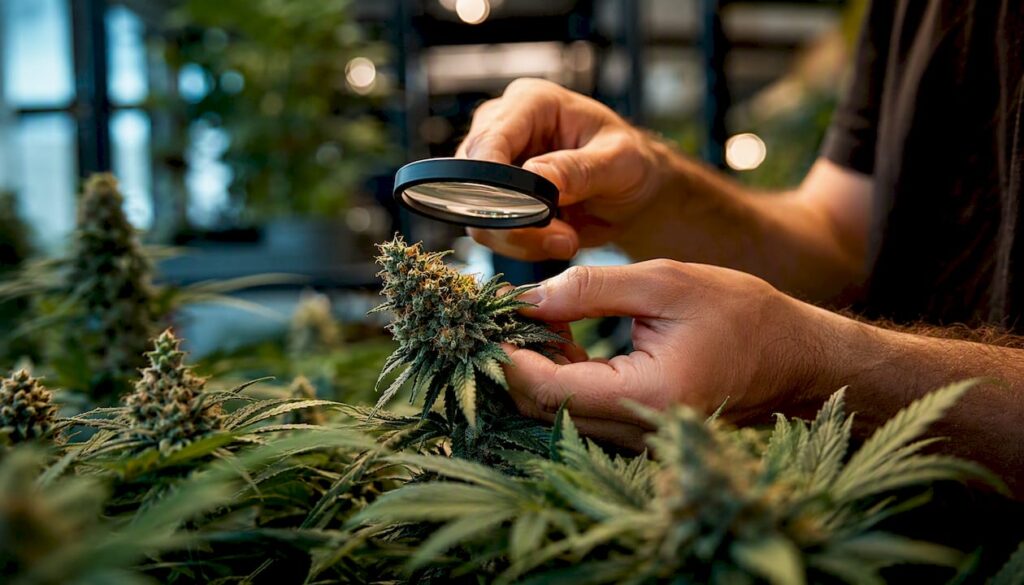
- Harvest timing: harvesting before peak maturity produces profiles with lower THCA and residual CBG; harvesting late increases CBN through THC degradation. Trichomes as indicators of maturity are the most reliable visual reference for deciding the exact moment.
Recommended sampling schedule:
Take the bud sample in the expected harvest week, before drying. Keep the sample in an airtight bag, refrigerated (4 °C) and protected from light. Send it to the laboratory within 48 hours to avoid terpene degradation. The resulting COA will be representative of the batch if growing conditions were stable throughout flowering.
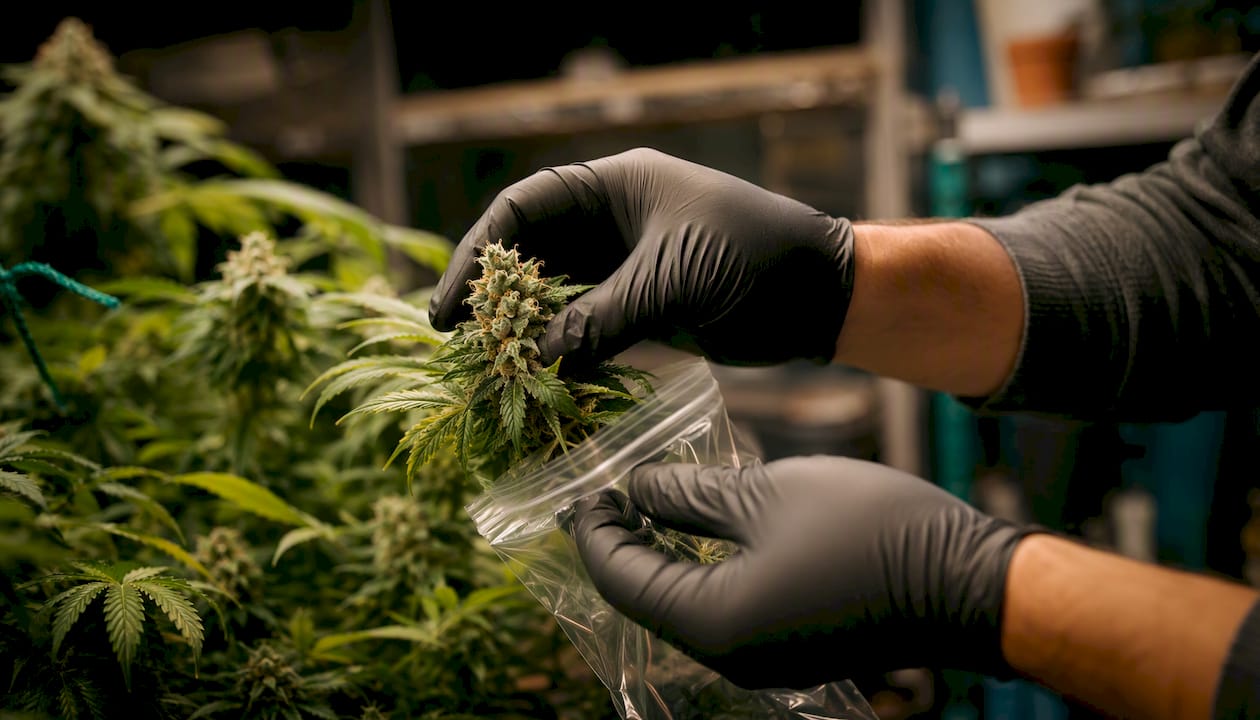
Pro tip: Keep temperature, humidity and photoperiod stable during the last four weeks of flowering. Environmental variability in that phase is the main cause of discrepancies between the seed’s reference COA and the actual result of your harvest.
How to choose a variety based on its cannabinoid profile
Choosing by goal is the most direct method: first define what you are looking for (recreational effect, pain relief, anti-anxiety, industrial production) and then look for profiles that have historically been associated with that goal.
Steps to choose a variety:
- Define your goal: recreational, analgesic, anxiolytic, industrial or balanced.
- Identify candidate ratios: THC-dominant for intense recreational use; 1:1 for balanced; CBD-dominant with THC < 1 % for use without intoxication.
- Ask for the batch COA before buying, not afterwards.
- Check the terpene profile: myrcene if you’re after relaxation, limonene if you prefer more active effects.
- Check contaminants and traceability: metals, pesticides and mycotoxins within safe limits.
- Run a small-scale test: 1 or 2 mother plants before committing your whole investment.
- THC-dominant (>15 %, CBD <1 %): intense psychoactive effects, for recreational use or severe chronic pain.
- Balanced (1:1 to 2:1 THC:CBD): moderate psychoactivity with greater tolerability; clinical research.
- CBD dominant (THC <1 %): industrial use, everyday wellbeing, formulations with no intoxication.
Questions you should ask the seed bank before buying:
- Do you have a current-batch COA with cannabinoid and terpene profile?
- Which Ph. Eur. chemotype does this variety correspond to?
- Under what growing conditions was that COA obtained?
To spot quality signs in seeds and know what separates premium genetics from mediocre ones, the Bluedoggenetics guide on how to identify premium genetics is a practical read before any purchase.
Pro tip: Always start with 1 or 2 mother plants to test the real phenotype before scaling up. The reference COA is a guide, not a guarantee: your grow environment will always introduce variation.
Why the Sativa/Indica distinction is no longer enough
Scientific evidence and industry experts have been pointing out for years that the labels Sativa and Indica describe morphology and geographical origin, not chemical composition. The review on the complexity of the chemical profile of cannabis published in PMC documents how the interaction between cannabinoids and terpenes, and not the morphological category, determines the final effect. The chemotype is quantifiable, reproducible and verifiable; the Sativa/Indica label is not.
The European Pharmacopoeia and AECANI support the use of chemotypes as a technical basis for classification and regulation. The WHO report on CBD stresses the importance of purity and traceability control for CBD-rich products, something only a chemotype analysis can guarantee.
The Sativa/Indica classification is useful for describing a plant’s growth habit, but it does not predict its chemical profile or its effects. Using chemotypes based on laboratory analysis is the only way to make reproducible technical decisions about cannabis varieties.
Signs that a supplier works with technical rigour:
- Publishes a batch COA with a full cannabinoid and terpene profile.
- State the Ph. Eur. chemotype on the variety page.
- Specify the analytical method (HPLC or GC) and the accredited laboratory.
Professional tip: When a seller only offers you a Sativa/Indica label with no chemotype data or COA, you are buying morphology, not chemistry. Demand the data before deciding.
My perspective on profiles and seed selection
What has surprised me most when working with different varieties is the gap between what a spec sheet promises and what a phenotype actually produces under specific conditions. I have seen varieties labelled «high in THC» deliver harvests with terpene profiles so poor that the experience was flat, without depth.
The practical lesson is that the THC number is the marketing of cannabis. The complete profile, including terpenes and minor cannabinoids, is the real substance. For growers, this means that choosing a seed doesn’t end at the catalogue: it ends when you have the batch’s COA in hand and have done a small-scale phenotype test.
Another point that tends to be overlooked: the variability between phenotypes of the same variety can be greater than you expect. Two plants from the same seed, grown in the same space, can produce different terpene profiles. Managing that variability means selecting the mother with the profile closest to your goal and stabilising the flowering conditions.
Pro tip: Always keep a sample of the harvested batch under controlled conditions (darkness, stable temperature, airtight bag) and send it for analysis before selling or consuming on a large scale. A COA of your own harvest is worth more than any reference from the seed bank.
Seeds with a defined profile: options from Bluedoggenetics
Choosing a seed with a documented cannabinoid profile makes the difference between a predictable harvest and a surprise. Bluedoggenetics works with selected seed banks that offer real traceability: varieties with COAs available per batch, stable genetics and technical sheets that go beyond the Sativa/Indica label.
If you are looking for a THC-dominant profile with expressive terpenes for recreational or high-potency medicinal growing, the Bluedoggenetics shop includes feminised varieties from reputable seed banks with verified profiles. For growers looking for CBD-dominant or balanced profiles, aimed at industrial or therapeutic use without intoxication, our selection of premium feminised and autoflowering seeds covers that range with options for different cycles and growing conditions.
Before you complete your order, ask for the COA of the batch you will receive. Bluedoggenetics offers personal support to answer questions about profiles and traceability, with discreet shipping and order tracking included. Visit the shop, check the variety pages and ask for the COA before committing your investment.