

The genotype is the complete genetic code that a cannabis plant inherits from its parents, while the phenotype is the visible and chemical expression of that code as it interacts with the environment. Understanding the difference between genotype and phenotype in cannabis is not an academic exercise: it is the basis for planning harvests, selecting varieties and getting repeatable results. The THCAS and CBDAS genes, located on chromosome 7, determine the plant’s chemotype. The environment, however, decides how far that genetic potential is realised. Bluedoggenetics works with stabilised genetics precisely because it understands this distinction and applies it to every variety in its catalogue.
In short:
- The genotype is the inherited genetic code; the THCAS and CBDAS genes, on chromosome 7, determine the plant’s chemotype.
- The phenotype is the visible expression of the genotype and changes depending on the light, temperature, humidity and nutrients of the grow.
- F1 hybrids offer uniformity and hybrid vigour; F2 seeds provide useful variability for phenohunting.
- Preserving an exceptional phenotype requires taking cuttings before harvest, because future seeds segregate the traits.
- Bluedoggenetics documents the parental lineage of each variety to offer harvests with predictable phenotypes.
What is the genotype and how does it influence the cannabis plant?
The genotype is the architectural blueprint of the plant. It contains all the hereditary information encoded in the DNA, passed on by the parents through genes and alleles. Each gene can come in different versions, called alleles, and the combination of those alleles determines traits such as cannabinoid content, morphology, flowering time and pest resistance.
The THCAS and CBDAS genes are the most studied in cannabis. Variations in THCAS and CBDAS correlate directly with the plant’s THC and CBD levels. This means that the chemotype, that is, the cannabinoid profile, is encoded in the DNA before the seed germinates.
| Allele | Main effect | Resulting chemotype |
|---|---|---|
| THCAS dominant | High THC production | Type I (high THC) |
| CBDAS dominant | High CBD production | Type III (high CBD) |
| Both alleles present | Mixed production | Type II (THC and CBD) |
| None dominant | Minimal cannabinoids | Type IV (fibre/seed) |
Knowing a variety’s genotype lets you predict its behaviour before growing it. A grower who works with documented genetics has an advantage over someone who chooses seeds with no known genetic history.
💡 Pro tip: when you buy seeds, ask for information about the parental lineage. A serious seed bank like Bluedoggenetics documents the genetic origin of each variety so you can anticipate the profile of your harvest.
What is a phenotype and how does it show in cannabis plants?
The phenotype is everything you can observe and measure in a plant: its height, bud structure, leaf colour, aroma, trichome density and cannabinoid and terpene profile. It is the result of the interaction between the genotype and the environment in which the plant grows.
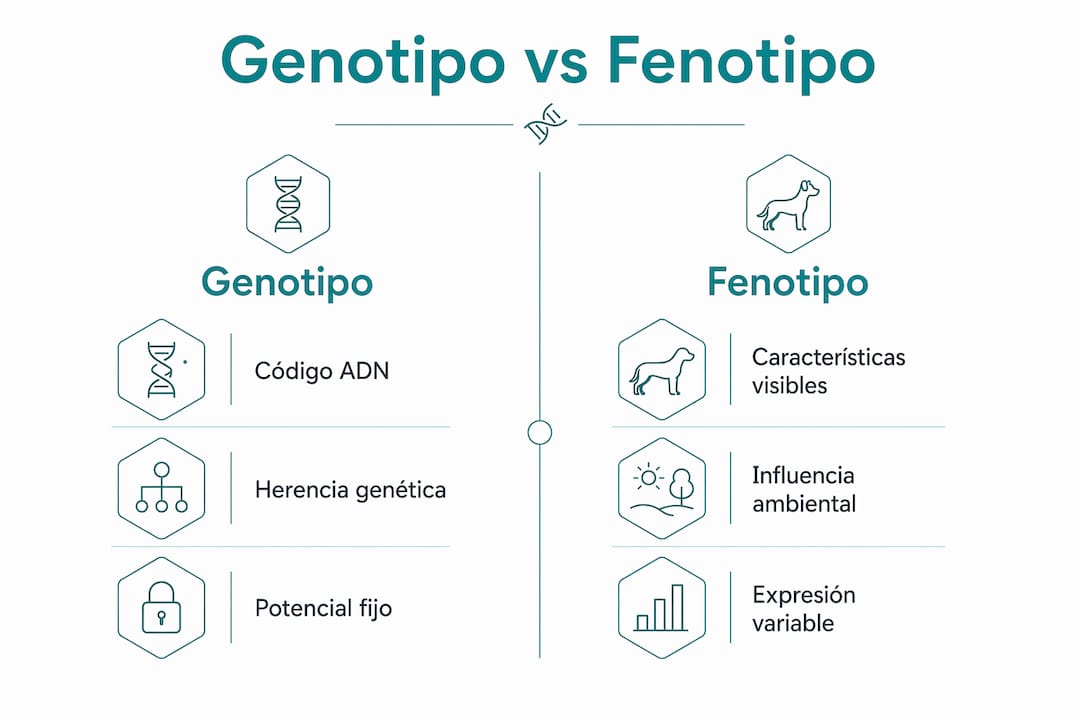
The phenotype reflects how genes are expressed under specific conditions of light, temperature, humidity and nutrients. Two genetically identical clones grown in different conditions can show notable differences in aroma, yield and potency. This isn’t a genetic flaw: it’s phenotypic plasticity in action.
The factors that affect cannabis phenotype fall into three main categories:
- Light: intensity, spectrum and photoperiod change the size of the plant, the density of the buds and the production of resin.
- Temperature: temperature differences between day and night influence pigmentation, aroma and terpene concentration.
- Nutrients: an excess or deficiency of nitrogen, phosphorus or potassium affects yield and can change the final chemical profile.
- Humidity: inadequate levels encourage mould or water stress, which alters the expression of resistance traits.
The environment alters terpene profiles even in genetically identical clones. This explains why the same variety grown indoors and outdoors can smell and taste different.
💡 Pro tip: to maximise the phenotypic expression of a variety, keep conditions stable during flowering. Sudden temperature fluctuations in the last few weeks are the most common mistake that reduces the quality of the terpene profile.
Why can two plants with the same genotype show different phenotypes?
The answer lies in the interaction between genes and environment. The genotype sets the upper limit of what the plant can achieve, but the environment determines how much of that potential is actually expressed. The genotype sets the limit, but the environment dictates the final outcome of the phenotype, even in identical clones.
When you grow seeds of the same variety, each plant inherits a slightly different combination of alleles because of genetic segregation. This produces visible phenotypic variability: one plant may be taller, another more compact; one may have a fruitier aroma and another a more earthy one. This variability is normal and, when well managed, it is an opportunity.
| Characteristic | F1 seeds | F2 seeds |
|---|---|---|
| Phenotypic uniformity | High | Low to moderate |
| Hybrid vigour | Present | Reduced |
| Genetic variability | Low | High |
| Recommended Use | Planned production | Selection and breeding |
| Allele segregation | Minimum | Significant |
F1 hybrids are uniform and produce hybrid vigour, whereas F2 seeds offer greater phenotypic variability and genetic segregation. For growers looking for predictable harvests, F1s are the logical choice. For those who want to explore and find exceptional phenotypes, F2s open up a range of possibilities.
The phenomenon known as phenohunting takes advantage of precisely this variability. Phenohunting looks for unique phenotypes by germinating large numbers of seeds of the same genotype to identify the plant with the most desirable traits. Once found, it is preserved through cuttings. You can learn more about the differences between F1, F2 and BX seed types to understand how each generation affects the variability of your grow.
How do you select and stabilise desired phenotypes when growing?
Phenotype selection is the process of identifying, among several plants, the one that best expresses the traits you are after: higher yield, more intense aroma, greater potency or better resistance. This process requires systematic observation and clear criteria from the start.
- Define your criteria before germinating. Decide which traits you prioritise: yield, terpene profile, flowering time or resistance. Without clear criteria, the selection process becomes subjective and inconsistent.
- Germinate enough seeds. To run a serious phenohunt you need at least 10–20 plants of the same variety. With fewer plants, genetic variability doesn’t show itself enough to find the optimal phenotype.
- Record everything. Note down height, structure, colour, aroma in early and late flowering, and time to maturity. Written data is more reliable than memory.
- Take cuttings before harvest. Once you have identified the plant with the desired phenotype, clone it before harvesting. Preserving unique phenotypes requires cuttings, as future seeds segregate the traits and do not guarantee reproducing the exact phenotype.
- Work with F1 for uniformity and F2 for diversity. F1 hybrids offer uniformity and easy planning, while F2 seeds are ideal for growers looking for phenotypic diversity and new traits.
Hybrid vigour in F1 is the result of homozygosity in stable parent lines. It increases yield, resistance and crop uniformity. For growers who want to understand this concept in depth, the article on hybrid vigour in cannabis explains its advantages in detail.
💡 Professional tip: if you find an exceptional phenotype, take at least 3–4 cuttings from that plant before harvesting it. A single clone is a risk: if it dies, you lose the phenotype for good.
What scientific advances help predict phenotypes in cannabis?
Cannabis genetics has taken a qualitative leap in recent years. Modern predictive models integrate genomic, transcriptomic and metabolomic data to anticipate a plant’s cannabinoid profile before it is grown.
«A 2026 study integrated specific alleles into predictive models for cannabinoids and achieved an accuracy of R²=0.9398 for CBD. This means that, with the right genetic profile, it is possible to predict a plant’s CBD content with a reliability above 93 %. Genomics, transcriptomics and metabolomics working together make possible what once required years of visual selection.»
Advances in genetic sequencing are transforming cannabis breeding towards more predictable and stable profiles. Selection no longer depends only on visual observation: breeders can identify favourable alleles before the plant flowers.
| Technology | Use in cannabis | Benefit for the grower |
|---|---|---|
| Genomics | Identification of THCAS/CBDAS alleles | Chemotype prediction |
| Transcriptomics | Gene expression analysis | Understanding the response to the environment |
| Metabolomics | Cannabinoid and terpene profile | Selection for chemical quality |
For advanced growers, these tools open the door to genetic selection based on objective data. The article on triploid cannabis genetics illustrates how genetic science is redefining the limits of modern growing.
Key points
The genotype defines the maximum potential of the cannabis plant, but only proper environmental management turns that potential into a truly high-quality phenotype.
| Point | Details |
|---|---|
| Genotype as a genetic blueprint | Inherited DNA determines the chemotype and morphological traits before germination. |
| Phenotype as a visible result | Gene expression varies with the light, temperature, humidity and nutrients of the grow. |
| F1 for uniformity, F2 for diversity | F1 hybrids guarantee predictable harvests; F2 seeds let you find rare phenotypes. |
| Phenohunting with cuttings | Identifying the ideal phenotype and cloning it is the only reliable way to preserve its traits. |
| Predictive science in 2026 | Integrated genomics and metabolomics models predict the CBD profile with accuracy above 93%. |
What years of growing teach you about genotype and phenotype
When you start growing, it is common to buy seeds by variety name expecting consistent results. It takes several harvests to understand that the name guarantees nothing: what matters is the genetics behind the seed and the environment where it is grown.
The hardest lesson often comes when you see two plants from the same pack produce buds that are completely different in aroma and density. It isn’t a mistake by the seed bank: it is the natural phenotypic variability of unstabilised seeds. That’s why it makes sense to work with F1 when you need uniformity and to turn to F2 only when you have the time and space to do a serious phenohunt.
The most surprising thing about current scientific progress is that predicting the cannabinoid profile is no longer science fiction. Models with 93% accuracy for CBD are completely changing the way breeders design varieties. For the home grower, this translates into increasingly reliable seeds and more consistent profiles.
The most practical advice: control the environment before blaming the genetics. Mediocre phenotypes are often transformed by adjusting the night-time temperature or improving the light spectrum. The genotype sets the ceiling, but how you manage the plant decides how high it gets.
Seeds with documented genetics at Bluedoggenetics
Choosing seeds with stabilised genetics is the first step towards growing with good judgement. At Bluedoggenetics you will find a curated catalogue of feminised and autoflowering varieties with documented parental lineage, designed for growers who want predictable results without giving up quality. Each variety goes through a selection process that guarantees genetic purity and recognisable phenotypes harvest after harvest. Shipping is discreet, prices are competitive and the team answers questions before and after your purchase. If you are looking for specific varieties to start your next phenohunt, or simply want a uniform harvest, the Bluedoggenetics shop has options for every level of experience.
Frequently Asked Questions
What is the difference between genotype and phenotype in cannabis?
The genotype is the genetic code inherited from the parents; the phenotype is the visible and chemical expression of that code in interaction with the environment. Two plants with the same genotype can show different phenotypes if they grow in different conditions.
Can the environment change a plant’s genotype?
No. The environment doesn’t change the plant’s DNA, but it does determine how and how much the genes are expressed. The genotype is fixed from germination; the phenotype varies according to growing conditions.
What are the THCAS and CBDAS genes?
These are the genes responsible for THC and CBD synthesis in cannabis, located on chromosome 7. Their allelic variations determine the plant’s chemotype, that is, whether it will mainly produce THC, CBD or a mix of both.
What is phenohunting for?
Phenohunting consists of germinating many seeds of the same genotype to identify the plant with the most desirable traits. Once found, it is preserved through cuttings to keep that phenotype in future grows.
Which type of seeds should you choose for uniform harvests?
F1 seeds are the best option for uniform harvests because they come from stable parental lines and produce hybrid vigour. F2 seeds are preferable when the aim is to explore phenotypic variability and find new traits.