

Cannabis trichomes are the resinous glands where all the plant’s cannabinoids and terpenes are synthesised. Their maturity, visible through changes in colour and shape, is the most reliable indicator for deciding the exact moment to harvest. Ignoring these changes means losing potency, flavour, or getting a different effect from the one you wanted. In this guide you will find how to read trichome maturity indicators accurately, which tools you need and how to interpret each sign to get the most out of Bluedoggenetics varieties or any other grow.
In short:
- Stalked capitate trichomes on the calyxes, not on the sugar leaves, are the most reliable indicator for deciding when to harvest.
- For maximum THC potency, harvest when 90 % of the trichomes are milky and less than 10 % are amber.
- Amber trichomes reflect THC degradation and a change in the terpene profile, not genuinely elevated CBN levels.
- Combining the colour of the pistils and the swelling of the calyxes with trichome analysis gives the most accurate reading of maturity.
- Bluedoggenetics selects varieties for their resinous yield and well-defined cannabinoid profile, making trichomes easier to read.
How do you identify the ripeness stages of trichomes?
Trichome assessment is the gold standard for determining cannabis maturity. The correct technical term is capitate-stalked trichomes, which are the only ones relevant for gauging the plant’s chemical maturity. There are three clearly distinct visual stages that you should know before you approach your plants with a magnifying glass.
Transparent or clear trichomes. They indicate premature development. The plant is still producing cannabinoids, and harvesting at this point means losing much of the THC potential. They look glassy, almost like quartz crystal.
Milky or opaque white trichomes. They mark the peak of THC production. The trichome head fills with resin and loses transparency, taking on a milky white colour. This is the moment of highest cannabinoid concentration in the plant.

Amber trichomes. They indicate the start of THC degrading into CBN. The golden or brown colour appears when the resin begins to oxidise. The more amber trichomes, the greater the sedation and the lower the stimulating potency.
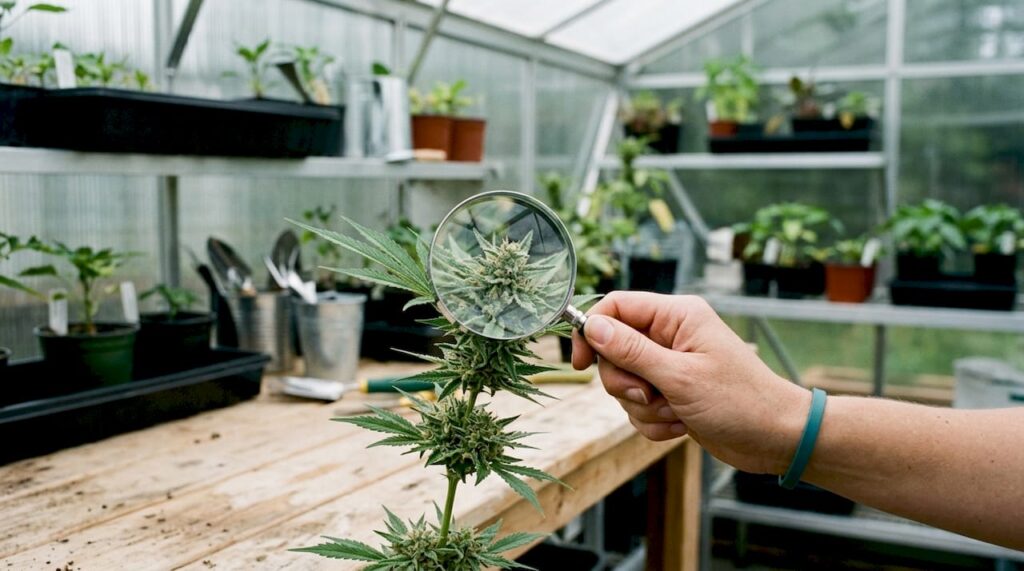
To tell these three stages apart reliably, an accurate assessment requires at least 30x magnification, although at 60x–100x you get consistent views that remove any doubt. A 30x jeweller’s loupe is enough to get started, but a USB digital microscope gives you clear images that you can compare between sessions.

💡 Pro tip: always inspect the trichomes on the flower calyxes, not on the sugar leaves. Sugar leaves mature earlier and can lead you to harvest prematurely if you use them as your main reference.
Before inspecting, let the plant rest for at least two hours without intense direct light. Strong light makes trichomes look more opaque than they really are. Cut a small sample of the calyx with clean scissors and place it on a white surface to make observation easier.
- Use a 30x–60x magnifier or a digital microscope with LED lighting.
- Always look at the calyxes, never the sugar leaves, as your main reference.
- Take samples from different parts of the plant: the upper part matures before the lower.
- Record your observations with photos to compare progress day by day.
- Repeat the inspection every 2–3 days during the last weeks of flowering.
What is the relationship between trichome colour and the final effect?
The colour of the trichomes is not just aesthetic. It reflects the actual chemical composition of the resin at that moment. Trichome maturation is coordinated by specific genes that synchronise structural differentiation with the biosynthesis of cannabinoids and terpenes. This explains why the visual change and the chemical change happen at the same time.
The optimal harvest window varies depending on the effect you want:
- Cerebral, stimulating effect: harvest when 90% of the capitate-stalked trichomes are milky and fewer than 10% are amber. THC is at its peak and the more volatile terpenes are still present.
- Balanced effect: the ideal window is 70–90 % milky trichomes and 10–30 % amber. This range combines potency with a touch of muscle relaxation.
- Sedative, heavy effect: harvest when the percentage of amber trichomes exceeds 30%. THC has partially degraded and the terpene profile has shifted towards more sedative compounds.
«CBN content in the living plant stays low, at around 0.5–1.5%. The sedative feeling attributed to the amber trichome comes mainly from the change in the terpene profile and the degradation of THC, not from genuinely high CBN levels. This means that harvesting late does not produce a pure CBN medicinal effect, but a heavier experience resulting from several factors combined.»
For growers looking for the optimal THC:CBD ratio in medicinal varieties, reading trichomes is even more critical. High-CBD varieties often show a different maturity window from THC-dominant ones, and microscopic analysis is the only way to time the harvest precisely.
Secondary indicators: pistils and calyxes as supporting signs
Trichomes are the main indicator, but not the only one. The pistils and the condition of the calyxes offer complementary visual cues that you can read with the naked eye, no magnifier needed. Used together, these three indicators give you a complete picture of ripeness.
- Watch the colour of the pistils. Pistils start out white or cream and turn orange, red or brown as the plant matures. The colour change in the pistils coincides with the peak concentration of cannabinoids, which makes it a good supporting visual indicator. When 70–80 % of the pistils have changed colour, the plant is entering the harvest window.
- Check how swollen the calyxes are. Calyxes are the small pods that surround each pistil. As they mature, they visibly swell and take on a rounder shape. A swollen, well-formed calyx indicates that the flower has reached its full development.
- Sync both signals with trichome analysis. Orange pistils and swollen calyxes, combined with 70–90 % milky trichomes, confirm that you are in the right window. If the pistils have changed but the trichomes are still clear, wait. The plant hasn’t yet reached its chemical peak.
- Monitor the whole plant, not just the main cola. The flowers at the top mature before the lower ones. If you harvest the whole plant at the same time going only by the main cola, the lower flowers may be immature. Consider a staggered harvest for plants with a big difference in maturity between areas.
- Document the changes with photographs. Photographing the pistils and calyxes every two days lets you see the progress clearly and make decisions based on real data, not intuition.
Combining trichome analysis with monitoring of pistils and calyxes is the recommended practice for maximising yield and quality in professional harvesting. No single indicator is as reliable as all three together.
Common mistakes and variations by genetics or environment
The most common mistake among growers is confusing the trichomes on sugar leaves with those on the calyx. Sugar leaves mature earlier and show amber trichomes while the calyxes are still at peak THC. Using the leaves as a reference systematically leads to premature harvests.
Genetics can also change the standard rules. Some varieties with atypical pigmentation, such as those that produce purple or pink flowers, have trichomes with violet or pinkish tones. This colour is due to anthocyanins, not to maturity or degradation. For these genetics, the clear-milky-amber rules do not apply directly. The best strategy is to combine trichome analysis with calyx swelling and the timings given by the seed bank as an initial reference.
Environmental conditions also affect trichome development. High temperatures speed up resin degradation and can make trichomes go from milky to amber faster than expected. Intense ultraviolet light in outdoor growing stimulates trichome production, but it also speeds up their oxidation. Growing in cold or humid climates can slow the process down and give you more room to manoeuvre at harvest.
💡 Pro tip: optimal ripeness varies with each genetic. The breeder’s timings are a guide, not a guarantee. The microscope is your ultimate tool for each specific strain.
The optimal maturity of trichomes varies with the genetics, so microscopic analysis should always be the definitive guide, above any standard calendar. Knowing the premium genetics you grow makes the difference between a good harvest and an excellent one.
Key points
Microscopic analysis of capitate-stalked trichomes on the calyxes is the most reliable method for determining the optimal harvest window and maximising cannabis quality.
| Point | Details |
|---|---|
| Minimum tools needed | Use a 30x magnifier or a digital microscope to tell clear, milky and amber trichomes apart. |
| Correct inspection area | Always examine the floral calyxes, never the sugar leaves, to avoid premature harvests. |
| Peak potency window | Harvest at 90 % milky trichomes and less than 10 % amber for peak THC. |
| Supporting indicators | Combine trichome analysis with pistil colour and calyx swelling for greater accuracy. |
| Variations by genetics | Varieties with atypical pigmentation require adjusting the standard interpretation of trichome colour. |
What years of growing teach you about trichomes
A common mistake among first-time growers is harvesting based only on the breeder’s calendar. The plant may look good and the pistils may be orange, but the result is often a harvest with a flat effect, lacking depth, that doesn’t do justice to the variety. That’s where the digital microscope comes in: once you start looking closely, the way you decide on the moment of harvest changes completely.
The hardest thing to take on board is that there is no exact harvest day. There is a window, and that window is defined by the plant, not the calendar. Some varieties that in theory flower in 8 weeks need 10 to reach the desired trichome profile, and others finish earlier than expected in summer because of the heat.
The most effective routine is to inspect the trichomes every two days during the last three weeks of flowering, always at the same time and always on the calyxes, photographing each session for comparison. When the percentage of milky trichomes stabilises and the first amber ones start to appear, the ideal moment is only a few days away. It doesn’t pay to rush: that patience is the difference between a decent harvest and a memorable one.
Trichome analysis isn’t complicated. It takes consistency, a good optical tool and knowing exactly where to look. Once it becomes part of your routine, it’s hard to imagine harvesting any other way.
Seeds with exceptional trichomes at Bluedoggenetics
Knowing the trichome maturity indicators is only half the job. The other half starts much earlier, with the choice of genetics. A variety with dense, well-distributed resin production makes trichomes easier to read and ensures that the effort of analysis translates into real quality in the jar. In the Bluedoggenetics seed catalogue you’ll find feminised and autoflowering varieties selected for their resin output and well-defined cannabinoid profile. Each strain comes with information about its flowering cycle, which gives you a solid reference to start your trichome analysis at the right time. Visit the Bluedoggenetics shop and choose the variety that best suits your harvest goals.
Frequently Asked Questions
When are the trichomes ready for harvest?
Trichomes are ready when 70–90 % of the capitate-stalked ones on the calyxes are milky and 10–30 % are amber, depending on the desired effect. For maximum THC potency, look for 90 % milky with less than 10 % amber.
What magnification do I need to see trichomes properly?
A 30x magnifier is enough to tell the three main stages apart. With 60x–100x you get clearer, more consistent images that remove any ambiguity in the reading.
Why are my trichomes purple or pink?
The atypical colour in the trichomes of certain varieties is due to anthocyanins, natural pigments in the plant. It does not indicate maturity or degradation. For these genetics, combine the analysis of calyxes and pistils with the breeder’s timings as a reference.
Can I use sugar leaves to judge ripeness?
No. Sugar leaves mature before the calyxes and can show amber trichomes while the flower is still at peak THC. Always use the flower calyxes as your main reference.
Does an amber trichome mean more CBN in the plant?
CBN content in the living plant stays low even with plenty of amber trichomes. The more sedating effect you notice when harvesting late comes mainly from the change in the terpene profile and the breakdown of THC, not from high levels of CBN.