


The THC:CBD ratio is the proportion between tetrahydrocannabinol and cannabidiol in a cannabis variety, and it directly determines what kind of effect you will experience. It is not a minor detail on the label: it is the most important variable when choosing between a recreational, functional or medicinal variety. Understanding this relationship lets you grow and consume with good judgement, not by intuition. In this guide you will find the effect profiles for each ratio, examples of real varieties, classification trends in 2026 and practical tips for applying this knowledge from your very first grow.
How does the THC:CBD ratio influence the effects of cannabis?
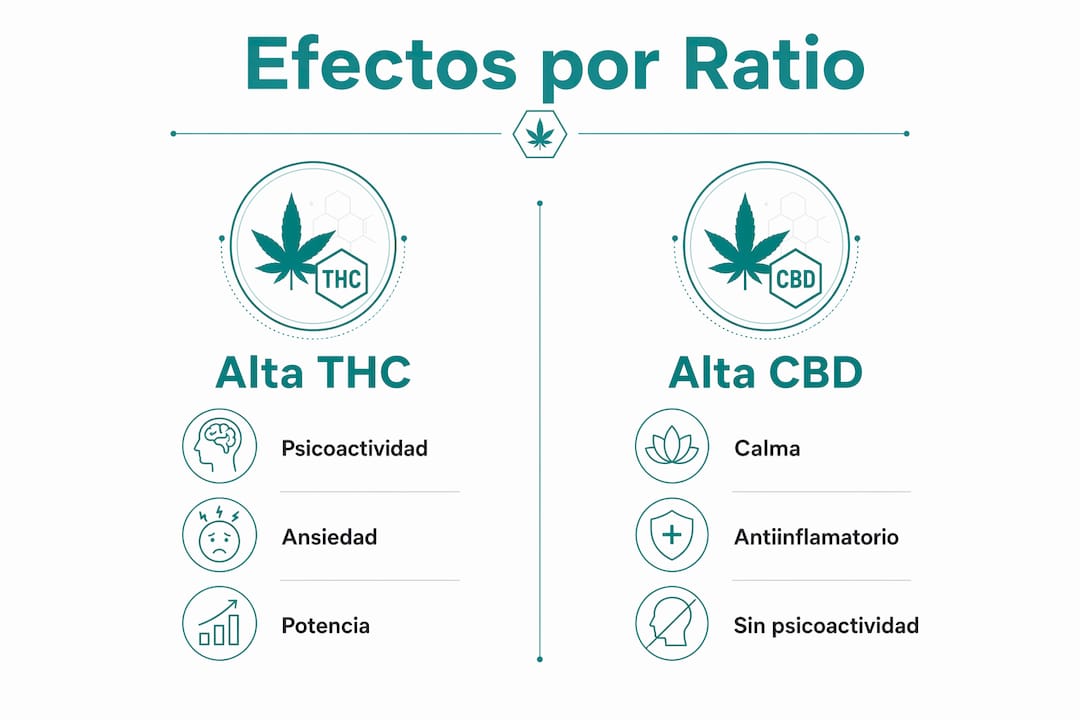
The effect a variety produces depends directly on the proportion between its main cannabinoids. THC:CBD ratios range from 0:1 (THC only) to 20:1 or more (CBD only), and each point on that spectrum produces a different experience.
0:1 profile: pure THC and its risks
A variety without CBD offers the most intense psychoactivity. The problem is that with no CBD present, THC acts without modulation on the CB1 receptors, which increases the risk of anxiety, paranoia and tachycardia in sensitive people. This profile is the most common in high-potency recreational varieties, but also the one that causes the most negative experiences in users with no previous experience.
1:1 ratio: balanced synergy
The 1:1 ratio combines moderate psychoactivity with therapeutic effects. CBD acts on the 5-HT1A and GPR55 receptors, reducing the anxiety and paranoia that THC can induce. The result is a more manageable experience, with mental clarity and bodily relaxation at the same time. For medicinal users and beginners, the 1:1 ratio is the most recommended, as it combines therapeutic benefits without overwhelming effects.
CBD-dominant ratios: 2:1 and higher
From a 2:1 ratio in favour of CBD, the psychoactive effects are noticeably reduced. These profiles are ideal for those seeking functional relaxation without affecting concentration. At ratios of 20:1 or more, psychoactivity disappears completely. Varieties with this profile, such as Charlotte’s Web or Ringo’s Gift, produce no perceptible psychoactivity and are used in paediatric therapies for epilepsy and in treatments where the patient cannot tolerate any altered mental effect.
💡 Pro tip: If you’re after functional effects during the day, choose varieties with a 2:1 CBD:THC ratio. You keep mental clarity and get muscle relaxation without the typical rush of THC-dominant varieties.
The so-called Entourage Effect explains why equal doses of THC feel different depending on the proportion of CBD present. CBD modulates the THC experience, adjusting its bioavailability and the intensity of the psychoactive effect. It is not just that it “blocks” THC: it turns it into something more manageable and, in many cases, more therapeutic.
Comparison of varieties by their THC:CBD ratio
Knowing the ratio in the abstract is useful, but choosing a specific seed requires real examples. The most representative varieties of each profile give you a clear reference point to decide what to grow or consume according to your goals.
| Strain | THC:CBD ratio | THC approx. | CBD approx. | Effect profile |
|---|---|---|---|---|
| Charlotte’s Web | 1:20+ | Very low | High | Non-psychoactive, medicinal use |
| Ringo’s Gift | 1:20+ | Very low | High | Therapeutic, anti-inflammatory |
| Cannatonic | 1:1 | Moderate | Moderate | Balanced, clarity, control |
| Royal Highness | 1:1 | 14% | 14% | Gentle, easy to control |
| Blue Dream | 5:1+ | 17–24% | Low | Energising, daytime use |
| GG4 (Gorilla Glue #4) | 10:1+ | Very high | Very low | Potent, sedating, for night-time use |
Royal Highness, with 14% THC and 14% CBD, is the most frequently cited example of a balanced variety for intermediate users. Its effect is predictable and easy to dose, which makes it an excellent option for those moving from high-CBD varieties towards more psychoactive profiles.
Blue Dream, with THC levels of 17–24%, is recommended for daytime use or for those starting out with potent varieties. Its low CBD content means the experience is more intense, but its terpene profile with limonene and myrcene makes it less anxiety-inducing than other varieties of similar potency.
Terpenes change the final effect as much as the ratio does. Myrcene brings sedation and boosts the effect of THC, while limonene lifts the mood and reduces anxiety. Two varieties with the same 1:1 ratio can feel very different if one has dominant myrcene and the other limonene. Knowing the full terpene profile alongside the ratio is the most accurate way to predict the real effect.
💡 Pro tip: Before buying seeds, look for the COA (Certificate of Analysis) from the seed bank or breeder. Laboratory data is more reliable than figures declared by the grower. Insist on verified analyses to confirm that the advertised ratio is real.
2026 trends: beyond the sativa/indica classification
The traditional classification into sativa and indica is no longer enough to predict effects. Classifying cannabis simply as indica or sativa is an outdated oversimplification. Modern genetics has mixed both categories so much that a plant’s morphology no longer predicts the effect you will experience.
The new classification standard in 2026 combines three variables:
- THC:CBD ratio: defines the psychoactive intensity and the basic therapeutic potential.
- Terpene profile: determines the nuance of the effect (sedating, energising, anxiolytic, euphoric).
- Other minor cannabinoids: CBG, CBN and THCP alter the experience in ways that the THC:CBD ratio alone cannot predict.
Expert growers combine specific terpene profiles with particular ratios to create varieties suited to specific uses. A variety with a 1:1 ratio and dominant myrcene produces sedation and deep relaxation. The same 1:1 ratio with dominant limonene brings mental clarity and wellbeing without drowsiness. This logic goes far beyond the old label of “relaxing indica, energising sativa”.
The use of COA (laboratory Certificates of Analysis) has become the standard for validating ratios in the seed market. The accuracy of cannabinoid analysis is the only real guarantee that the variety you grow has the profile you’re looking for. Data classed as “breeder_claimed” without laboratory backing should be taken with caution.
To select varieties in 2026, first check the full cannabinoid profile, then the terpene profile, and finally validate with an independent laboratory COA. This process takes longer than choosing by name or photo, but it guarantees predictable results both in growing and in consumption. If you want to go deeper into how to choose genetics from scratch, Bluedoggenetics’ seed germination guide is a good starting point.
How to measure and apply the THC:CBD ratio in growing and consumption
Knowing a variety’s ratio is the first step. Applying it correctly in growing and consumption is where many growers and consumers make avoidable mistakes.
For growers, the key steps are:
- Choose seeds with a verified ratio: buy from seed banks that provide laboratory data, not just data declared by the breeder. Bluedoggenetics works with curated, verified genetics to ensure the cannabinoid profile is as advertised.
- Record phenotypes: within the same variety, different phenotypes can express slightly different ratios. Keep a record of each plant to identify which one best expresses the desired profile.
- Control the harvest point: harvesting too early reduces the final THC and can alter the ratio. Harvesting late converts THC into CBN, which shifts the effect towards something more sedating.
For consumers, the practical recommendations are equally specific:
- Microdosing with high-THC varieties: microdosing is the recommended practice to avoid overwhelming effects with potent varieties. Start with minimal doses and wait for the full effect before repeating.
- Personal log of effects: note down the variety, the ratio, the dose and the effect obtained. After 4–6 sessions with the same variety, you will have enough data to fine-tune precisely.
- Professional advice for medicinal use: if you use cannabis to treat a specific condition, the ratio should be adjusted with medical guidance. Medicinal cannabis has real, well-documented applications, but self-medicating without good judgement can be counterproductive.
💡 Pro tip: For new consumers trying 1:1 ratio varieties, always keep pure CBD to hand. If the effect of the THC becomes uncomfortable, an extra dose of CBD can soften the experience within minutes.
Patience is the most underrated tool. Many consumers switch varieties before understanding how a particular one affects them. Give each variety at least three sessions before drawing conclusions about its ratio and its effects on your particular physiology.
Key points
The THC:CBD ratio is the most decisive variable for predicting the effect of a cannabis variety, and it should be combined with the terpene profile for an accurate, reproducible selection.
| Point | Details |
|---|---|
| The ratio defines the base effect | 1:1 ratios offer moderate psychoactivity; 20:1 CBD ratios eliminate the mental effect. |
| The Entourage Effect transforms the experience | CBD modulates THC through 5-HT1A and GPR55 receptors, not just by blocking it. |
| Terpenes complete the profile | Sedating myrcene and energising limonene change the final effect beyond the ratio. |
| The sativa/indica classification is outdated | The cannabinoid and terpene profile predicts effects far more accurately than morphology. |
| The COA is the only real guarantee | Ask for independent laboratory analysis to confirm the ratio before growing or buying. |
What nobody tells you about choosing by ratio
I’ve been working with cannabis varieties for years, and the most repeated mistake I see is choosing by THC potency instead of by ratio. A grower once brought me samples of two varieties with the same 20% THC. One had minimal CBD, the other was around 10% CBD. The effects were so different that they seemed like plants of different species.
What has changed my perspective the most is understanding that CBD is not the “mild cannabinoid” as opposed to the “strong” THC. They are two molecules that work together, and the ratio between them defines the experience more precisely than any variety name or marketing category. When I started selecting genetics by ratio and terpene profile instead of by name or lineage, the results in growing and in consumption improved noticeably.
My recommendation for any grower just starting out: plant a balanced 1:1 strain first. Learn how it behaves in your space and how it feels when consumed, and use that experience as a reference to move towards more extreme profiles. Strains like Cannatonic or Royal Highness are not for beginners because they are “weak”. They are for smart growers who want to understand the plant before scaling up potency.
And for consumers: stop looking for the highest THC in the catalogue. Look for the ratio that suits what you need at that moment. Sometimes that is a 1:1 for a functional afternoon. Other times it is a 20:1 CBD for sleeping without mental effects. Knowing the ratio gives you real control over your experience, and that is worth more than any potency number.
Find your ideal variety at Bluedoggenetics
If you already know which ratio you are after, the next step is choosing the right seeds. Bluedoggenetics offers a curated selection of feminised and autoflowering seeds with verified cannabinoid profiles, from balanced 1:1 varieties for intermediate users to high-CBD options for medicinal use and powerful genetics for advanced growers. Every variety in the catalogue is selected with care, not just for popularity. Shipping is discreet and order tracking ensures you receive exactly what you need to grow successfully. Explore the full catalogue in the Bluedoggenetics shop and filter by cannabinoid profile to find the variety that fits your goals.
For balanced varieties, Royal Highness (14% THC / 14% CBD) is a solid choice for any grower who wants to learn to work with 1:1 ratios. If you are looking for potency with a defined terpene profile, Blue Dream remains a reliable reference for daytime growing and experienced users.
Frequently Asked Questions
What is the THC:CBD ratio in cannabis?
The THC:CBD ratio is the proportion of tetrahydrocannabinol to cannabidiol in a variety. It determines the psychoactive intensity and the therapeutic potential of the plant.
What is the best THC:CBD ratio for medicinal use?
The 1:1 ratio is the most recommended for medicinal use because it combines moderate psychoactivity with therapeutic benefits without overwhelming effects. For therapies with no mental effect, 20:1 CBD ratios are the standard option.
How does CBD affect the effect of THC?
CBD acts on the 5-HT1A and GPR55 receptors, reducing the anxiety and paranoia induced by THC. It doesn’t just block the psychoactive effect, it modulates it towards a more manageable experience.
How do I measure a variety’s THC:CBD ratio?
The most reliable way is to ask for the COA (Certificate of Analysis) from an independent laboratory. The figures declared by the breeder are a guide, but not always precise.
Does the sativa/indica classification predict the effect better than the ratio?
No. The sativa/indica classification is an outdated simplification. The THC:CBD ratio combined with the terpene profile predicts the real effects far more accurately than the plant’s morphology.