

Terpenes are the volatile aromatic compounds that the cannabis plant synthesises in its glandular trichomes. They are not mere perfumes: they actively modulate how you perceive the effects, setting apart varieties with practically identical THC levels. That is the relationship between aromas, terpenes and cannabis effects that is worth understanding before choosing any variety.
Three ideas that sum up everything you need to know:
- Terpenes define aroma because they are volatile molecules that evaporate at room temperature and stimulate the olfactory receptors; each strain has a unique profile of dozens of terpenes.
- They modulate the effects through the so-called entourage effect: they interact with cannabinoids such as THC and CBD, amplifying, attenuating or redirecting their action on the nervous system.
- β-Caryophyllene is the only cannabis terpene with directly demonstrated pharmacological action as a ligand of the CB2 receptor, which makes it a special case within this group of compounds.
What are terpenes? Basic chemistry and categories in cannabis
Terpenes are hydrocarbons built from isoprene units (C₅H₈). In cannabis, they are synthesised in the same glandular trichomes that produce cannabinoids, sharing a common biosynthetic pathway that starts from isopentenyl pyrophosphate (IPP). That metabolic proximity is no coincidence: it explains why the plant can simultaneously regulate the production of THC and terpenes depending on environmental conditions.
Monoterpenes and sesquiterpenes: the two key categories
The most practical classification for growers and consumers distinguishes two main groups:
- Monoterpenes (C₁₀): made up of two isoprene units. They are the most volatile, with boiling points generally below 180 °C. Myrcene, limonene, α-pinene, linalool and terpinolene belong to this group. They evaporate quickly during drying, so curing has a big influence on their final concentration.
- Sesquiterpenes (C₁₅): three isoprene units. Less volatile and more stable against heat and oxidation. β-caryophyllene and humulene are the most relevant examples in cannabis. They tend to persist better after prolonged storage.
A distinction worth keeping clear: terpenoids are terpenes that have undergone chemical modifications (oxidation, cyclisation), such as oxidised linalool. In practice, the term «terpenes» is used broadly to refer to both groups.
Volatility is the most critical factor from a practical point of view. Drying too quickly or at a high temperature can remove a large share of the monoterpenes before the product reaches the consumer. That’s why slow curing at a controlled temperature isn’t an artisanal whim, but a chemical decision with direct consequences for the final aroma profile.
Main cannabis terpenes: aroma, sources and effect tendencies
Cannabis can contain more than 200 different terpenes, but a handful dominate the aromatic profile of most commercial varieties. Knowing them lets you read a COA with a critical eye and choose a strain with more information than just the THC percentage.
According to an analysis of thousands of consumption sessions, citrus aromas are associated with more energising experiences, whereas earthy and woody aromas correlate with relaxation. This correspondence isn’t magic: it reflects the underlying terpene profiles.
| Terpene | Aromatic notes | Natural sources | Associated effect tendency |
|---|---|---|---|
| Myrcene | Earthy, herbal, mango | Mango, hops, thyme | Sedative, muscle relaxant |
| Limonene | Citrus, lemon, orange | Citrus, juniper | Stimulating, anxiolytic |
| α-Pinene | Pine, resin, fresh | Pine, rosemary, basil | Alertness, may counteract memory deficit |
| Linalool | Floral, lavender, spicy | Lavender, coriander | Anxiolytic, mild sedative |
| β-Caryophyllene | Spicy, pepper, wood | Black pepper, clove | Anti-inflammatory, anxiolytic (CB2 agonist) |
| Humulene | Earthy, woody, herbal | Hops, sage | Appetite suppression, anti-inflammatory |
| Terpinolene | Floral, herbal, mild citrus | Apple, lilac, nutmeg | Slightly sedating, antioxidant |
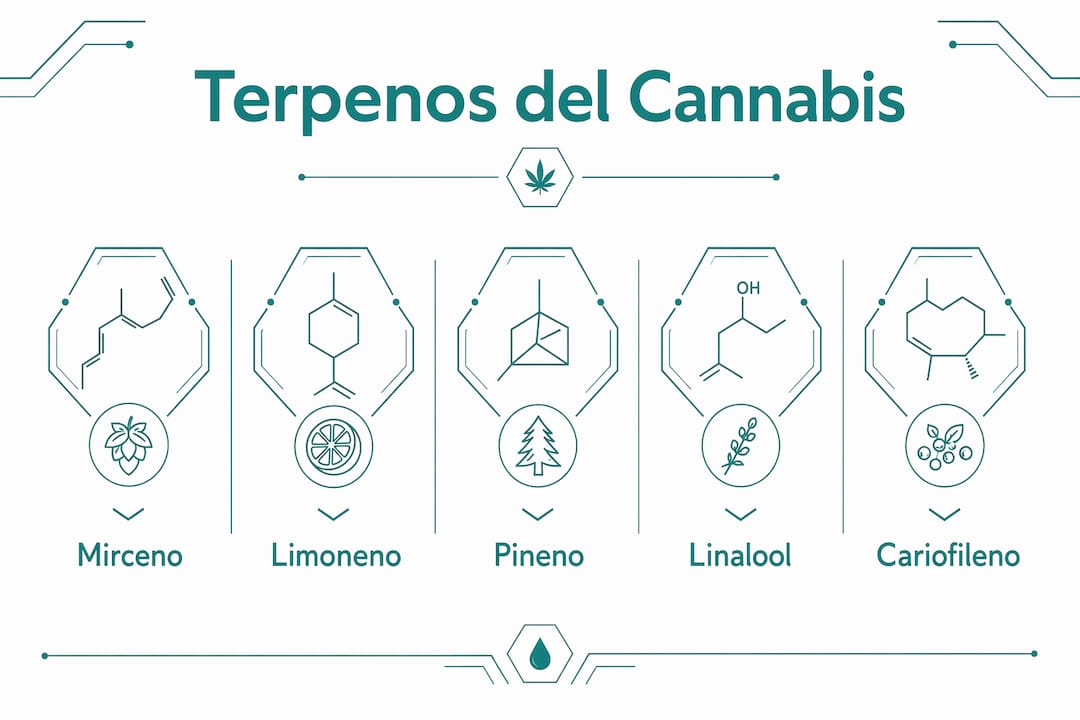
Some terpenes dominate a variety’s bouquet simply because they are synthesised in higher concentrations, not because they are inherently more potent. Myrcene, for example, is often the main terpene in many modern varieties, which explains that characteristic ripe mango aroma with an earthy undertone that you’ll recognise in many current flowers.
Pro tip: If you see a COA where the main terpene is clearly dominant in dry weight, that compound probably defines the aromatic character of the variety. Below 0.05 %, its contribution to the aroma is marginal.
The terpene composition defines the final effect of cannabis and can set apart varieties with similar THC levels, with monoterpenes such as myrcene associated with sedative effects and limonene or pinene with more active experiences.
How do terpenes work? The entourage effect, receptors and the limits of the evidence
The central concept here is the entourage effect (entourage effect): the hypothesis that cannabinoids and terpenes act in synergy, and that whole-plant extract may have greater benefits than pure isolates. The review by Russo (2011) laid the conceptual foundations of the field, describing potential mechanisms and therapeutic effects of several terpenes such as linalool, limonene, α-pinene and β-caryophyllene, and their possible therapeutic synergy with cannabinoids.

Proposed molecular mechanisms
Terpenes can act on the endocannabinoid system and other receptor systems in several ways:
- Direct agonism: β-caryophyllene acts as a ligand of the CB2 receptor, with documented anti-inflammatory action. It is the strongest case of direct pharmacological action of a terpene in cannabis.
- Allosteric modulation: some terpenes can modify the conformation of CB1 or CB2 receptors, altering the response to THC without binding to the main active site.
- Bioenhancement: recent research indicates that certain terpenes act as bioavailability modulators, increasing membrane permeability and helping cannabinoids reach the central nervous system.
A cell study showed specific synergistic interactions between THC and terpenes such as borneol, limonene, sabinene, terpineol, α-pinene and ocimene at the CB1 receptor, while β-caryophyllene and linalool stood out at CB2. In addition, experimental studies in animal models show that isolated terpenes can produce cannabimimetic behaviours and that combining them with cannabinoid agonists results in additive or synergistic effects.
Where the evidence is and where data is lacking
It’s worth being honest here: most of the evidence comes from cell and animal models. Clinical trials in humans remain limited, and directly transferring preclinical results to clinical recommendations calls for caution. An illustrative example: a recent controlled study assessed whether α-pinene could reduce the memory deficits induced by inhaled THC in healthy adults, and did not find the expected effect, although it did confirm the safety of directly inhaling α-pinene at doses of up to 15 mg. That result does not invalidate the entourage effect, but it does underline that terpene-cannabinoid interactions are specific and not universally predictable.
Confusion about the primacy of THC is common: the terpene profile acts as a fine modulator and, for many patients, defines therapeutic quality more than the THC percentage.
Can terpenes cause psychoactivity or anxiety?
The short answer is no, at least not directly. The classic psychoactivity of cannabis, that “stoned” feeling, is produced by THC binding to the CB1 receptor in the central nervous system. Terpenes do not produce that effect on their own at the concentrations found in normal flowers.
What they can do is modulate how you perceive the effects of THC:
- Limonene as an anxiolytic: a human study showed that the simultaneous inhalation of d-limonene and THC significantly reduced the scores for “anxious/nervous” and “paranoid” compared with THC alone, without altering the magnitude or duration of other subjective effects. That has real implications for people who are sensitive to cannabis-induced anxiety.
- Linalool: associated with mild anxiolytic and sedative effects, with evidence from animal models pointing to interaction with the GABAergic system.
- Myrcene in high doses: in animal models it has been associated with pronounced sedative effects; its role in the classic “indica vs sativa” distinction is one of the most active debates in the field. In fact, the indica/sativa classification is less predictive than the actual terpene profile of the variety.
Some practical recommendations for consumers with a history of anxiety:
- Prioritise varieties with limonene or linalool as their main terpenes.
- Avoid flowers with a very dominant myrcene if you want a more active effect or if the sedative effect makes you uncomfortable.
- Always check the THC:CBD ratio of the variety, as CBD also modulates THC-induced anxiety.
- Consult a health professional if you take medication, especially anxiolytics or antidepressants, before combining cannabis with any terpene profile.
This article is general information, not medical advice. Consult a healthcare professional about your specific situation.
How terpenes are measured: laboratories, GC-MS and how to read a COA
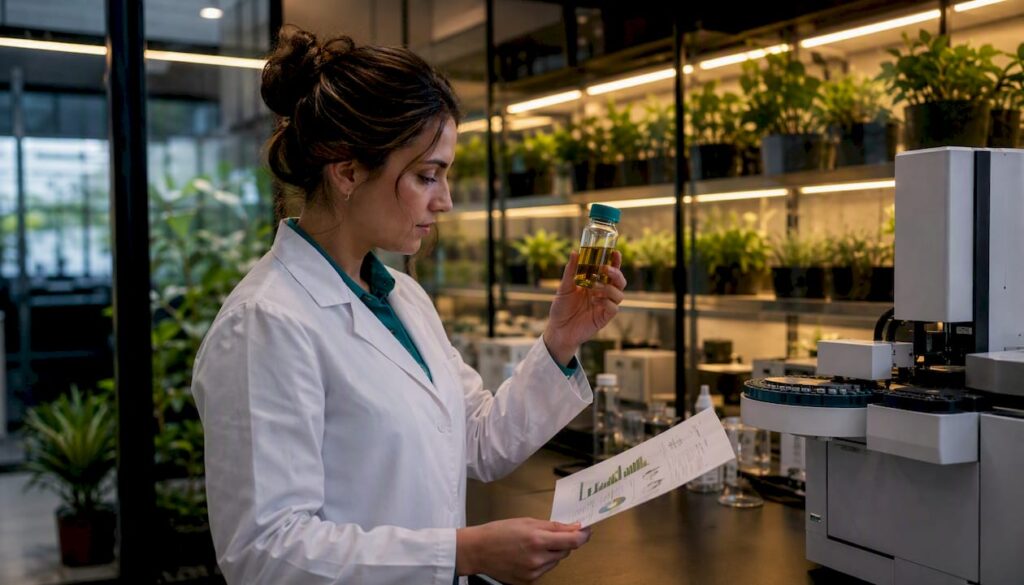
The standard technique for quantifying terpenes in cannabis is gas chromatography coupled with mass spectrometry (GC-MS) or its simpler variant, GC-FID (flame ionisation detector). The reason HPLC (high-performance liquid chromatography) is not used for terpenes is straightforward: terpenes are volatile compounds that separate better in the gas phase. HPLC is the standard technique for cannabinoids, not for terpenes.
In GC-MS, the sample is vaporised, the compounds are separated according to their boiling point and affinity for the column, and the mass spectrometer identifies each molecule by its fragmentation pattern. The result is a chromatogram with peaks corresponding to each terpene, quantified as a percentage of dry weight or in mg/g.
What to look for in a terpene COA
A reliable certificate of analysis (COA) for terpenes should include:
- List of individual terpenes with their percentages or concentrations (not just “total terpenes”).
- Limits of detection and quantification (LOD/LOQ) for each compound; without this, you can’t tell whether a “0%” means a genuine absence or simply that the laboratory didn’t detect it.
- Date of extraction and analysis, since terpenes degrade over time and the sample analysed may not reflect the current product.
- Batch number for traceability.
- Sample conditions: whether it was analysed fresh, dried or after curing, because the values vary significantly.
- Name and accreditation of the laboratory (ISO 17025 is the benchmark standard for testing laboratories).
| COA item | Why it matters |
|---|---|
| Individual terpenes listed | Allows you to compare profiles between batches and varieties |
| Declared LOD/LOQ | Check that the zeros are real, not equipment limits |
| Analysis date | Terpenes degrade; an old COA may not be representative |
| Batch number | Lets you make a claim if the product doesn’t match the analysis |
| ISO 17025 accreditation | Ensures the laboratory follows validated procedures |
Pro tip: Be wary of COAs that only show “total terpenes” with no breakdown by compound. That figure tells you nothing useful about the aroma profile or the expected effects.
How to use terpene profiles to choose a variety
Choosing a variety by its terpene profile is more precise than going by the commercial name or the «indica/sativa» label. Here is a step-by-step process that works whether you are a grower or a consumer.
-
Define your goal. Are you after evening relaxation, energy for the day, pain relief or reduced anxiety? Each goal has priority terpenes: myrcene and linalool for relaxation; limonene and α-pinene for energy; β-caryophyllene for inflammation and anxiety.
-
Check the COA. Look for the dominant terpene and the next two or three in concentration. The profile is defined by the combination, not by a single compound. A variety with limonene at 0.8 % and linalool at 0.5 % will have a different character from another with the same percentages but myrcene at 1.2 % as the dominant one.
-
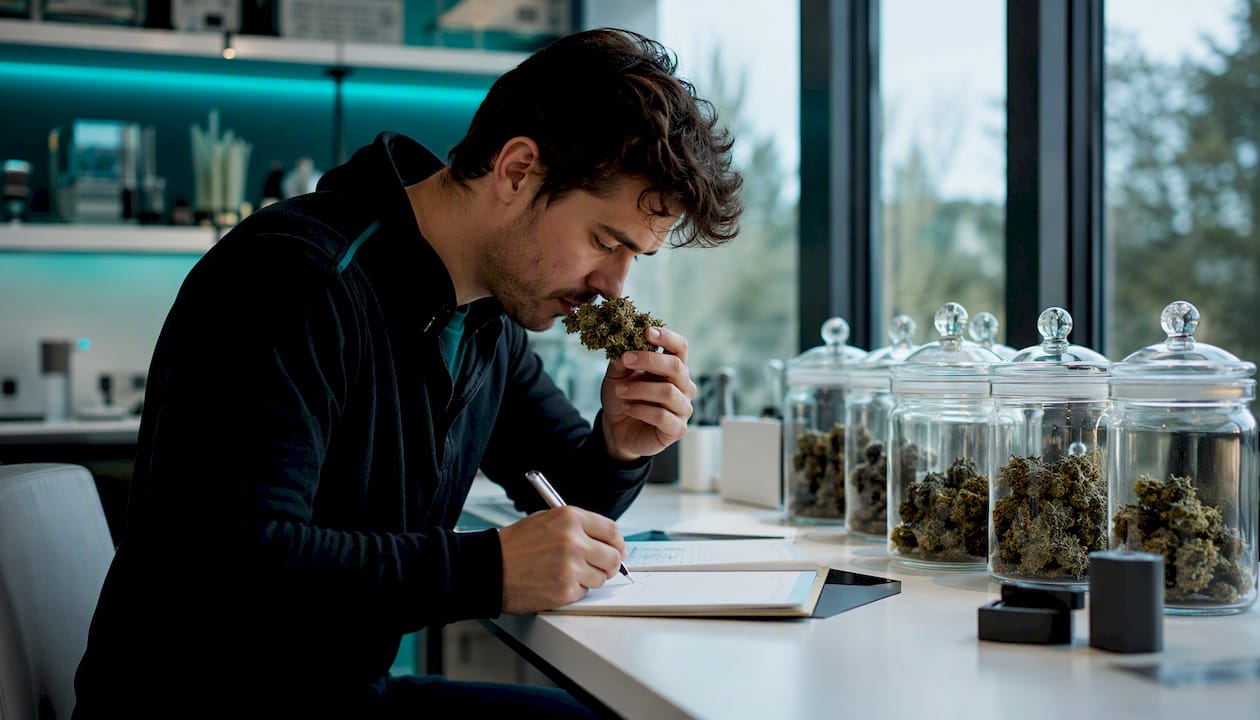
Smell the sample before consuming it. Your nose is a natural terpene detector. If the aroma is pleasant and fits your goal (citrus for energy, floral for calm), it’s a good sign that the profile suits you.
-
Adjust your vaporising temperature. Terpenes have different boiling points: myrcene ≈ 166 °C, limonene ≈ 176 °C. Vaporising at lower temperatures extracts more monoterpenes and fewer cannabinoids; raising the temperature gets you more THC but you may lose part of the aromatic profile. Terpene profiles for vaporisers are a useful resource for fine-tuning this practice.
-
Keep a record of your observations. Note down the variety, the batch, the dominant terpene and how you felt. With three or four entries you can already identify personal patterns that no COA can predict for you.
- For growers: the expression of the terpene profile depends as much on genetics and phenotype as on growing conditions. Two plants from the same seed can have different profiles if they grow in different environments.
- For consumers: if you don’t have access to a COA, aroma is your best tool. A flower with no smell has hardly any terpenes, regardless of its THC.
Why do plants produce terpenes and which factors affect their expression?
Terpenes did not evolve to delight human consumers. Their ecological functions are defensive and reproductive: they repel herbivores and insects, attract pollinators and act as antimicrobial and antifungal agents that protect the plant against pathogens. That evolutionary pressure explains why cannabis produces such complex and variable terpene profiles.
From an agronomic point of view, several factors modulate terpene expression:
- Genetics: the genotype sets the ceiling for terpene production. Without the right genetic foundation, no growing technique will produce a rich profile. Knowing the characteristics of premium genetics is the first step towards ensuring a good profile.
- Photoperiod and light intensity: greater exposure to UV light in the final weeks of flowering stimulates the production of trichomes and, with them, of terpenes.
- Controlled stress: moderate water deficit in the final weeks, low night-time temperatures and reduced nutrients at the end of the cycle can increase terpene concentration.
- Harvest timing: harvesting at the optimum point of trichome maturity preserves the full terpene profile. The maturity of the trichomes is the most reliable indicator for deciding when to cut.
- Drying and curing: terpenes are volatile and are lost with fast drying or at high temperatures. Slow drying (7–14 days at 15–20 °C and 50–60 % relative humidity) and curing in airtight containers for 4–8 weeks are the practices that best preserve the aromatic profile.
- Storage: low temperature, darkness and absence of oxygen slow down terpene degradation. Sesquiterpenes such as β-caryophyllene are more stable than monoterpenes against prolonged oxidation.
Applied perspective: terpenes as modulators in genetics selection
At Bluedoggenetics we apply this logic directly when selecting our catalogue. When we assess a genetic line, the terpene profile declared by the seed bank is one of the entry criteria, not a secondary detail. A variety with 22 % THC but a poor terpene profile, or one that is inconsistent between batches, does not give the grower the sensory experience or the consistency of effects they are looking for.
The practices we recommend based on experimental evidence and a review of the available literature:
- Minimum curing of 4 weeks in airtight glass jars, with daily burping during the first week to release moisture without losing terpenes.
- Curing temperature between 18 °C and 21 °C; above 25 °C the evaporation of monoterpenes speeds up noticeably.
- Handle after harvest with gloves and avoid prolonged exposure to direct light, as UV light degrades terpenes and cannabinoids simultaneously.
- Batch record and analysis date on each COA so you can compare how the profile evolves between harvests.
Robust preclinical evidence supports selecting by terpene profile, although clinical trials in humans remain the missing link for confirming specific mechanisms with precision.
Quick glossary of terpene terms
- Terpene: a volatile organic compound derived from isoprene, synthesised in the glandular trichomes of cannabis. Responsible for aroma and with potential to modulate effects.
- Terpenoid: a chemically modified terpene (oxidised, cyclised). In practice, the term “terpene” usually covers both.
- Monoterpene: a 10-carbon terpene (two isoprene units). High volatility, low boiling points. Examples: myrcene, limonene, linalool, α-pinene.
- Sesquiterpene: a 15-carbon terpene (three isoprene units). More stable and less volatile than monoterpenes. Examples: β-caryophyllene, humulene.
- Entourage effect: a hypothesis according to which cannabinoids and terpenes act synergistically, producing effects greater than those of any single compound on its own.
- Chemotype: cannabis variety defined by its chemical composition (cannabinoids and terpenes) rather than by its morphology or commercial name.
- COA (certificate of analysis): a document issued by an accredited laboratory that details the chemical composition of a sample, including cannabinoids and terpenes with their concentrations.
- GC-MS: gas chromatography coupled with mass spectrometry. A standard technique for identifying and quantifying terpenes in cannabis.
- Bioenhancement: the ability of certain terpenes to increase the bioavailability of cannabinoids, making it easier for them to be absorbed and reach the central nervous system.
- Myrcene: the dominant monoterpene in many modern varieties; earthy/mango aroma, tends to be sedating.
- β-Caryophyllene: a sesquiterpene with direct action on the CB2 receptor; spicy/peppery aroma, with documented anti-inflammatory properties.
Key points
Cannabis terpenes are not a secondary aromatic detail: they are active modulators that, together with THC and CBD, determine the complete experience of each variety.
| Point | Details |
|---|---|
| Terpenes modulate effects | The terpene profile sets apart varieties with similar THC; myrcene tends to sedate, limonene to energise. |
| β-Caryophyllene is unique | It is the only terpene with proven direct action on the CB2 receptor, with anti-inflammatory properties. |
| Clinical evidence is limited | The preclinical evidence is robust, but human trials remain scarce; avoid absolute claims. |
| Curing preserves the profile | Slow drying (7–14 days) and airtight curing (4–8 weeks) at 18–21 °C are critical for preserving terpenes. |
| Bluedoggenetics selects by profile | The catalogue prioritises varieties with stated terpene profiles that are consistent between batches. |
What really matters when we talk about terpenes
There is a trend in the industry to present terpenes as the solution to everything: myrcene puts you to sleep, limonene cheers you up, β-caryophyllene cures inflammation. The reality is more nuanced and, in my opinion, more interesting.
What the data clearly show is that the terpene profile matters, but not universally or predictably for every person. The study with α-pinene and THC in humans is a good example: the hypothesis was reasonable, animal models supported it, and yet the result in people was null for that specific pair. That doesn’t invalidate the entourage effect, but it does force us to be more precise: not all terpenes interact in the same way with all cannabinoids, nor in all people, nor at all doses.
What I do find solid, and what is often underestimated, is the role of the terpene profile as a quality criterion for growing. A flower with well-preserved terpenes is a well-grown, well-cured flower. An intense, complex aroma is not just a sensory pleasure: it is evidence that the trichomes are intact and that post-harvest was done with care. When you assess a variety, your nose is your first laboratory.
Selecting by chemotype, rather than by commercial name or botanical classification, is the approach that makes the most sense for both consumers and growers who want consistent results.
Seeds with defined terpene profiles at Bluedoggenetics
If you have made it this far, you now have the tools to choose a variety with real judgement. Bluedoggenetics selects its catalogue by prioritising genetics with documented terpene profiles that are consistent between batches, because knowing which terpenes dominate a variety is just as important as knowing its THC.
For growers looking for a relaxing, earthy profile, myrcene-dominant varieties are the natural starting point. For those who prefer a more active, citrusy effect, genetics with limonene or α-pinene as their main terpenes offer that direction. All the seeds in the catalogue include genetic information from the originating seed bank, which lets you cross-check against COAs when the seed bank publishes them.
Take a look at the full catalogue of premium seeds and filter by the profile that fits your growing goal. If you have any doubts about which variety best suits your space or your experience as a grower, the Bluedoggenetics team will answer your questions before you complete your order. You can add your seeds directly from the basket, with discreet shipping and order tracking included.
Useful sources and recommended reading
-
The Individual and Interactive Effects of Alpha-Pinene and Delta-9-THC in Healthy Adults (PMC, 2025): the first controlled study in humans to evaluate inhaled α-pinene and THC; it establishes a reference methodology for future trials on the entourage effect.
-
Taming THC: potential cannabis synergy and phytocannabinoid-terpenoid entourage effects (Russo, 2011): a seminal review that described the potential mechanisms of the entourage effect and the pharmacological effects of key terpenes; the conceptual foundation of the field.
-
Review on terpenes and pharmacological modulators (PMC, 2024): a recent review that summarises the state of the preclinical and clinical evidence, and underlines the need for more human trials.
-
Terpene bioenhancement and bioavailability modulation (Nature Scientific Reports, 2021): a study on the role of terpenes as modulators of cannabinoid bioavailability; experimental support for the concept of bioenhancement.
-
Terpenes and the “entourage effect” (Project CBD, in Spanish): an accessible explanation of the entourage effect with pharmacological and therapeutic examples; useful as an introduction for consumers.
-
Terpenos del cannabis: qué son y por qué modifican el efecto (Revista THC): an article in Spanish with data on cannabimimetic behaviours, curing practices and analysis of consumption sessions.
-
Entourage effect: the terpenes that boost THC according to a study (Revista THC): summary of the cell study on synergistic interactions between specific terpenes and CB1/CB2 receptors.
-
Cannabis medicinal y sus terpenos (Receta Cannabis): a Spanish-language resource on the role of β-caryophyllene as a CB2 ligand and on telling varieties apart by terpene profile.
-
Terpenes, the “secret” ingredient behind aroma and therapeutic properties (Dinafem): an article aimed at growers on the synthesis, preservation and properties of the main cannabis terpenes.