


Hybrid vigour in cannabis, technically known as heterosis, is the genetic phenomenon whereby the first generation of a cross between two distinct parental lines produces plants that are more vigorous, uniform and productive than either of their parents. This concept is the basis of modern F1 seeds and explains why certain cultivars consistently outperform traditional varieties in size, yield and stability. If you grow cannabis and want to understand what lies behind the “F1” and “hybrid” labels, this article gives you the complete answer.
In short:
- Hybrid vigour (heterosis) is a genetic phenomenon that produces F1 plants that are more vigorous, uniform and productive than their parents.
- This vigour is concentrated in the F1 generation and gradually fades in F2 and later generations due to Mendelian segregation.
- Well-designed F1 hybrids can reach up to 2 kg of flowers per square metre under professional growing conditions.
- Not everything labelled “hybrid” on the market is a true F1: real hybrid vigour depends on genetically divergent, stabilised parent lines.
- The cannabinoid and terpene profile is independent of hybrid vigour, so it is worth verifying the genetic origin before buying.
What is hybrid vigour in cannabis, explained in genetic terms?
Hybrid vigour, or heterosis, is defined as the increase in yield, size and adaptability that appears in the first filial generation (F1) when two genetically distinct, stable parent lines are crossed. It is neither magic nor marketing. It is the direct result of allelic complementation: when two plants with different genotypes are crossed, the offspring inherit functional versions of genes that in the parents could have been compromised by recessive alleles.
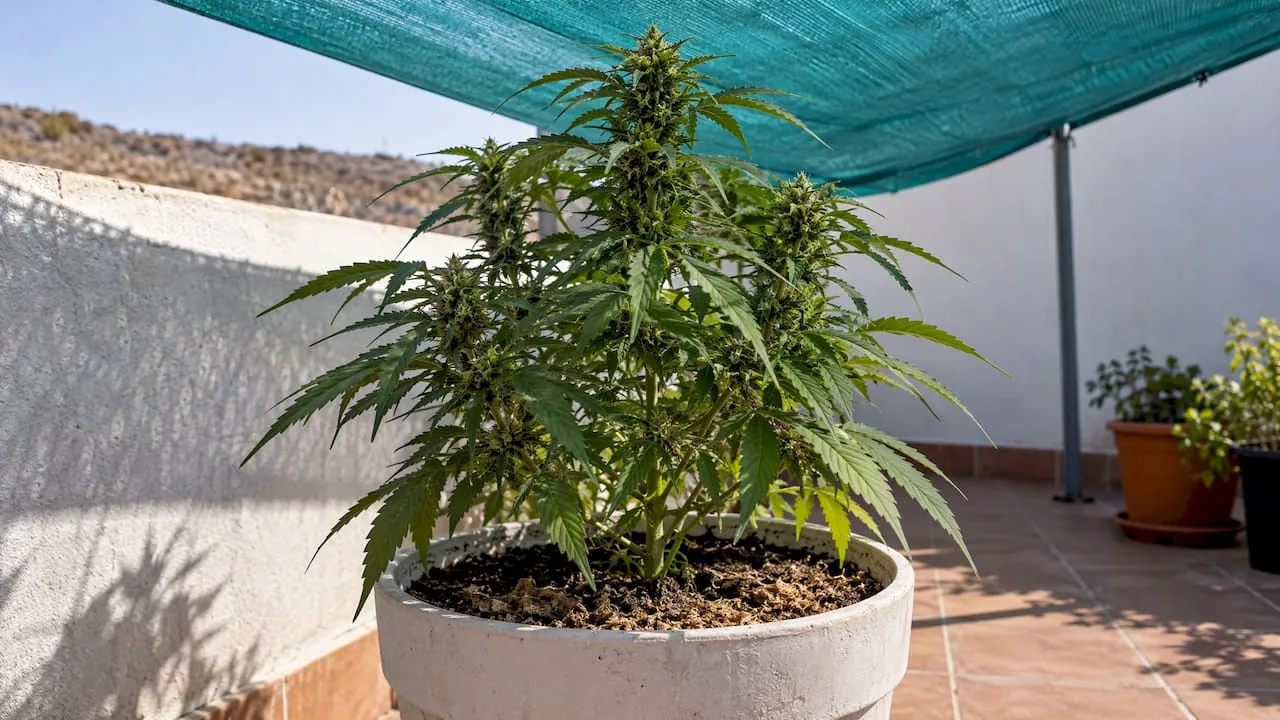
In cannabis, this mechanism produces F1 plants with predictable, superior characteristics. F1 seeds produce plants that are typically larger, more vigorous and more uniform than either parent thanks to heterosis, although this vigour declines in F2 due to genetic segregation. This means that if you want real uniformity in your grow, the generation you sow matters as much as the genetics you choose.
Typical results in cannabis F1 plants include:
- Faster vegetative growth rate from germination
- Phenotypic uniformity between plants from the same batch
- Greater resistance to environmental stress, pests and diseases
- Potentially higher yield of flowers and resin
- More predictable growing cycles, which makes planning easier
💡 Pro tip: Don’t confuse hybrid vigour with THC or CBD potency. Heterosis mainly affects growth and physical uniformity. The cannabinoid and terpene profile depends on the specific genetic selection of the parents.
F1, F2 and later generations: what is the real difference?
This is the question that confuses intermediate growers the most. The short answer is that hybrid vigour is concentrated almost exclusively in F1 and gradually dilutes in later generations.
When you cross two F1 plants with each other to obtain F2, Mendelian segregation comes into play. In F2 there is greater phenotypic variability, with classic segregation patterns such as 25%/50%/25% in traits controlled by a single gene. This means that in a batch of F2 seeds, some plants will express outstanding traits, others will be mediocre, and most will fall somewhere in between. The uniformity that defines F1 disappears.
| Generation | Uniformity | Relative vigour | Recommended Use |
|---|---|---|---|
| F1 | Very high | Maximum | Production growing |
| F2 | Medium to low | Reduced | Phenotype selection |
| F3 and later | Variable | Variable | Line stabilisation |
| IBL lines | High (stabilised) | Moderate | Advanced breeding |

For home and commercial growers looking for consistent results, F1s are preferred for uniform crops, while F2s are mainly used in breeding to discover and select interesting new phenotypes. This doesn’t mean F2s are inferior in every context. If you’re a breeder looking to isolate a specific phenotype, the variability of F2 is exactly what you need.
💡 Pro tip: If you buy seeds from a seed bank and the pack doesn’t clearly state whether they are true F1 or F2, ask directly. Many commercial seeds labelled as “hybrids” are actually F2 or later generations, with less guaranteed uniformity.
Practical benefits of hybrid vigour in your grow
The benefits of hybrid cannabis are not abstract. They translate into concrete results that you can measure in every growing cycle.
- Bigger, more productive plants. Well-designed F1 hybrids can reach yields that traditional varieties cannot match. F1 hybrids report up to 2 kg of flowers per square metre in professional growing under optimal conditions. That figure represents a significant leap compared with conventional varieties, which average between 400 and 700 grams per square metre indoors.
- Uniformity that simplifies management. When all your plants are the same size, flower at the same pace and have the same structure, training (LST, SCROG, topping) becomes much more efficient. You don’t waste time adjusting each plant individually.
- Predictable cycles. The genetic stability of F1s reduces surprises. You know when it will flower, how tall it will grow and what to expect at harvest. For commercial growing, this predictability is the difference between profit and loss.
- Greater resilience. Vigour in cannabis plants extends to tolerance of adverse conditions. A concrete example: the 9001 variety from Kame Seeds, designed for the Argentine climate, shows how well-designed hybrid genetics achieve high resistance to fungi and notable production outdoors under demanding climate conditions.
- Best effort-to-result ratio. For home growers with limited space, every square metre counts. Investing in F1 seeds of proven quality maximises the return of every cycle.
How do you select and make the most of hybrid vigour in your grow?
Knowing what hybrid vigour is is only half the job. The other half is knowing how to choose the right seeds and handle them to get the most out of their potential.
To identify authentic, quality F1 seeds, consider these criteria:
- Verifiable origin. Buy from seed banks or distributors that clearly document the crossing process and the parent lines used. Vigour depends on the cross between well-chosen parent lines, and not every hybrid is a true F1 with maximum vigour.
- Batch uniformity. If you can see reviews or reports from other growers, look for comments on consistency between plants from the same pack.
- Documented genetic stability. Serious seed banks publish data on generations and selection processes. If that information doesn’t exist, treat the seeds as F2 or of undetermined generation.
To boost vigour once your plants are under way, nutrient management is key. F1 plants respond especially well to balanced feeding, with available nitrogen in the vegetative stage and elevated phosphorus/potassium in flowering. Early training, such as LST or topping in the third or fourth week of vegetative growth, takes advantage of the accelerated growth characteristic of heterosis.
You can also explore the types of hybrid cannabis available to understand how different genetic combinations affect the final profile of your harvest.

💡 Pro tip: Combining hybrid vigour with a terpene profile that suits your goals is the smartest strategy. An F1 with maximum heterosis but with an aromatic profile that doesn’t interest you is not the best choice. Look for a balance between yield and sensory quality.
Is “hybrid” in marketing the same as hybrid vigour?
No. This confusion is one of the most frequent and costly for growers who buy based on labels.
In botany and genetics, “hybrid” simply describes any plant that results from a cross between two different varieties or species. Practically all modern cannabis is technically a hybrid in this broad sense. But that doesn’t mean all those plants express heterosis or real hybrid vigour.
The term “hybrid” is a broad category and does not in itself indicate hybrid vigour. It depends on whether the cross was between genetically divergent, stabilised parent lines. A casual cross between two plants of unknown generation can be called a “hybrid” in a seed bank’s catalogue, but it will not produce the same level of heterosis as an F1 developed over multiple generations with IBL (inbred lines).
Besides, the cannabinoid and terpene profile determines the effect more than the plant’s botanical label. This means that a “hybrid” with aggressive marketing can have a mediocre terpene profile and ordinary physical vigour, while a less-promoted variety with genuine F1 genetics can far outperform it in yield and quality.
To read seed bank labels correctly, bear in mind:
- If the seed bank doesn’t explicitly mention “F1” or “first filial generation”, assume it isn’t one.
- Terms such as “Indica/Sativa hybrid” describe the balance of effects, not the genetic generation.
- Look for information on the parent lines. Reputable seed banks document them.
- Consult guides such as the one on premium cannabis genetics to learn how to tell real quality from marketing.
Key points
Real hybrid vigour in cannabis only occurs in F1 crosses between genetically distinct, stabilised parent lines, and it dilutes with each later generation.
| Point | Details |
|---|---|
| Heterosis occurs in F1 | Only the first filial generation expresses maximum vigour; F2 and later lose uniformity. |
| F1 is not a synonym for “hybrid” | Most commercial cannabis is hybrid, but few are true F1s with real heterosis. |
| Higher potential yield | Well-designed F1 hybrids report up to 2 kg/m² under professional conditions. |
| The terpene profile is independent | Physical vigour does not guarantee potency or aroma; both depend on specific genetic selection. |
| Verifying the origin is key | Buying from seed banks that document parent lines and generations protects your investment. |
What years of growing have taught me about hybrid vigour
When I started working with genuine F1 seeds, the difference was immediate and hard to ignore. The plants got going faster, grew more uniformly and managing the space became simpler in a way I hadn’t experienced with conventional varieties. But I also learnt a hard lesson: not everything sold as a “premium hybrid” lives up to that promise.
What I have found hardest to get across to new growers is that hybrid vigour is not an automatic guarantee of overall quality. It is an advantage in growth and uniformity. If the parents have a poor terpene profile or unstable genetics, the resulting F1 will grow vigorously but will not necessarily produce flowers of superior quality. Heterosis amplifies what is already in the genetics; it does not correct deficiencies.
My practical recommendation for 2026: prioritise seed banks that publish real information about their parent lines and selection processes. The market is maturing and demanding growers no longer settle for empty labels. If a seed bank cannot tell you whether its seeds are true F1 or F2, that is enough information to make your decision.
Seeds with real hybrid vigour at Bluedoggenetics
If, after understanding the genetics behind hybrid vigour, you want to apply it to your next grow, Bluedoggenetics has what you need. The catalogue includes feminised and autoflowering seeds selected for their genetic stability, uniformity and proven performance. Every available variety is curated so that demanding growers, both home and commercial, get exactly what they’re looking for: predictable, productive plants of consistent quality. Shipping is discreet, order tracking is transparent, and the Bluedoggenetics team is available to help you choose the genetics that best suit your space and growing goals.
FAQ
What is hybrid vigour in cannabis?
Hybrid vigour, or heterosis, is the genetic phenomenon whereby the first generation (F1) of a cross between two different parent lines produces plants that are more vigorous, uniform and productive than their parents. It shows up mainly in growth, size and phenotypic uniformity.
Why does hybrid vigour decline in F2?
When two F1 plants are crossed to produce F2, Mendelian segregation redistributes the alleles and breaks the genetic complementation that generated heterosis. The result is greater phenotypic variability and less uniformity between plants of the same batch.
Do all cannabis hybrids have hybrid vigour?
No. “Hybrid” is a broad category that describes any cross between different varieties, but true hybrid vigour requires a cross between genetically divergent, stabilised parent lines. Most commercial cannabis labelled as “hybrid” is not a true F1.
How much can an F1 cannabis hybrid yield?
Under professional growing conditions and with optimal parameters, well-designed F1 hybrids report up to 2 kg of flowers per square metre. In home growing with good management, yields are significantly higher than those of conventional varieties.
How do I identify authentic F1 seeds when buying?
Look for seed banks that explicitly document the parent lines and the crossing process. If the pack only says “Indica/Sativa hybrid” without mentioning F1 or the original lines, it is likely they are not true F1s. Check a seed selection guide to verify the quality criteria before buying.