


Sexing cannabis plants is the process of identifying whether a plant is male, female or hermaphrodite, and it is the most important decision you make before flowering. Without this step, a single male plant can pollinate your whole crop and turn dense, resinous buds into clusters full of seeds. Understanding how sexing cannabis plants works and when to act makes the difference between a quality harvest and weeks of wasted work.
How does sexing cannabis plants work?
Sexing cannabis plants consists of observing the reproductive structures that appear at the nodes of the plant, generally between the third and sixth week after germination. These structures, called pre-flowers, are the first visual indicator of sex before the plant enters full flowering. Identifying them correctly and in time is the basis of any successful sinsemilla grow.
Female plants develop pistils with white, thread-like stigmas that protrude from a green calyx. Male plants, on the other hand, form small pollen sacs grouped in clusters that resemble tiny grapes. These morphological differences make it possible to tell the sex visually from around 3 to 6 weeks, although the exact timing varies depending on the genetics and environmental conditions.
Males usually reveal their sex before females. Males show their sex earlier than females and release pollen in the later stages of flowering, progressing gradually from pre-flowers to mass pollination. This gives you a window of time to act before the damage becomes irreversible.
Key visual signs for identifying sex:
- Female: calyx with two white pistils, dense buds, abundant trichome production
- Male: spherical pollen sacs at the nodes, sturdier and more upright stems, lower trichome density
- Hermaphrodite: the simultaneous presence of pollen sacs and pistils on the same plant, usually due to stress
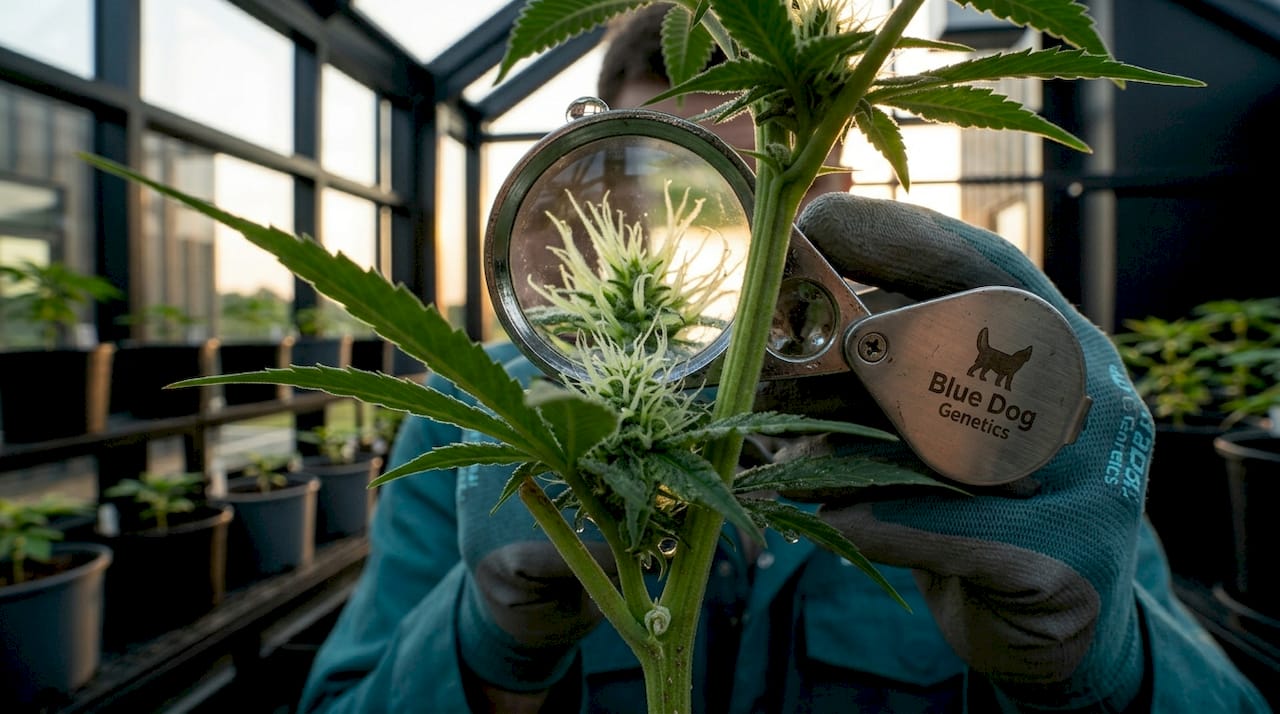
💡 Pro tip: Use a 30x magnifying glass or a handheld microscope to examine the nodes from week 3. Pre-flowers are small and easy to mistake for stipules if you’re not experienced.
What genetically determines sex in cannabis?
The genetics of sex in cannabis is more complex than it seems. For years it was assumed that the XX/XY chromosome system explained everything, but current science shows a more sophisticated picture. Three Monoecy1 genes, identified as CsREM16, lncREM16 and CsKAN4, directly influence sexual expression and the development of male, female or mixed flowers. This means the genotype is the blueprint, but the environment and gene regulation are the builders.
Hermaphroditism in cannabis is not a random accident. Sex determination does not depend only on the Y chromosome, but on the interaction between genetics and environmental signals, which explains why plants subjected to severe stress, such as sudden light changes, extreme heat or physical damage, can develop flowers of both sexes. A hermaphrodite plant is as problematic as a male: its pollen sacs can pollinate the entire crop.
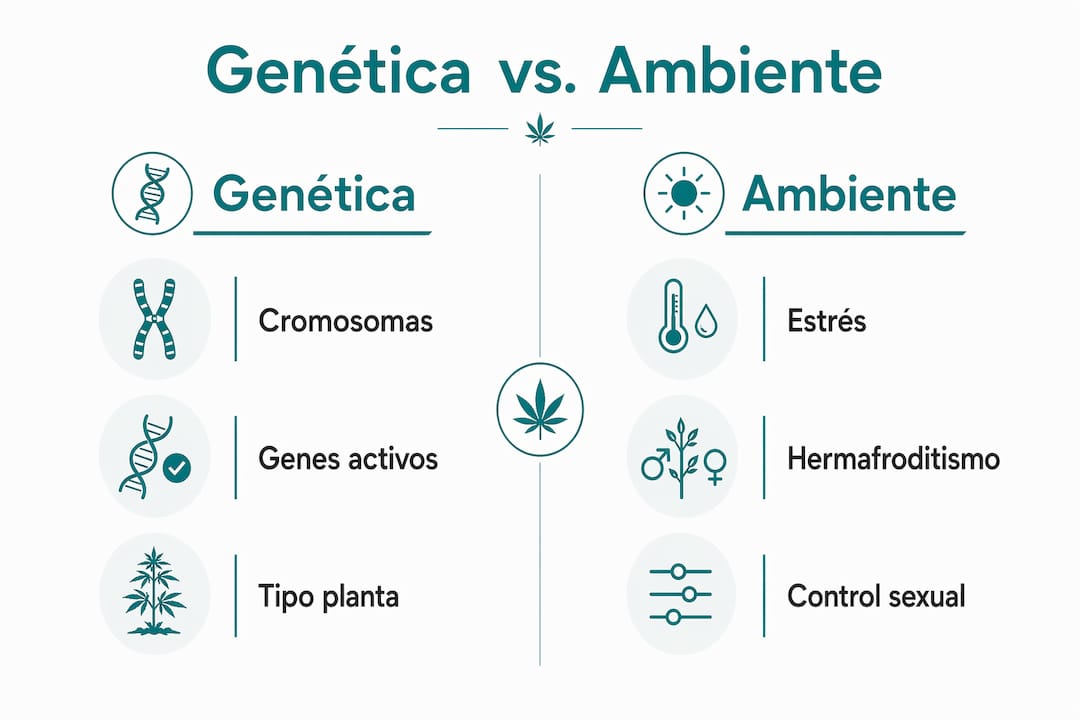
| Plant type | Chromosomes | Active genes | Result |
|---|---|---|---|
| Female | XX | CsKAN4 active, CsREM16 suppressed | Pistils, buds, resin |
| Male | XY | CsREM16 active, CsKAN4 suppressed | Pollen sacs, without significant resin |
| Hermaphrodite | XX or XY | Mixed expression due to stress or genetics | Flowers of both sexes, risk of pollination |
The practical implication for the grower is straightforward: choosing stable genetics and managing the environment consistently drastically reduces the appearance of hermaphrodites. Premium genetics have been selected precisely to minimise this instability.
💡 Pro tip: If you spot a hermaphrodite, remove it from the growing space immediately. Do not use it as a mother plant or keep its seeds, as the tendency towards hermaphroditism has a genetic basis and is passed on to the offspring.
When and how should you sex plants so you don’t lose production?
The timing of sexing directly determines how much control you have over your harvest. Acting late can mean unwanted pollination, buds full of seeds and a drastic drop in cannabinoid concentration. Acting in time gives you options: remove males, keep them for selective pollination or simply protect your females.
The optimal process follows these steps:
- Weeks 3 to 4 in vegetative: examine the nodes with a magnifying glass. Pre-flowers may already be visible in fast-flowering varieties.
- Switch to a 12/12 photoperiod: if you grow indoors, this is the moment when sexual differentiation speeds up. Check your plants every two days.
- Week 1 to 2 of flowering: most plants reveal their sex clearly. Remove the males before the pollen sacs mature.
- If you want to keep a male for seed production: keep the cutting in vegetative growth with 18 hours of light. Keeping a male cutting in vegetative growth prevents early pollen production and lets you synchronise its flowering with the females when you need to.
- Selective pollination: apply the male’s first pollen to selected female pre-flowers close to the start of flowering of the rest of the crop. The technique of selective pollination with the male’s first pollen achieves viable seed production without compromising the rest of the buds.
The risk of not acting in time is real: if the male releases pollen before you spot it, the nearby females will produce seeds instead of resin. This not only reduces the weight and quality of the bud, but also lowers the cannabinoid concentration throughout the whole plant.
What is the best method for sexing cannabis?
Growers have several options for identifying the sex of their plants, and each has advantages depending on the type of grow and the level of experience.
Visual observation of pre-flowers is the most accessible method and the one most growers use. It needs no special equipment beyond a magnifying glass, and with practice it becomes quick and reliable. Its only limitation is that it depends on the pre-flowers being visible, which can take longer with some genetics.
Molecular methods such as PCR tests make it possible to identify a seedling’s sex before pre-flowers appear, even at the germinated seed stage. They are accurate and useful for breeding projects or large-scale commercial growing, but their cost and accessibility make them impractical for the average home grower.
Using cuttings in the vegetative stage is a very useful intermediate technique. You take a cutting from each plant, put it under 12/12 to induce flowering, and within two weeks you know the sex without having put the mother plant at risk. This is especially valuable when you’re working with regular seeds of high genetic value.
| Method | Cost | Speed | Accuracy | Recommended for |
|---|---|---|---|---|
| Visual observation | Very low | Medium (weeks 3 to 6) | High with practice | All growers |
| Cutting at 12/12 | Low | Medium (2 weeks) | Very high | Valuable regular seeds |
| Molecular PCR | High | Fast (days) | Very high | Commercial or breeding projects |
For most growers, visual observation combined with the cutting technique covers 95% of cases. Consulting a seed selection guide before you start also helps you choose genetics with stable sexual expression.
What impact does correct sexing have on the quality of the grow?
The impact of sexing on the quality of the final product is measurable and significant. Female inflorescences concentrate 16.88 times more CBD than male ones, linked to greater trichome activity and resin biosynthetic genes. That difference is not marginal: it is the difference between a quality medicinal or recreational grow and a low-yielding one.
The biological reason is clear. Unpollinated females concentrate all their metabolic energy on producing resin, trichomes and cannabinoids to attract pollen that never arrives. This frustrated reproductive strategy is exactly what the grower wants to take advantage of. The higher concentrations of cannabinoids in females reinforce the practice of removing males early to maximise the quality and yield of resin and buds.
“A single male not detected in time can pollinate dozens of females within days, turning weeks of work into a crop full of seeds with half the cannabinoid potential.”
For commercial grows, the cost of a sexing error multiplies. For the home grower, the impact is just as real: less potency, less aroma, less yield per square metre. The density and colour of trichomes also help you assess the plant’s maturity and plan the harvest precisely, something that is only possible with well-managed sinsemilla females.
Key points
Correct and timely sexing of cannabis plants is the practice that separates quality growing from mediocre growing, and it depends on precise observation, genetic knowledge and acting in good time.
| Point | Details |
|---|---|
| Early visual identification | Examine pre-flowers with a magnifier from week 3 so you can act before pollen is released. |
| Complex sex genetics | The genes CsREM16, lncREM16 and CsKAN4 regulate sex beyond the XX/XY system. |
| Impact on cannabinoids | Females produce up to 16.88 times more CBD than males, which justifies removing them early. |
| Synchronisation for seed production | Keeping male cuttings in vegetative growth allows selective pollination without compromising the crop. |
| Stress-induced hermaphroditism | An unstable environment activates genes that produce mixed flowers; environmental consistency prevents this. |
What I learned after losing an entire grow to a male
There was a cycle when I trusted my eye too much and didn’t use a loupe until the second week of flowering. By then, a male that had gone unnoticed had already released enough pollen to seed half the space. The result was a crop with seeds in almost every bud and noticeably reduced potency. That mistake taught me more than any guide.
What I find hardest to watch in experienced growers is overconfidence when it comes to sexing. They think they’ve already mastered it and let their guard down. The problem is that hermaphroditism can appear in a plant that was perfectly female in previous cycles, especially if there was temperature stress or light interruptions. Constant observation isn’t just for beginners: it’s for everyone.
My most practical recommendation is this: if you’re working with regular seeds, always take cuttings before switching to 12/12 and sex them separately. That way you protect your mother plants and make informed decisions without time pressure. And if you want to reproduce a specific genetic, learn to handle the male’s first pollen with precision. Flowering synchronisation between male and female is as important as the genetic selection itself.
Combining what you know about genetics with what you observe while growing is what distinguishes a grower who improves from one who repeats the same mistakes. Sexing is not a formality. It’s the moment you decide what kind of harvest you’re going to have.
Grow without worrying about sexing: feminised seeds at Bluedoggenetics
If you want to remove the uncertainty of sexing right from the start, feminised and autoflowering seeds are the answer. They are genetically designed to produce female plants in more than 99% of cases, which means that every seed you germinate becomes a productive bud. At Bluedoggenetics you will find a curated catalogue of premium feminised varieties selected for genetic stability, potency and yield. If you are looking for proven genetics with discreet shipping and personal service, visit the Bluedoggenetics shop and choose the variety that best suits your space and growing goals.
FAQ
When can you identify the sex of a cannabis plant?
Sex can be identified visually between weeks 3 and 6 after germination, when the pre-flowers appear at the nodes. Males usually show their pollen sacs before females show their pistils.
What happens if I don’t remove the males in time?
A male that releases pollen can pollinate all the nearby females, causing them to produce seeds instead of resin. This drastically reduces the concentration of cannabinoids and the value of the final bud.
Do autoflowering plants also need sexing?
Feminised autoflowering varieties don’t require manual sexing because they are genetically designed to produce only females. Regular-seed autoflowering varieties can produce males and require the same identification process.
What is hermaphroditism in cannabis and how is it prevented?
Hermaphroditism happens when a plant develops flowers of both sexes, usually because of environmental stress such as light interruptions, extreme heat or physical damage. Keeping conditions stable and choosing genetics with a track record of stability are the best preventive measures.
Can you tell a seed’s sex before germinating it?
With molecular methods such as PCR tests it is possible to identify sex before germination, but they are expensive and not very accessible for the home grower. The practical alternative is to use certified feminised seeds.