

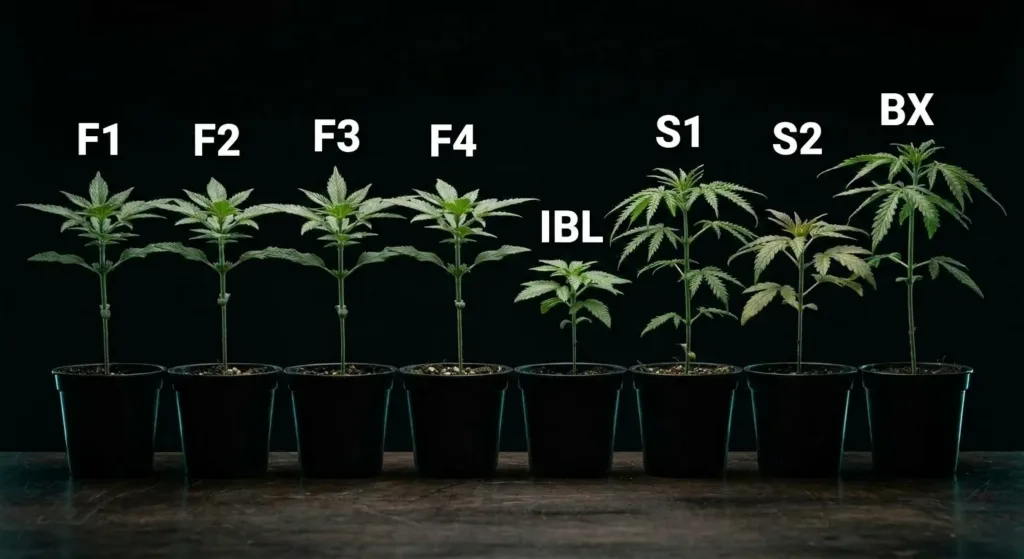
F1, F2, IBL, S1 and BX tell you how a cannabis seed was produced and, with that, how alike the plants will be. F1 is the first cross between two different parents; F2, the cross of two F1s; BX, a backcross to one of the parents; S1, a plant that pollinates itself (always feminised); and IBL, a line stabilised over many generations.
Here’s what each abbreviation means, which one to choose for what you’re after, and the catch almost nobody mentions: an ‘F1’ isn’t always uniform.
The basics: what these abbreviations tell you
Think of dogs. Two pedigree Labradors have puppies that look like photocopies: that’s a stable line (IBL). If you cross a Labrador with a Poodle, the puppies – the famous labradoodle F1s – come out fairly similar to each other. But if you cross two labradoodles (F2), the same litter has puppies with a Labrador coat, a Poodle coat and everything in between.
Cannabis works the same way. The ‘F’ comes from filial (offspring): F1 are the children, F2 the grandchildren. And the key is the parents: if they aren’t pure, the F1 already comes out varied. Try it:
Why an F1 comes out uniform and an F2 doesn’t
A single colour gene: A = purple flower (dominant), a = green flower.
Two pure lines: one only has AA (purple) and the other only aa (green). Press ‘Cross’. F1: all alike. Each daughter gets an A from one parent and an a from the other: all Aa, all purple. This is a true F1. F2: variety returns. Crossing two Aa F1s gives AA, Aa and aa in a 1:2:1 ratio. One in four comes out green. Two parents that are already hybrids (Aa), like almost all commercial strains. Press ‘Cross’. The ‘F1’ is already varied. It’s the first cross, but the parents weren’t pure: there are purple and green plants from the start. That’s why many ‘F1s’ on the market aren’t uniform. F2: just as varied. With hybrid parents, the letter F tells you the generation, not how alike the plants are.
What each abbreviation means
How each type is made
- Uniformity
- High, if the parents are stable lines
- What to expect
- Similar, vigorous plants
- Who it’s for
- Growers who want a predictable crop
- Watch out
- If you sow its seeds, the next generation (F2) won’t come out the same
- Uniformity
- Low
- What to expect
- Several phenotypes in the same pack
- Who it’s for
- Pheno hunters and breeders
- Watch out
- Sow several seeds to find the good one
- Uniformity
- Medium, rising with each BX
- What to expect
- Plants very similar to the recurrent parent
- Who it’s for
- Anyone wanting to recover a specific flavour or structure
- Watch out
- Inbreeding increases with every backcross
- Uniformity
- Medium: the daughters resemble the mother, but they aren’t clones
- What to expect
- Feminised seeds with traits of an elite mother
- Who it’s for
- Anyone wanting ‘their friend’s plant’ as a seed
- Watch out
- Slightly less vigour; watch for male flowers
- Uniformity
- Very high
- What to expect
- Near-identical plants, generation after generation
- Who it’s for
- Breeders and anyone wanting a pure classic strain
- Watch out
- Less vigour than an F1; in return, you can save its seeds
What Is an F1 in Cannabis?
F1 stands for ‘Filial 1’: the first generation of a cross between two different strains. For example, pure Afghan × pure Haze = Afghan x Haze F1. If both parents are stable, all the daughters get the same mix and come out very alike, with hybrid vigor: more strength, more resilience and higher yields than their parents.
Mind the label: almost all commercial strains are crosses of hybrids, so their ‘F1’ tells you the generation, not the uniformity. A different case is the F1 Fast Version line from Sweet Seeds: the first cross of an elite clone with an autoflowering line, giving a photoperiod plant that flowers sooner.
What Is an F2 in Cannabis?
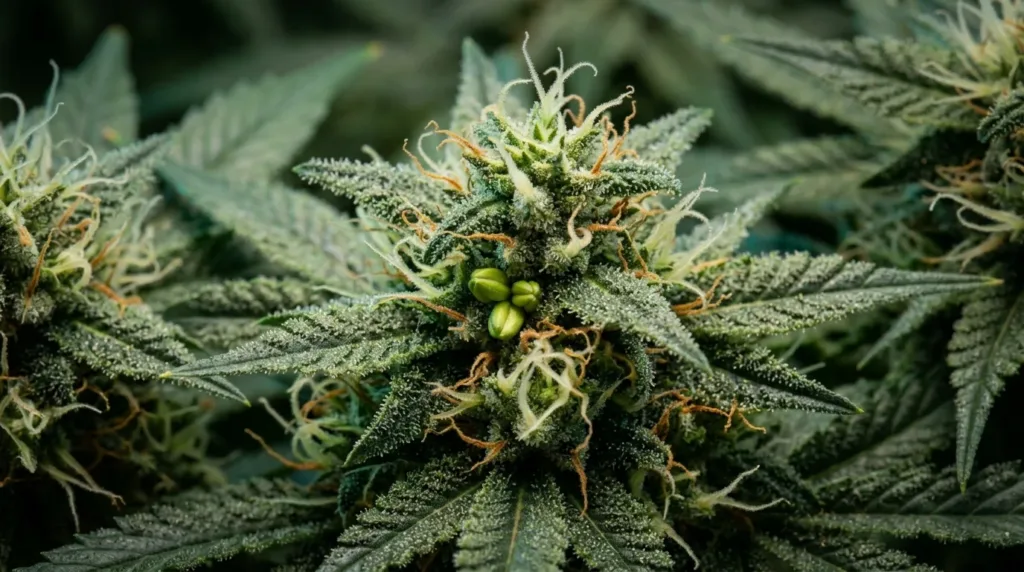
F2s (‘Filial 2’) come from crossing two F1 plants with each other: Afghan x Haze (F1) × Afghan x Haze (F1) = F2. The genes are reshuffled and new phenotypesappear: some plants lean towards Afghan, others towards Haze and others sit in between. It’s the starting point for creating new lines and a goldmine for anyone looking for a standout plant in flavour, potency or yield. In return, they’re less predictable.
What Does BX or Backcross Mean in Cannabis?
BX stands for backcross – a hybrid is crossed again with one of its parents (the ‘recurrent parent’) to reinforce its traits. Example: Cream Caramel x Skunk × Cream Caramel = BX1. It can be repeated (BX2, BX3…), and each time the result looks more like that parent. It’s the technique for recovering the flavour of a classic strain or fixing a specific structure. We explain it in depth in backcrossing explained for breeders.
What Is an IBL?
IBL stands for Inbred Line, i.e. a stabilised line: a strain crossed within its own lineage and selected over many generations (usually F5–F6 or more) until almost every plant comes out the same. It isn’t born from a chance cross, but from years of selection. That’s why it’s the ideal base for creating stable hybrids, and why you can save its seeds without the strain falling apart. An example in our shop: Original White Widow (IBL).
What Does S1 Mean?
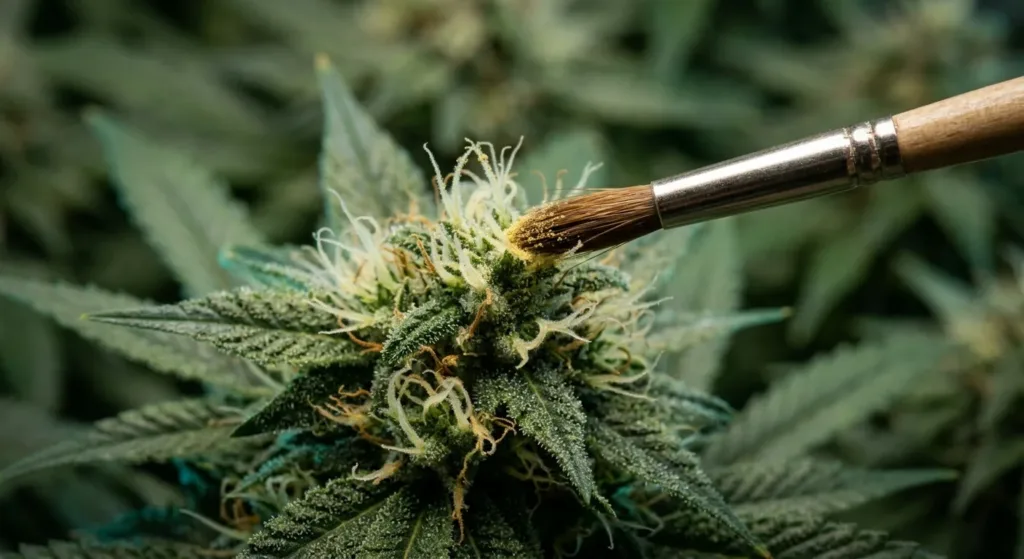
S1 stands for Selfed 1: a self-pollinated plant. A female is sprayed with silver thiosulfate (STS) or colloidal silver so it produces male flowers, and it is pollinated with its own pollen. All the seeds come out feminised and are very likely to resemble the mother, though they aren’t clones: the daughters vary. It’s how an elite clone is taken to seed, as in S.A.D. Sweet Afghani Delicious S1. If it’s repeated many times (S2, S3…), the plants lose vigour.
Comparison Table
| Type | How it’s made | Uniformity | Diversity | Who it’s for |
|---|---|---|---|---|
| F1 | First cross of two parents | High if the parents are stable; otherwise, medium | Low | Growers who want a predictable crop |
| F2 | Cross of two F1s | Low | High | Pheno hunting, breeding |
| BX | Backcross with one parent | Medium, rising with each BX | Medium | Fixing traits from a specific parent |
| IBL | Selection over 5–6+ generations | Very high | Very low | Breeders and pure classic strains |
| S1 | Self-pollination of a female | Medium | Low-medium | Reproduce an elite mother in seed form |
Which Genetics to Choose Based on Your Goals?
- Looking for ease and uniformity? Go for an IBL or an F1 from stable parents. If it’s your first grow, also check out our seeds for beginners.
- Do you want to find a unique phenotype? F2s are ideal for exploring: sow several.
- Fell in love with a strain and want to repeat it? Choose a BX or an S1.
- Want to make your own seeds? Start with regular seeds from an IBL: their daughters keep the strain.
Common mistakes
| Mistake | What happens | Better this way |
|---|---|---|
| Believing every ‘F1’ is uniform | Different plants in the same pack | Ask which parents it comes from |
| Saving seeds from an F1 | The next generation comes out varied (F2) | Save seeds from an IBL |
| Expecting clones from an S1 | The daughters are similar, but they vary | Sow several and select |
| Making S2, S3… without control | Less vigour, more weak plants | Cross with another line from time to time |
‘True’ F1s: what’s new in 2026
In farming, an F1 tomato or maize seed comes out identical because it comes from two pure lines. In cannabis this barely existed: making a pure line takes years. That’s changing. Royal Queen Seeds started creating its own IBLs in 2019 and in 2023 launched its first F1s by crossing them. And in February 2026, a team at Southern Cross University (Australia) published how to shorten the road: using single seed descent and sex reversal, it took several lines to six generations of inbreeding in about 18 months. Its five F1 hybrids came out more uniform than their parents and with hybrid vigour.
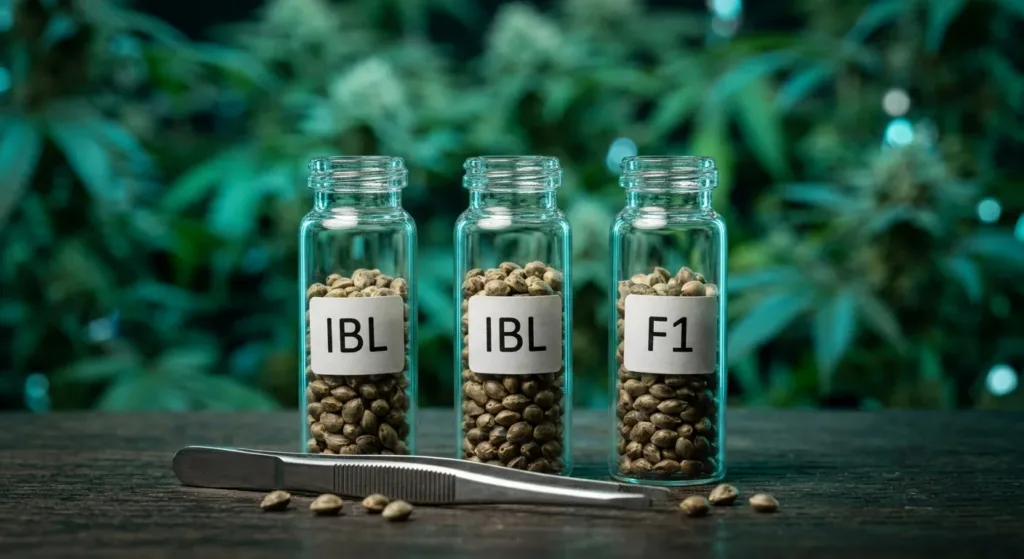
For you as a grower, it means ‘F1’ is starting to regain its traditional meaning: uniform, vigorous plants. Until then, the useful question is still the same: which parents does it come from?
For breeders: advanced level
Each generation fixes more
Theoretical average per generation, not counting the breeder’s selection.
% of the recurrent parent’s genetics. The F1 has 50%; each backcross splits the remaining half: 75% in BX1, 87.5% in BX2 and almost 94% in BX3. That’s why few seed banks go beyond BX3.% of genes already fixed (homozygosity). Starting from a hybrid plant, each self-pollination fixes half of what’s left: 50% in S1, 75% in S2… It takes 5–6 generations to pass 95%, roughly how long it takes to make an IBL.
Why a BX3 almost ‘is’ the parent
The F1 carries half of each parent. Each backcross adds half of that parent again, so the other parent’s share halves in every generation: 50% → 75% → 87.5% → 93.75%. These are averages: the breeder selects at every step and can speed up or slow down what matters to them. That’s why few seed banks go beyond BX3: after that there’s little to gain and inbreeding builds up.
S1 and hermaphrodites: what’s true and what isn’t
An S1 made with STS on a stable female needn’t produce more hermaphrodites: the reversal is chemical, not genetic. The risk appears if the mother was already throwing male flowers on her own, because that tendency is inherited. And self-pollination uncovers hidden defects (recessive genes), so with an S1 it pays to sow several and keep the best.
Other abbreviations you’ll see: P1, F3–F6, S2, ‘x’
P1 are the starting parents. F3, F4, F5… are the following generations from crossing siblings; the higher the number, the more stable, until you reach an IBL. S2 is an S1 self-pollinated again. And the ‘x’ between two names (Gelato x Zookies) only says it’s a cross: if it has no abbreviation, it’s almost always a hybrid of hybrids. To understand why the same seed gives different plants, read genotype and phenotype in cannabis.
Frequently Asked Questions
Are F1 seeds better?
If they come from two stable lines, yes for a predictable crop: uniform plants with hybrid vigour. If they come from hybrid parents, they’re like any other cross: good, but varied.
Is an S1 the same as a feminised seed?
Every S1 is feminised, but not every feminised seed is an S1. The usual way is to cross a female with pollen from another reversed female; the S1 uses pollen from the same plant. More in feminised vs regular seeds.
Can I save seeds from an F1?
You can, but its offspring will be an F2: varied plants, different from the one you had. For the daughters to resemble the mother, save seeds from an IBL.
Which is better, BX or S1?
It depends on what you have. With just an elite clone, S1. If you also have its parents, a BX lets you fix traits with less inbreeding.
What does ‘F1 Fast Version’ mean?
It’s a Sweet Seeds line: the first cross (F1) of a photoperiod elite clone with an autoflower. The result is still photoperiod-dependent, but flowers sooner than the original: around 6–8 weeks in most cases.
Understanding Leads to Better Growing
The abbreviations tell you where a seed comes from and what to expect: uniformity (IBL, F1 from stable parents), variety (F2) or resemblance to a specific plant (BX, S1). Before buying, check each strain’s page and ask yourself which parents it comes from. If you already know what you want, you’ll find them all in our feminised seeds and regular.