

- Cannabis reserve seeds: why they are essential
- Signs
Genetic stability in seeds means the plant that grows from them will reproduce the same traits, generation after generation: predictable yield, aroma and cannabinoid profile. To achieve it, the action is simple: buy seeds that are already stabilised instead of relying on cuttings from ageing mothers, and preserve your genetic material with proven methods. At Bluedog Genetics you will find varieties with guaranteed uniformity and educational content designed to help you make this decision with confidence.
In short:
- Genetic instability in seeds causes variations in yield, aroma and cannabinoid profile between plants from the same batch.
- Keeping mother plants for years increases the risk of somatic mutations and gradual deterioration of the plant, which affect quality and vigour.
- Seeds stored under controlled conditions or by cryopreservation offer greater reliability for preserving genetics in the long term.
- Working with F1 seeds from reliable seed banks guarantees greater uniformity and consistency without the need to set up complex stabilisation programmes.
- Official certification of cannabis seeds does not yet exist in Spain, so the seller’s reputation and traceability are key to making sure of quality.
Why genetic stability determines your harvest
A genetically unstable plant is not a theoretical problem; it’s the difference between repeating an excellent harvest and never finding it again. Phenotypic variation, those visible changes in height, trichome colour or resin density, usually comes from a genetic base that is not yet fixed. When you buy seeds from an unstable batch, two plants from the same packet can give completely different results in yield and cannabinoid profile.
Recent scientific evidence adds another layer of complexity: a study of genetic mosaicism in cannabis found hundreds of thousands of unique variants between different parts of the same plant, which shows that not even a single plant is genetically uniform inside. This intra-plant variation affects both the clones taken from that mother and, potentially, the seeds she produces.
For a small grower this means less predictable harvests from one cycle to the next. For a medium-sized producer with several hundred plants, the instability multiplies into losses of uniformity on a commercial scale.
- Yield and cannabinoids can vary between plants from the same bag of seeds.
- Genetic mosaicism affects clones and, to a lesser extent, seed offspring.
- Medium-sized growers suffer more from the financial impact of an unstable batch than small ones.
Breeding methods that increase genetic stability in plants
Fixing desired traits doesn’t happen by accident.
- Inbred lines (IBL). An IBL is achieved by crossing related plants over several generations until the desired traits are fixed. They require large populations and rigorous selection to avoid inbreeding depression, a genetic weakening that appears when a line is fixed too much without renewing the genetic base. Specialist genetics guides estimate that stabilising a line like this can take five to seven generations or more, depending on the selection programme.
- F1 hybrids. Crossing two stable, distinct parental lines produces F1 seeds with uniformity and hybrid vigour, which gives strong, consistent plants in the first generation. The limitation comes if you try to breed those F1s with each other: the second generation (F2) can segregate traits far less predictably.
- S1 seeds (self-pollination). They are obtained by self-pollinating a single mother plant, normally to fix a specific phenotype without crossing it with another genetic. According to the technical definitions of cannabis genetics, S1 seeds are useful when you want to preserve exactly one standout specimen without diluting its characteristics.
- Backcrosses. These involve crossing a hybrid with one of its original parents to reinforce a specific trait, such as pest resistance or a particular terpene profile, without losing the rest of the genetic base.
If you grow on a small scale, you do not need to set up a full IBL programme. Working with F1 seeds from a reputable seed bank gives you the consistency you are looking for without the time or space needed to fix a line of your own. If you are also interested in learning to cross your own genetics, this breeding guide to crossing unique genetics explains the process step by step.
The risks of keeping mother plants for too long
Cloning a mother plant year after year seems the safest way to preserve a genetic line that works, but science says otherwise. Every time a cell divides, there is a small probability of somatic mutation, and those mutations accumulate over time in a phenomenon that population genetics knows as Muller’s ratchet: once an unfavourable mutation appears in a clonal line, there is no sexual way to eliminate it.
Deterioration is not always noticeable straight away. It usually shows up as a gradual loss of vigour, subtle changes in the cannabinoid profile or lower resistance to environmental stress, exactly what the study on genetic mosaicism in cannabis documented when comparing tissue from different parts of the same plant.
- Replace your mother plants periodically instead of keeping them indefinitely.
- Always take cuttings from the base of the plant, where fewer somatic variants accumulate than in the tips.
- Avoid prolonged environmental stress on mother plants: extreme temperatures and irregular watering speed up the appearance of visible mutations.
💡 Pro tip: Keep a simple record of the date you started using each mother plant. If you notice reduced vigour or changes in aroma after two or three years of continuous cloning, it’s time to replace her with a new plant grown from seed, not with another cutting from the same one.
How to preserve your genetics long term without losing quality
Storing seeds well is the cheapest and most reliable way to preserve a genetic, but it isn’t the only one, and choosing the right method depends on your budget and how much value that material has for you.
- Storing seeds in controlled conditions. Keep your seeds in a dark, dry, cold place, ideally between 4 and 8 degrees, in an airtight container with a desiccant sachet inside. This guide to seed storage and preservation details the most common mistakes when keeping seeds at home.
- Cryopreservation. Freezing tissue or seeds at ultra-low temperatures almost completely halts cellular activity, which eliminates the risk of somatic mutation over time. It makes sense for elite material you don’t want to risk, but it requires specialised equipment that is rarely within reach of a home grower.
- Controlled micropropagation. Multiplying tissue in a laboratory makes it possible to preserve and scale up a specific genetic line, but it requires vigilance. A study on cannabis micropropagation over 60 weeks found that mutations initially increase and then tend to stabilise around the fifth transplant, which makes that point the ideal moment to check and discard plantlets with undesirable variations.
- Producing seeds versus keeping clones. If your aim is to preserve a genetic line for years, producing seeds almost always wins: they eliminate the cumulative risk of continuous cloning and are much easier to store than a living tissue culture.
To understand why it’s worth building your own seed reserve instead of relying only on cuttings, this guide on why a genetic collection matters explores the logic behind this approach in more depth.
What to look for before buying resilient, stable seeds
Not all seed banks work with the same rigour, and spotting that before you buy saves you a whole growing season wasted. These are the signs that really matter:
- The seller shows phenotyping data, not just photos of finished buds.
- The batch was tested on a reasonable number of plants, not on two or three isolated specimens.
- There is an explicit guarantee of uniformity or germination rate.
- The seed bank states which stabilisation generation the line is at (F1, S1, advanced IBL).
If you want to go a step further, there are accessible genetic tests such as SSR markers or genotyping by sequencing (GBS), which offer a good balance between cost and accuracy for monitoring genetic variation in commercial crops. They are not necessary for a small home grow, but they are the standard tool when working at scale.
Before paying, ask the seller directly how many plants they tested in that batch, which stabilisation generation the variety is at and what feminised rate they guarantee. A serious seed bank answers these questions straight away. This practical guide to identifying premium genetics gives you a complete checklist to apply before any purchase.
Regulations and certifications that affect seed genetics
Spain does not have a specific genetic certification system for cannabis seeds equivalent to the one that exists for conventional agricultural seeds under the official plant variety catalogues. This means that, unlike an officially registered cereal or vegetable, almost no cannabis variety on the collectible seed market carries a state certificate of genetic stability verified by a public body.
In practice, quality assurance rests on the seed bank’s reputation and internal practices: stated germination rates, in-house phenotyping tests and traceability of the parent lines. Some seed banks voluntarily publish germination test results or stability data as a way of standing out, a de facto standard rather than a legal obligation.
For the grower, this changes the approach: in the absence of an official certification equivalent to that of agricultural consumer seeds, the due diligence falls to you. Choosing a seller who documents their selection processes and offers explicit quality guarantees effectively replaces a seal that the market is not yet required by law to have.
Cases where genetic stabilisation made the difference
Small-scale stabilisation programmes show a consistent pattern: the size of the selection population matters more than luck. Specialist guides to cannabis genetics note that growing between 50 and 200 plants per generation noticeably speeds up the fixing of the desired traits, compared with programmes that try to stabilise a line with a handful of specimens.
This pattern is repeated in the commercial production of F1 hybrids: seed banks that maintain well-fixed parental lines, each one already stabilised through generations of prior selection, achieve a uniformity in the offspring that no improvised cross between two loose plants can match. The stability of the F1 depends entirely on the quality of stabilisation of its two parents, not on the F1 generation itself.
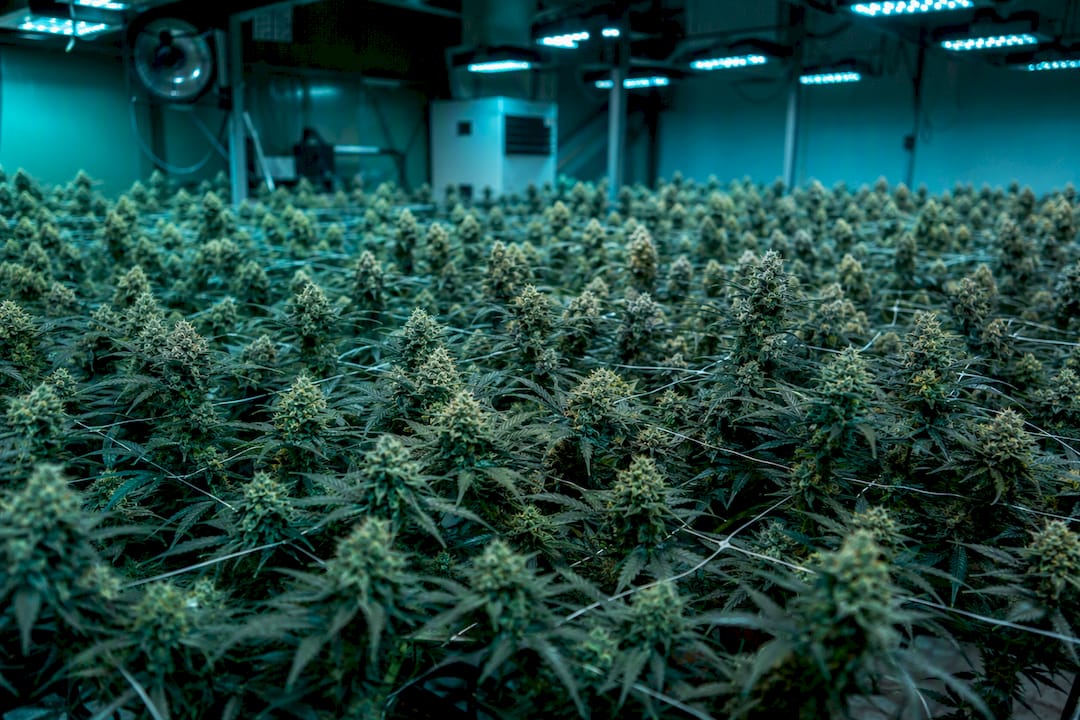
The opposite case is also instructive. Lines that were maintained exclusively by cloning for years, with no renewal from seed, end up showing the intra-plant variation documented in the study on genetic mosaicism in cannabis: the same genetic label, but increasingly less uniform agronomic behaviour. The practical lesson is that stabilisation is not a one-off event, but a process that has to be sustained with continuous selection and periodic renewal of the parent material.
Common mistakes that ruin the stability of a line
The most common mistake is confusing “proven genetics” with “stabilised genetics”. A mother plant that gave a spectacular harvest once does not guarantee that its seeds will repeat that result if it never went through a real process of selection and trait fixing over several generations.
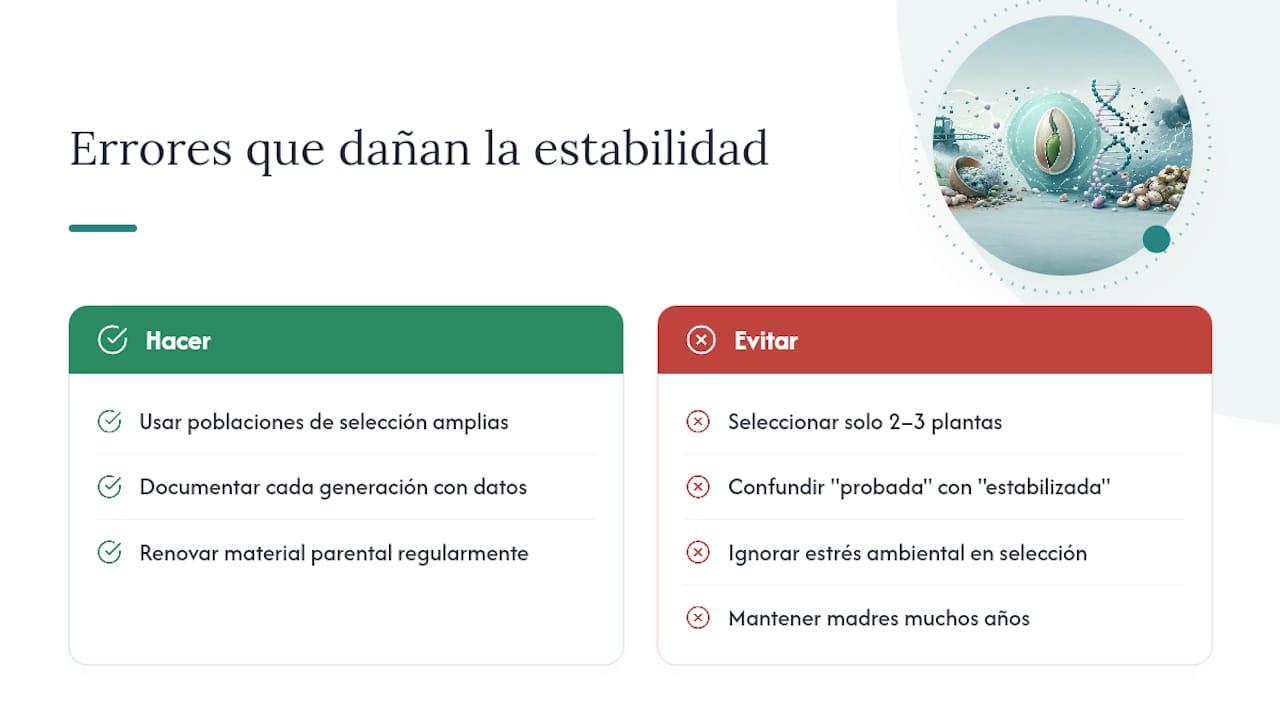
The second mistake is working with populations that are too small when trying to fix your own line. Selecting only two or three plants per generation reduces the available genetic diversity and increases the risk of inbreeding depression, that weakening which appears when a line is fixed without enough genetic base behind it.
Another common mistake is ignoring environmental stress during the selection phase: extreme temperatures, irregular watering or pests can induce visible somatic mutations that are later mistaken for “interesting new phenotypes”, when in fact they are accumulated genetic damage. Finally, many growers keep mother plants for too many years without renewing them, carrying the same Muller’s ratchet risk that was explained earlier.
Prevention comes down to three simple habits: working with broad selection populations, documenting each generation with concrete yield and profile data, and renewing the parent material before signs of deterioration appear, not after.
What we learned reviewing genetics and which resources to use
The science behind genetic stability is advancing faster than popular knowledge on the subject. Although precision gene editing promises solutions for the future, for most home growers the practical routes are still phenotype selection, producing F1 hybrids and preservation through seeds or cryopreservation. You do not need a laboratory to apply these principles.
Bluedog Genetics maintains educational content designed precisely to fill that gap between science and day-to-day growing practice. If you want to dig deeper before buying, the guide to genotype and phenotype in cannabis and the guide to seed storage and preservation are a good practical starting point.
From the theoretical approach to the real genetic stability of your seeds
This is where many growers go wrong: they think genetic stability is a problem exclusive to large seed banks, when in reality it is the variable that most quietly ruins home harvests. It isn’t a lack of nutrients or poor watering that frustrates an experienced grower the most; it’s discovering, three months after sowing, that the plant that grew looks nothing like the one they expected because the seed was never truly fixed.
Our position is clear: the obsession with absolute stability has its limits too. An excessively inbred line gains predictability but loses resilience against pests and environmental stress, that balance between homozygosity and hardiness which popular-science analyses of seed selection explain well. Don’t look for the “most stable possible” genetics at any price; look for genetics that are stable enough for your specific goal, with room to adapt to your climate and your growing method.
What truly sets apart a grower who improves harvest after harvest from one who always starts from scratch is discipline in preservation: renewing mothers, documenting generations and buying from seed banks that share their phenotyping data without you having to ask twice.
Why choose Bluedog Genetics for your next sowing
All of the above points to the same practical conclusion: stability can’t be improvised, it is either bought well or grown with patience. Bluedog Genetics selects its varieties by working with exclusive, well-regarded seed banks that document their phenotyping processes, so you aren’t buying an empty promise, you are buying genetics with real traceability behind them. Every order arrives with discreet shipping and full tracking, and the quality guarantees cover exactly what a grower needs: knowing that the seed they receive matches the variety and the stabilisation generation advertised.
If you want to start on a solid footing, take a look at the full catalogue in the Bluedog Genetics shop, where you’ll find both feminised and autoflowering seeds classified by profile and growing difficulty. For those who value uniformity above all, the F1 lines in the catalogue offer the predictable starting point we talked about earlier; for those who want to experiment with their own crosses starting from an already fixed base, it’s worth checking the varieties with an advanced stabilisation generation shown on each product page. Add your favourites to the basket and complete your purchase with the quality guarantee and order tracking included with every shipment.
Sources
Recommendations
Genetic stability in seeds: what it is and how to ensure it
32