

For SCROG, the most reliable option is to use feminised photoperiod seeds with a compact structure and a tendency to produce lots of tips. Autoflowering plants can work, but with reservations: their fixed cycle leaves less room to fill the mesh. Whichever you choose, allow enough vegetative time before forcing flowering, because without it the net never gets fully covered.
In short:
- We recommend using feminised photoperiod seeds with a compact structure and a tendency to branch, to get an even, full canopy with no surprises in size.
- It is essential to plan the placement of the net in advance, installing it 20-30 centimetres above the substrate before the tips grow past it.
- Genetics and phenotypic stability influence the uniformity of the crop and reduce the amount of corrective work needed in the canopy.
- Choosing varieties that are resistant to fungi and respond well to natural training favours growing with fewer mould risks in densely populated mesh setups.
- Autoflowering plants can be trained with SCROG if you use gentle guides, large pots and realistic expectations for canopy coverage.
What SCrOG is and why it shapes your choice of seeds
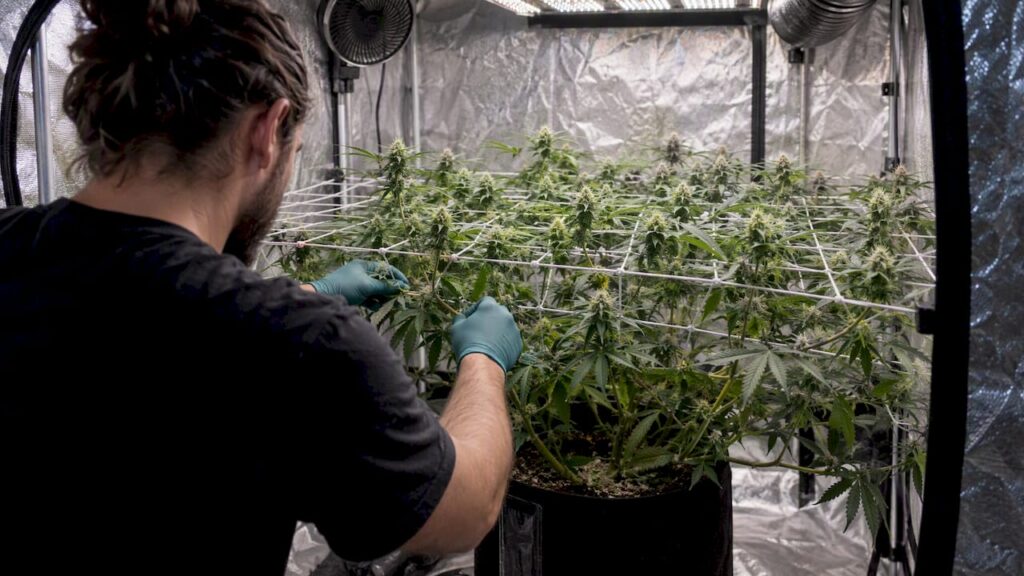
Screen of Green, known as SCROG, involves placing a horizontal net over the crop and guiding the branches through it so that all the tips receive direct light. The aim is not just aesthetic: it seeks to even out the canopy so the plant directs its energy into many flowering sites instead of a single dominant top.
That is why the genetics you choose matter as much as the technique itself. A plant with a natural tendency to branch heavily and with short internodal distance fills the screen sooner and more evenly than a vertically growing genetic with few lateral branches. When light is distributed evenly across the canopy, yield improves, and there is also greater uniformity of cannabinoids and terpenes between the different flowers, something confirmed by trials on light supplementation within the canopy in medicinal cannabis growing.
What you should be clear about before buying seeds:
- A uniform number of tops across plants from the same batch makes for an even fill of the net.
- A short internodal distance reduces the risk of empty gaps in the mesh.
- Even light distribution across the canopy directly affects the quality and quantity of the final harvest.
Why genetics matter: structure, uniformity and handling
Not all genetics respond the same way under a net. Indica-dominant varieties tend to have short internodes and a compact structure, which makes them easier to manage with SCROG because they need less training. Sativas, on the other hand, tend to stretch more during the switch to flowering, which means you have to install the net lower or control the stretch with pruning. Hybrids behave somewhere in between, and that’s where it pays to check the spec sheet before you decide.

Phenotypic stability is another factor that few growers look into in depth. A seed bank with consistent genetic selection delivers plants that are more alike within the same batch, and that translates into a canopy that is easier to level. If you buy ten seeds of the same variety and each one grows differently, you will spend more time correcting uneven growth than enjoying the grow.
Before buying, ask for or look for this information in the supplier’s description:
- Estimated flowering time, to plan when to switch to 12/12.
- Typical internodal distance, which indicates how much training work you will need.
- Tendency to branching, key to knowing how many tops each plant can produce.
Pro tip: if the seed’s product page doesn’t mention internodal distance or branching tendency, ask the supplier directly before buying: that information is worth more than any photo of a bud.
How to choose seeds for SCrOG: practical step-by-step checklist
Buying seeds for SCrOG without clear criteria usually ends in an uneven canopy and extra hours of training. This sequence helps you decide with a clear head before clicking “buy”.
- Measure your space before looking at genetics. The available height and the volume of the tent determine which plant architecture you can afford, not the other way round.
- Prioritise photoperiod feminised plants. They give you total control over how long to keep the vegetative stage, something autoflowering plants don’t offer.
- Check the consistency of the batch. Look for reviews or descriptions that mention phenotypic stability and consistent flowering times among seeds of the same variety.
- Calculate the vegetative days according to estimated vigour. A slow-growing genetic line may need two or three more weeks under vegetative light to fill the mesh.
- Ask the supplier about internodal distance and branching tendency. These are the two details that best predict how the plant will behave under the net.
- Rule out pure sativa-dominant genetics if your height is limited. Their natural stretch makes it difficult to keep the canopy under control in small spaces.
If you grow in a small cabinet or want quick results with little volume, our guide to seeds for micro-growing explains how to match the genetics to the space you actually have. And if you still have doubts about how to read a feminised seed data sheet, go over them in the article on how to choose feminised photoperiod seeds.
Pro tip: note down in a grow journal the flowering time the seed bank promises against the time your plant actually takes: that difference helps you plan your next batch better.
Photoperiod vs autoflowering: advantages and limitations for SCROG
Feminised photoperiod plants remain the most convenient option for filling a full screen. You can extend the vegetative stage for as long as you need until the net is covered, and only then force flowering by changing the photoperiod. That control is exactly what SCrOG needs to maximise the number of usable tops.
Autoflowering plants run on a fixed life cycle that doesn’t depend on the photoperiod, which leaves much less room to wait for the plant to fill the mesh before it starts flowering on its own. Aggressive training or badly timed pruning on an autoflowering plant can take away recovery time that it then has no way of making up, because its growth window is short.
That said, you can work with autoflowering plants in SCROG if you adjust your expectations:
- Use gentle, gradual training instead of abrupt bending, so as not to stress a plant with limited time.
- Opt for pots somewhat larger than usual, which encourage faster root development and earlier lateral expansion.
- Accept that net coverage will be partial compared with a photoperiod plant, and plan your plant density accordingly.
If you want to go deeper into how to adapt this genetics to training techniques, our guide on autoflowering cannabis and its advantages explains which precautions to take.
Mesh size, placement height and setup planning
Netting isn’t much use if it is put in place late or with the wrong mesh size. As a practical guide, an opening of between 5 and 7 centimetres usually strikes a good balance between canopy control and ease of threading the branches through the squares. As for height, placing the net between 20 and 30 centimetres above the substrate or the rim of the pot usually leaves enough room for the plants to grow up to it without falling short or overshooting it.
The important thing is to install the mesh before the shoots reach it, not after. If you wait for the tips to grow past it, you lose the chance to guide them gently and end up forcing branches that have already hardened.
- Adjust the height of the net according to the vigour of the genetics: a fast-growing variety needs it set up earlier.
- In small pots, lower the mesh slightly to compensate for the smaller available root volume.
- Start guiding the first tips as soon as they appear above the net, without waiting for them to grow several centimetres.
Common mistakes when using SCROG with seed choice and how to fix them
The most common mistake is choosing a sativa-dominant genetic for a space with little height and then watching the stretch during flowering overwhelm the mesh. The solution is controlled apical pruning before the change of photoperiod and, if your lighting system allows it, reducing the intensity of far red light during the vegetative stage, which is one of the factors that most influences stem elongation.
Another common problem is uneven phenotypes within the same batch: some plants grow quickly and others lag behind, breaking the uniformity of the canopy. When you spot this early, during the first weeks of vegetative growth, separate or reposition the slower plants to give them more direct light, or simply replace them if the gap is too large.
High relative humidity combined with a dense canopy is the perfect recipe for mould. To avoid it:
- Clear away large leaves that cover the lower areas of the canopy and hinder air circulation.
- Keep relative humidity under control during flowering, lowering it gradually as the buds fatten up.
- Make sure airflow also reaches underneath the net, not just above it.
Why trust this guide: the author’s experience and the editor’s resources
I sign this guide as Omar, and on the Bluedog Genetics blog I have previously written about germination and microgrowing, two areas that directly overlap with how to plan a SCrOG starting from the choice of seed. We work with a curated selection of genetics, with support designed to make the buying decision easier.
If you’re about to get started, our complete guide to germinating cannabis seeds covers the step before any SCrOG, and the article on the differences between indica, sativa and hybrids expands on what we summarise here about genetic architecture.
Selection of specific varieties recommended for SCROG based on resilience and yield
When choosing a variety, look for genetics that combine resistance to fungus with a structure that doesn’t shoot up in height. Indica-dominant varieties or balanced hybrids with short internodes tend to be the most rewarding, because they produce plenty of side branches from the base without needing an excessively long vegetative stage.
Resistance to grey mould and powdery mildew is especially relevant under SCrOG, as the dense canopy created by the technique reduces natural airflow between buds. A genetic line with less compact buds and good aeration between flowers copes better with accumulated humidity than an extremely dense-budded variety, even though the latter may promise more grams per plant in ideal conditions.
Yield under a screen doesn’t depend only on the genetic potential of the variety, but on how many uniform tops you manage to expose to the light. That’s why it’s worth prioritising genetics known for their natural branching over those that only stand out for the size of a single central bud. In our feminised seeds category you’ll find varieties with these characteristics described in each product page.
Pruning and training techniques that complement SCrOG to maximise production
SCrOG rarely works on its own. Combining it with other low-stress training techniques improves canopy uniformity even further. LST (low stress training), which involves bending and tying down branches without breaking them, helps steer growth towards the empty gaps in the mesh before the plant even reaches it.
Apical pruning, or topping, removes the dominance of the main tip and multiplies the number of side branches that then spread across the net. Applied early enough before the change of photoperiod, it is one of the most direct ways to increase the number of tips available for flowering.
Selective defoliation during early flowering, removing large leaves that block light from reaching the lower buds, also improves light penetration within the canopy. It’s best applied in moderation: defoliating too much or too late can stress the plant just when it needs the most energy to fatten up its flowers.
Impact of substrate and nutrients on SCROG development
A well-aerated substrate encourages rapid root development, which means a plant that reaches the screen sooner and with more vigour for branching. Mixes with a good proportion of perlite or coco fibre usually drain better than compacted soil, which reduces the risk of waterlogging in pots that will spend several weeks under a fixed net.
During the vegetative stage, a slightly more generous supply of nitrogen helps sustain the lateral growth you need to fill the mesh, always within the ranges recommended by your fertiliser’s manufacturer. When entering flowering, the balance shifts towards phosphorus and potassium, but it’s best to do this gradually so you don’t abruptly halt the development of new tips that are still making their way through the squares of the net.
Pot size also affects the pace: a small container limits root volume and, with it, the speed at which the plant can branch out sideways to cover the mesh.
Ideal environmental control (light, humidity, temperature) for SCROG techniques
The distribution of light within the canopy matters as much as its total intensity. Trials on subcanopy and intercanopy light supplementation show that bringing direct light to the middle and lower parts of the canopy, not just the top, improves yield uniformity and the accumulation of cannabinoids and terpenes. Under a well-populated mesh, this is exactly what you need: the lower tips shouldn’t be left in permanent shade.
The light spectrum also influences how the plant behaves. According to a study on spectrum and plant density in cannabis, the combination of spectral composition, planting density and lighting schedule affects both final yield and terpene concentration, so adjusting the intensity to the growth stage avoids losses from excess light with no real benefit.
As for climate, the ideal temperature during the vegetative stage is around 22 to 26 degrees, dropping slightly in flowering to protect trichome quality. Relative humidity should be reduced gradually as flowering progresses, precisely because a dense SCrOG canopy retains more moisture than an untrained grow.
Methods to optimise ventilation and prevent common problems in SCrOG growing
A well-populated SCrOG canopy creates its own microclimate beneath the mesh, and that microclimate needs constant air renewal so it doesn’t become a breeding ground for mould. An extractor fan correctly sized for the volume of the tent, combined with one or more oscillating fans that move the air between the branches, makes the difference between a healthy canopy and one with botrytis problems halfway through flowering.

Positioning the fans so that air also circulates below the net, not just above it, helps prevent pockets of stagnant air between the lower branches. Clearing away large leaves that block inner areas of the canopy serves a double purpose: it improves ventilation and lets light penetrate beyond the top layer of buds.
Checking the relative humidity with a hygrometer inside the tent itself, not just in the room, gives a more reliable reading of the real environment surrounding the buds under the mesh.
The author’s perspective: when to play it safe and when to take a risk with autos
If you are starting out with SCrOG, play it safe with photoperiod feminised seeds: control over the vegetative stage makes up for any learning curve. Leave autoflowering varieties for quick tests or micro-growing once you have mastered training. And always keep the origin documentation for your seeds, as it will be useful if you ever need to prove where they came from.
Our recommendation: photoperiod seeds and resources to get started
For a SCrOG that fills the screen with no surprises, we work with a curated selection of feminised seeds designed for exactly this: compact structure, a good tendency to branch and clear technical sheets on flowering times. You can browse the available options in our feminised seeds category, and if you still need to take the step of germinating, our complete germination guide will have you ready to set up the screen with plenty of time to spare.
This article is general information and does not replace the advice of a qualified solicitor. Consult a qualified legal professional about your particular case before acting on this content.
Frequently Asked Questions
How do you grow with SCrOG?
A horizontal mesh is placed over the crop and the branches are guided through the squares as they grow, so that all the tips end up at the same height under the light.
What are the 3 types of seeds?
For SCrOG, photoperiod feminised seeds are usually the most manageable option because of the control they give over vegetative time.
What is the difference between an F1 and an F2 seed?
An F1 seed comes from the first cross between two stable parent lines and usually shows greater uniformity and vigour between plants. An F2 comes from crossing two F1 plants with each other, which introduces more phenotypic variation in the offspring, something to bear in mind if you want a uniform canopy for SCrOG.
What is the most productive autoflowering seed?
There is no autoflowering variety that is universally the most productive, because yield depends on handling, the growing environment and the specific genetics. What is constant is that autoflowering plants perform better under SCrOG when given gentle training and a pot with good root volume.