

Backcrossing in cannabis, known technically as a backcross, is the breeding method of crossing a hybrid with one of its original parents to recover and amplify specific traits. If you have ever wanted to preserve the characteristics of a legendary clone or introduce a particular trait without altering the entire base genetics, backcrossing is the tool you need to understand. This article breaks down the process generation by generation, explains its real advantages, its limits and how to apply it with stable genetics such as those in the Bluedoggenetics catalogue.
In short:
- Backcrossing crosses a hybrid with one of its original parents to recover and amplify specific traits without altering the genetic identity of the line.
- After three backcrosses (BX3), the genome of the recurrent parent exceeds 93 %, enough to turn an exclusive clone into seeds with high fidelity.
- The method works best with simple traits such as autoflowering or resistance to a specific disease, not with complex polygenic traits.
- Without rigorous phenotypic selection in each generation, the backcross doesn’t fix the traits: it can dilute them or drag along unwanted DNA (linkage drag).
- Bluedoggenetics offers seeds with stable genetics and consistent phenotypic expression, a good starting point for breeding programmes.
How does cannabis backcrossing work, explained generation by generation?
Backcrossing works by crossing an F1 hybrid with one of its two original parents, called the recurrent parent. The recurrent parent is the plant whose characteristics you want to preserve or reinforce. The other parent, from which the trait you want to introduce comes, is called the donor parent.
Genetic progression is mathematically predictable. With each backcross generation, the proportion of the recurrent parent’s genome increases significantly:

| Generation | Genetic contribution of the recurrent parent |
|---|---|
| F1 (initial cross) | 50 % |
| BX1 (first backcross) | ~75 % |
| BX2 (second backcross) | ~87,5 % |
| BX3 (third backcross) | ~93,75 % |
These genetic percentages by generation show that after three backcrosses, the plant is genetically almost identical to the recurrent parent, with the difference that it carries the trait introduced from the donor. That is exactly what a breeder wants when improving a line without losing its identity.
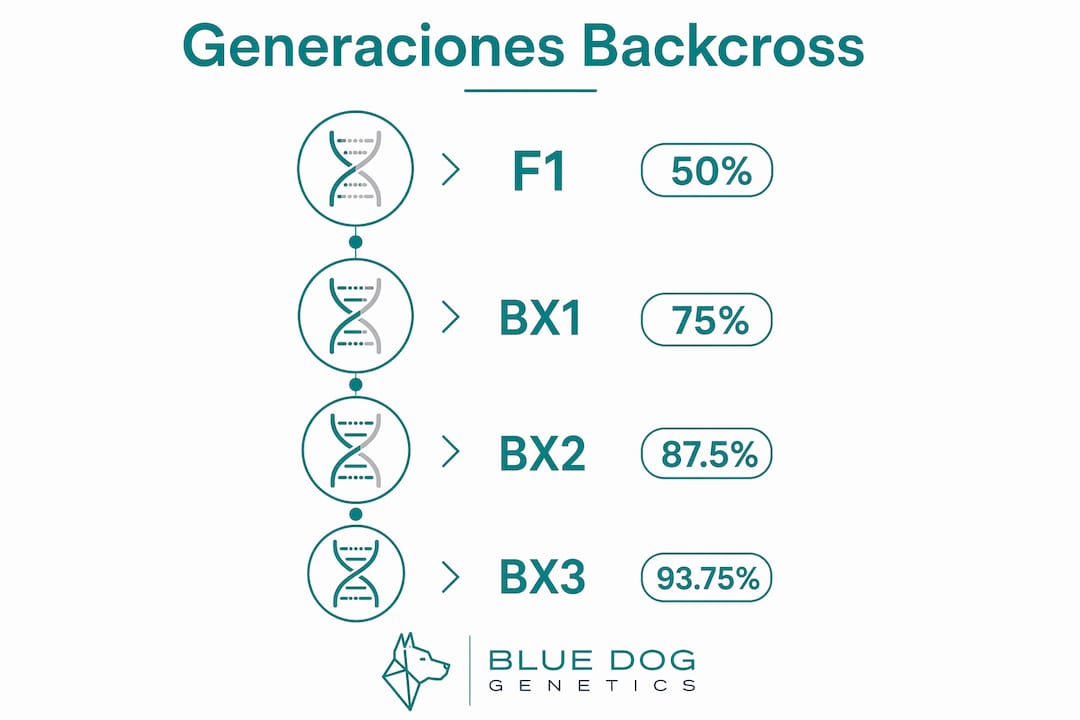
The terms BX1, BX2 and BX3 indicate how many consecutive backcrosses have been carried out. F1 and BX generations have different roles: F1s are vigorous, predictable hybrids, whereas BX generations make it possible to stabilise and recover traits from the recurrent parent. Understanding this difference is the foundation of any serious breeding programme.
What are the goals and advantages of backcrossing in cannabis breeding?
The main goal of backcrossing is to transfer a specific trait from a donor to a stable line without altering its overall genetic profile. This method is more effective for simple traits, such as resistance to a particular disease or autoflowering, than for complex traits controlled by multiple genes.
The most relevant advantages of backcrossing are:
- Preservation of genetic identity: after BX3, more than 93% of the genome comes from the recurrent parent. The plant is still recognisable.
- Surgical introduction of traits: you can add autoflowering, higher resin production or fungal resistance without redesigning the whole variety.
- Turning clones into seeds: backcrossing is the standard method for converting unique seedless clones into seed lines with high genetic fidelity to the original clone. This is especially valuable when you have an exclusive clone that you can’t reproduce in any other way.
- More stable, reproducible seeds: each well-executed backcross generation produces more uniform offspring than a simple cross between two different varieties.
💡 Pro tip: if your goal is to turn a legendary clone into seeds, aim for BX3 at the very least. At that level of backcrossing, the offspring will reproduce the original phenotype with very high fidelity.
Compared with other breeding methods, the backcross stands out for its precision. A simple cross between two varieties mixes 50% of each genome and generates high variability. The backcross, on the other hand, reduces that variability progressively while keeping the target trait. For growers who work with unique cannabis genetics, this precision makes the difference between a successful breeding programme and one that loses the best of the original plant.
What are the risks, limitations and misconceptions of backcrossing?
The biggest misunderstanding about backcrossing is believing that it automatically fixes a trait. Backcrossing does not guarantee fixation. It is a process of recovering the genome that requires rigorous selection in every generation so as not to lose recessive or desired traits. Without that active selection, the target trait can become diluted or disappear.
The most important technical limitations are:
- Polygenic traits: backcrossing works poorly when the desired trait depends on many genes at once, such as the complete terpene profile or the total yield. Those traits break apart and are redistributed with each cross.
- Linkage drag: when preserving the target trait, unwanted DNA from nearby genomic regions is dragged along with it. This unwanted genetic drag can reduce the plant’s vigour, resistance or quality.
- Variability without selection: a BX programme without strict phenotypic selection produces variability or loss of desired traits, even if the number of generations is high.
- The BX number is no guarantee of quality: seeing «BX3» in a description does not guarantee stability or uniformity. The number indicates the process, not the result.
«Backcrossing is a genetic recovery tool, not a guarantee of uniformity. Without conscious selection in every generation, the process can result in variable lines or ones with degraded traits. The breeder’s experience matters as much as the genetics themselves.»
Marker-assisted selection helps to reduce linkage drag, but this technology is out of reach for most independent breeders. The alternative is rigorous phenotypic selection based on visual experience and a deep knowledge of the variety. Anyone who has spent years working with a particular genetic line recognises deviations that a superficial analysis would miss.
How do you apply backcrossing in practice to preserve clones and improve crops?
Applying backcrossing correctly requires planning and documentation from the very first cross. The step-by-step process is as follows:
- Select the recurrent parent. Choose the plant whose genetics you want to keep. It must be phenotypically stable and represent the variety faithfully.
- Identify the donor parent. Choose the plant that provides the trait you want to introduce: autoflowering, resistance to mildew, higher trichome density, and so on.
- Make the F1 cross. Cross both parents and obtain the first hybrid generation.
- Select the best F1. Grow several F1 plants and choose the one that best expresses the donor’s trait while keeping the recurrent parent’s phenotype.
- Cross the selected F1 with the recurrent parent. You get BX1, with approximately 75% of the recurrent parent’s genome.
- Repeat the selection and the backcross. In each generation, select the plants that express the target trait and cross again with the recurrent parent. After BX3, the recurrent genome exceeds 93%.
- Document every generation. Record which plants you selected, why and what traits they showed. Without documentation, the programme loses coherence.
💡 Pro tip: grow at least 10–15 plants per BX generation. The more plants you evaluate, the greater the chance of finding the phenotype that combines the donor’s trait with the recurrent parent’s identity.
Backcrossing is also the preferred method for turning exclusive clones into seeds. If you have a seedless clone you can’t afford to lose, you can use a male plant of the same variety as the recurrent parent and carry out successive backcrosses until the seed offspring reproduce the clone’s phenotype with high fidelity. To better understand how the different genetic nomenclatures relate to each other, see the guide on F1, F2, IBL, S1 and BX in cannabis, which explains the practical meaning of each type of cross.
Key points
Backcrossing is the most precise method for introducing a specific trait into a genetic line without altering its identity, but it only works with rigorous phenotype selection in every generation.
| Point | Details |
|---|---|
| Genetic progression per generation | BX1 provides ~75 %, BX2 ~87.5 % and BX3 ~93.75 % of the recurrent parent’s genome. |
| Best use of the backcross | Simple, heritable traits such as autoflowering or resistance to specific diseases. |
| Main risk | Linkage drag can introduce unwanted DNA alongside the target trait. |
| Phenotypic selection | Without active selection in each generation, the BX programme produces variability or loss of traits. |
| Clone conversion | Backcrossing lets you turn unique clones into seed lines with over 90 % genetic fidelity. |
What nobody tells you about backcrossing until you do it yourself
The first thing you learn when working with backcrosses is that the BX number means nothing without sound judgement behind it. There are BX3 programmes with more variability than a poorly managed F2 cross, simply because the breeder did not select rigorously at each step. The process is a tool, not a magic formula.
What really makes the difference is how well you know the plant you want to preserve. If you don’t know exactly how it smells, how it grows, when it flowers and how it responds to stress, you can’t select with precision. Backcrossing requires knowing the recurrent parent better than any other plant in the garden.
Advice for those starting out: don’t try to introduce several traits at once. Pick one, work on it for three generations with strict selection and document everything. Results take time, but they are solid. Anyone looking for shortcuts in genetics usually ends up with unstable lines that don’t reproduce what they expected.
Realistic expectations matter too. Backcrossing doesn’t produce perfect results in BX1 or BX2. The reward comes in BX3 or BX4, when the plant starts to truly resemble the recurrent parent with the added trait. That patience is what separates breeders who build lasting lines from those who simply cross plants.
Seeds with a solid genetic base for your breeding programmes
Any backcross programme starts with quality genetic material. If the recurrent parent is not stable and well characterised, the backcross cannot give predictable results. At Bluedoggenetics you will find a catalogue of carefully selected feminised and autoflowering seeds, designed for growers who want genetics with defined, reproducible traits. Each variety is chosen for its stability and consistent phenotypic expression, which makes them a reliable starting point for backcrosses and advanced breeding programmes. Delivery is discreet and order tracking ensures you receive exactly what you need to work seriously.
For those who want to explore specific varieties before starting a BX programme, the Bluedoggenetics shop offers options with detailed information on each genetic line.
Frequently Asked Questions
What is backcrossing in cannabis?
Backcrossing is a breeding method that involves crossing a hybrid with one of its original parents to recover and amplify specific traits of that parent. It is used to preserve the genetic identity of a variety while introducing a particular trait from another parent.
How many generations of backcrossing are needed?
Three generations of backcrossing (BX3) are the usual standard, since at that point the genome of the recurrent parent exceeds 93%. To turn clones into seeds with high genetic fidelity, BX3 is the recommended minimum.
Does backcrossing automatically fix a variety’s traits?
No. Backcrossing does not guarantee automatic fixation. It requires rigorous phenotypic selection in every generation to keep the target trait and prevent it from being diluted or disappearing over time.
Which traits does backcrossing work best for?
Backcrossing works best for simple, highly heritable traits, such as autoflowering or resistance to a specific disease. For complex polygenic traits, such as a full terpene profile, the method is less effective.
What is linkage drag in backcrossing?
Linkage drag occurs when, in preserving the target trait, unwanted DNA from nearby genomic regions is unintentionally introduced. It can affect the plant’s vigour, yield or quality, and is minimised with strict phenotypic selection in every generation.