

Correct seed storage is the process of maintaining optimal conditions to preserve their quality and germination capacity, ensuring the success of every grow. For cannabis seeds, storing seeds to preserve quality is not a minor detail: it is the difference between a living genetic bank and a handful of inert material. The Faculty of Agricultural Sciences of the UNC, Johnny’s Selected Seeds and germplasm banks such as the Chilean example with capacity for 75,000 samples agree that time, humidity and temperature are the three factors that determine whether a seed reaches the sowing season alive. Controlling them does not require professional equipment, but it does require method.
In short:
- Seed viability depends on the balance between temperature, relative humidity and time, according to the 100-point rule (°F + relative humidity less than 100).
- Airtight glass jars with silica gel are the standard household option for blocking moisture and oxygen, the two main accelerators of deterioration.
- The fridge at 5–6 °C preserves seeds for 2 to 5 years, while the freezer at -18 °C with vacuum sealing can extend viability up to 10 years.
- A jar fresh out of the cold must never be opened: the resulting condensation damages the seeds immediately and irreversibly.
- An annual germination test with a sample of 5–10 seeds lets you spot a batch’s loss of viability before it becomes total.
Which environmental factors affect seed quality and preservation?
Loss of viability in seeds is not random. According to the UNC (2026), deterioration depends directly on the balance between humidity and temperature, and follows predictable kinetics that you can control if you act before storing your seeds.
Temperature: the accelerator of deterioration
Every extra degree multiplies the rate of enzymatic degradation inside the seed. The Ellis and Roberts model (1980) establishes that the relationship between temperature and longevity is logarithmic: dropping from 20 °C to 5 °C doesn’t just double the shelf life, it multiplies it several times over. For cannabis seeds, storing above 20 °C in summer is equivalent to using up months of viability in weeks.

Relative humidity: the most underrated factor
High relative humidity activates the seed’s internal metabolism even when there is no visible germination. This uses up energy reserves and speeds up oxidative damage. The concept of safe storage humidity, developed by the UNC, defines the hygroscopic equilibrium point below which the seed enters a state of true metabolic dormancy. Above that threshold, deterioration progresses even if the temperature is low.
The specific effects of poorly controlled humidity include:
- Fungal activation: above 65–70% relative humidity, fungi colonise the seed coat.
- Loss of vigour: seeds with high internal moisture germinate with weak roots and slow growth.
- Irreversible damage to the embryo: the combination of heat and moisture denatures key proteins in the embryo.
- Accelerated lipid rancidity: the fatty acids in the endosperm oxidise, reducing the energy available for germination.
The practical 100-point rule
Johnny’s Selected Seeds recommends a simple formula: add the temperature in °F to the relative humidity as a percentage, and the result should be less than 100. If you store at 42 °F (5.6 °C) with 50% relative humidity, you get 92. That combination is safe. If you go up to 68 °F (20 °C) with 55% humidity, you reach 123. Your seeds will deteriorate.
💡 Pro tip: Place a digital hygrometer inside the storage space. Govee or Inkbird models cost less than 15 € and give you real-time readings. Without data, you can’t make corrections.
What are the best techniques for storing cannabis seeds?
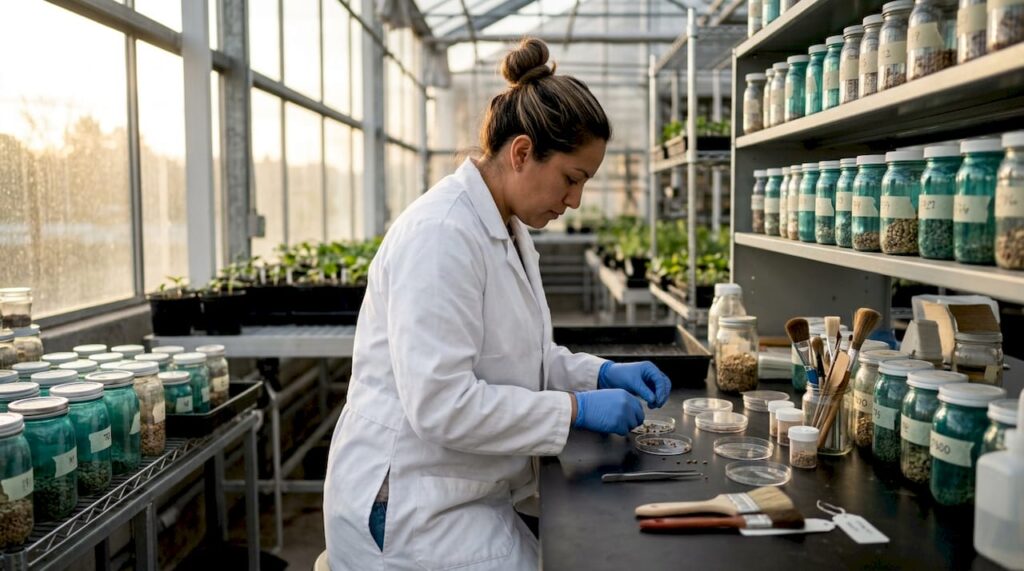
The best seed storage techniques combine airtight containers, humidity control with desiccants and a stable temperature. Airtight glass jars with a rubber seal, such as those from the Kilner brand or Mason jars, are the standard for home growers. Glass doesn’t absorb moisture or release chemical compounds, unlike conventional plastic.
Essential materials for storage
- Airtight glass jars: they protect against outside humidity and light. Use one per variety to avoid accidental mix-ups.
- Silica gel: absorbs residual moisture inside the jar. Use 5 g sachets for every 500 ml of volume. When the colour indicator changes from blue to pink, regenerate the gel in the oven at 120 °C for one hour.
- Vacuum-sealed bags: useful for long-term storage when you don’t have a freezer. They remove oxygen, which also contributes to lipid deterioration.
- Opaque aluminium foil: wrap the jars if you don’t have a dark space. UV light degrades terpenes and can damage the embryo in seeds with a thin shell.
Storage temperature depending on the time frame
For short-term storage (under 6 months), a cool, dark drawer at 15–18 °C is enough if the relative humidity is below 50%. For periods of 1–3 years, the fridge at 5–6 °C is the most practical option for a home grower. Place the seeds on a middle shelf, away from the vegetable drawer where humidity fluctuates.

💡 Pro tip: Never open the jar straight after taking it out of the fridge. Let it reach room temperature for 30–45 minutes before opening it. If you don’t, condensation deposits water directly onto the seeds, and that damage is immediate and irreversible according to Johnny’s Selected Seeds.
Before storing any seed, check that it is completely dry. A seed with high internal moisture spoils the whole batch in the same jar. If you have just received them or harvested them, leave them to rest on absorbent paper in a dry environment for 48–72 hours before sealing them. Knowing why bad seeds ruin your harvest helps you understand that the problem often starts before storage.
Which storage method is most efficient for cannabis seeds?
The choice of method depends on the storage period and the resources available. Not every grower needs the conditions of a germplasm bank, but they can certainly learn from its principles.
| Method | Temperature | Relative humidity | Estimated longevity | Complexity |
|---|---|---|---|---|
| Controlled environment | 15–18 °C | 40–50% | 6–12 months | Low |
| Fridge | 5–6 °C | 30–40% | 2–5 years | Medium |
| Household freezer | -18 °C | 15–25% | 5–10 years | Medium/High |
| Germplasm bank | -18 °C or lower | 15% | Decades | Very high |
The Chilean germplasm bank, with capacity for 75,000 samples, operates at -18 °C with 15% relative humidity and carries out periodic germination tests to validate viability. That level of control guarantees decades of preservation. For a home grower, a domestic freezer at -18 °C is viable if the seeds are perfectly dry and vacuum-sealed before going in. Residual moisture inside the jar turns into ice crystals that pierce the embryo’s cell membranes.
Freezing without proper preparation destroys more seeds than it preserves. The fridge at 5–6 °C with silica gel is the method with the best balance of effectiveness and simplicity for most growers. Also have a look at the seed selection guide to make sure you only store material with real potential.
Steps to implement an efficient storage system
A long-term seed preservation system doesn’t need to be complex. It needs to be consistent. Follow these steps to build yours:
- Inspect each seed before storing it. Discard any with a cracked shell, irregular dark spots or a wrinkled appearance. A damaged seed does not improve with storage.
- Dry the seeds before sealing them. Place them on absorbent paper in an environment with less than 50% relative humidity for 48–72 hours. Proper prior drying, in line with safe storage humidity, is the most overlooked step and the most critical.
- Choose the right container for the storage period. Airtight glass jar for under 2 years; vacuum-sealed bag or jar with silica gel for longer periods.
- Add silica gel to the container. Use one sachet for every 500 ml of volume. Check the colour indicator every 3–4 months.
- Label every container with the variety, storage date and origin. Without a label, you lose traceability. The Manual para el manejo de semillas en bancos de germoplasma stresses that traceability is just as important as physical conditions.
- Place the container in the fridge at 5–6 °C, away from the vegetable drawer. Avoid the fridge door, where temperatures fluctuate with every opening.
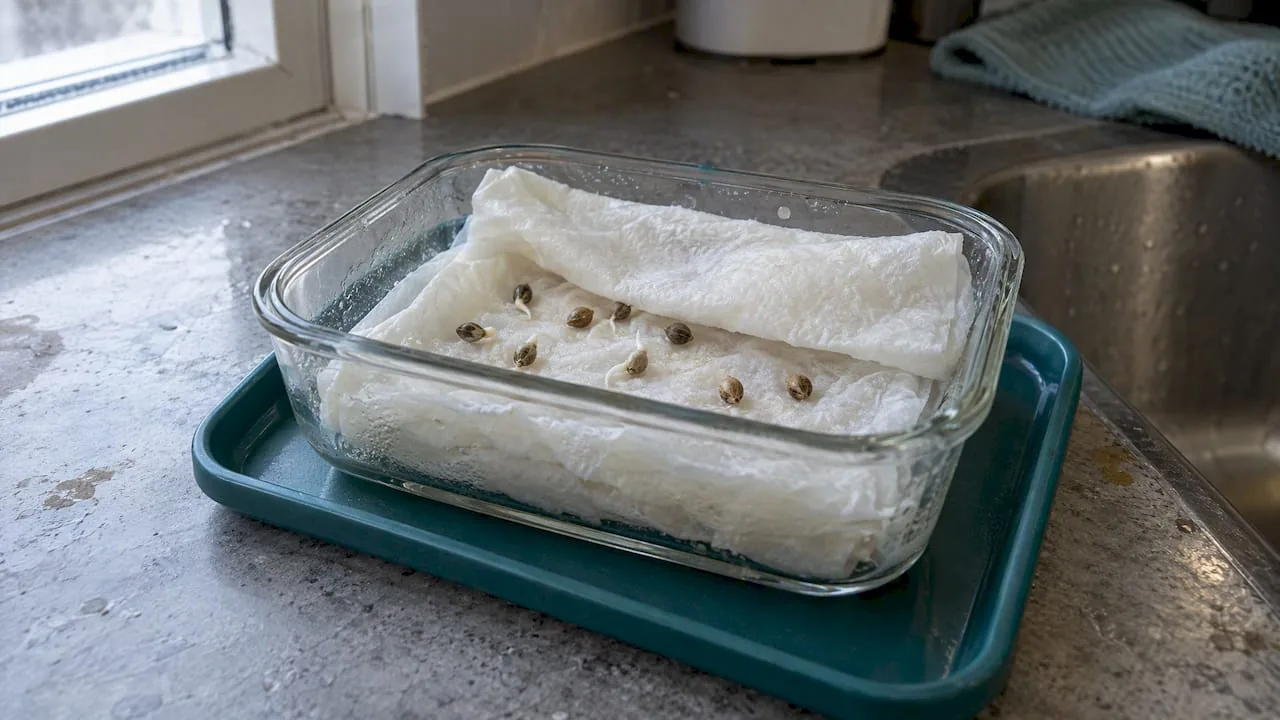
- Run regular germination tests. Every 12 months, germinate a small sample of 5–10 seeds using the standard damp paper method. If fewer than 70% germinate, the batch is losing viability and you should plan its use or replacement.
- Rotate your batches. Use the oldest seeds first. Replace batches with a low germination rate before the problem spreads to other varieties in the same storage space.
💡 Pro tip: When you take the jar out of the fridge for the germination test, always wait until it reaches room temperature before opening it. This detail, pointed out by Johnny’s Selected Seeds, stops condensation from ruining the rest of the batch you’re going to put back in the cold.
Key points
Efficient storage of cannabis seeds requires controlling temperature, humidity and time with airtight materials and a constant monitoring protocol to guarantee long-term viability.
| Point | Details |
|---|---|
| The 100-point rule | The sum of temperature in °F plus relative humidity should always be below 100 for safe storage. |
| Airtight container with desiccant | Use glass jars with silica gel to isolate the seed from humidity and outside oxygen. |
| Pre-drying is mandatory | Dry the seeds for 48–72 hours before sealing them to avoid internal biological activation that speeds up deterioration. |
| Avoid condensation when opening | Let the container reach room temperature before opening it so you don’t deposit water on the seeds. |
| Annual germination test | Germinate a sample of 5–10 seeds every 12 months to detect any loss of viability before it becomes total. |
What I learned from storing seeds badly
I’ve seen growers with incredible genetics lose them because of a mistake that seems minor: opening the jar straight out of the fridge. Condensation isn’t visible to the naked eye, but it leaves enough moisture on the shell to trigger deterioration processes within hours. A batch of a variety that took months to get hold of can be lost this way: a germination rate of 30% where 90% was expected.
What’s hardest to take on board is that storage isn’t a one-off task. It’s an ongoing discipline. You can have the perfect jar, the right silica gel and the ideal temperature, and still lose the batch if you don’t check the humidity indicator every quarter or if you don’t rotate batches sensibly. The Manual de bancos de germoplasma puts it clearly: human handling and standardised processes are just as critical as the physical conditions.
The most practical tip: label everything with the date and variety from day one. When there are five or six unlabelled jars in the fridge, chaos is inevitable. And a batch without traceability is a batch that will sooner or later be used at the wrong time. Organisation isn’t bureaucracy. It’s the foundation of any genetic collection worth keeping. If you’d like to go deeper into germination once you open the seed bank, Bluedoggenetics’ complete guide to germinating seeds is the logical next step.
Start with seeds worth keeping
Everything you have read about efficient seed storage only makes sense if the starting material is of real quality. Storing mediocre seeds with perfect technique does not improve the final result. At Bluedoggenetics you will find a curated selection of premium feminised and autoflowering seeds with verified genetics, discreet delivery and a quality guarantee on every order. Every variety in the catalogue is designed for growers who want to maximise their harvest from the very first seed. Explore the full shop and choose the varieties you will store using everything you have learned today.
Frequently Asked Questions
How long do well-stored cannabis seeds last?
Cannabis seeds stored at 5–6 °C with relative humidity below 40% in an airtight jar with silica gel keep a germination rate above 80% for 2–5 years. With freezing at -18 °C and vacuum sealing, viability can extend up to 10 years.
Is the fridge or the freezer better for storing seeds?
The fridge at 5–6 °C is safer for most home growers. The freezer at -18 °C offers greater longevity, but it requires the seeds to be completely dry and vacuum-sealed to prevent residual moisture from forming ice crystals that damage the embryo.
What is silica gel used for in seed storage?
Silica gel absorbs residual moisture inside the airtight container, keeping the internal relative humidity below the threshold that activates the seed’s metabolism. When the colour indicator changes, regenerate the gel in the oven at 120 °C for one hour before reusing it.
How do I know if my stored seeds are still viable?
Germinate a sample of 5–10 seeds on damp paper at 22–25 °C for 5–7 days. If fewer than 70% germinate, the batch is losing viability. Johnny’s Selected Seeds recommends doing this test every 12 months to spot deterioration before it affects the whole crop.
What happens if I open the jar straight out of the fridge?
The temperature difference between the cold jar and the warm surroundings causes immediate condensation on the seeds. That moisture speeds up deterioration irreversibly. Always let the container reach room temperature for 30–45 minutes before opening it.