

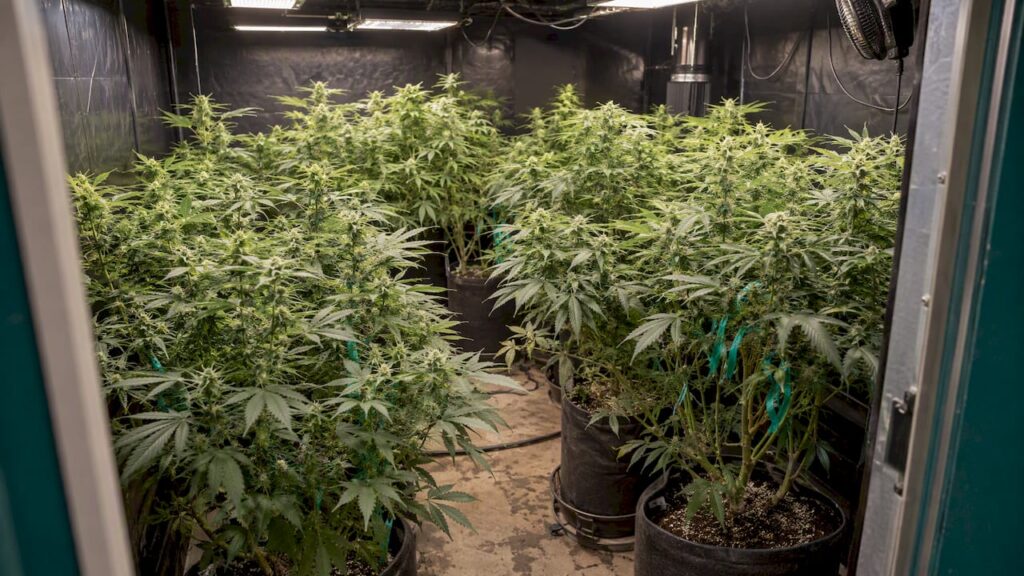
A vigorous variety for indoor growing is a genetic line that combines fast growth, strong roots and consistent branching, and it is the foundation for abundant harvests in controlled spaces. When choosing a seed, it’s best to prioritise genetic stability, a final size that fits your room and a natural tendency to branch. At Bluedog Genetics we work with varieties selected precisely for that indoor behaviour.
In short:
- In sealed rooms, keep CO₂ near 900 ppm, gradually raise the PAR from 400 to 750 and maintain about 25 °C during the vegetative stage.
- Limit nitrogen to less than 240 mg N/l during growth and reduce it before ripening to avoid oxidative stress.
- Top it after about four weeks and at least seven nodes; start low-stress training earlier to open up the canopy.
- For small spaces or short cycles, choose autoflowering varieties; photoperiod plants are better if you need to extend the growth period and have more control over the shape of the canopy.
- Maintain constant ventilation and place an oscillating fan at canopy height; measure humidity with a hygrometer at several points to detect damp pockets.
Which genetic traits define vigour indoors
When we talk about vigour, we mean the speed at which a plant accumulates biomass and the robustness of its stem and root system. It isn’t just “growing fast”: a truly vigorous plant builds a structure capable of holding heavy buds without bending, and develops roots that explore the substrate efficiently from the first few weeks.
There are traits you can observe and measure from the very start of the grow:
- Speed of main stem extension during the first two weeks of vegetative growth.
- Natural branching with no need to force extra nodes.
- Ability to recover after a transplant or a light adjustment.
- Phenotypic stability among seeds from the same batch.
The choice between autoflowering and photoperiod plants also comes into this equation. If your priority is to squeeze out the maximum vigour with full control over the canopy, a stable photoperiod plant gives you more room to manoeuvre. You can find out more about this concept in our article on hybrid vigour in cannabis, where we explain how this trait is passed on between generations.
Optimal environment to maximise vigour indoors
Genetics sets the ceiling, but the environment decides how much of that potential actually gets expressed. The studies from the University of Hohenheim on light spectrum and secondary metabolites in Cannabis sativa L. offer concrete benchmarks that you can apply directly in your grow room.
During the vegetative stage, it is best to raise the intensity gradually, moving from around 400 to 750 PAR, rather than exposing the plant to maximum levels all at once. This kind of gradual approach protects photosynthetic efficiency and reduces stress, according to the growing recommendations derived from these studies on light and yield, which also put CO2 at around 900 ppm in the vegetative stage and the temperature close to 25 °C as a favourable combination for growth.
- Raise the PAR in stages, not all at once, to avoid light shock.
- Keep CO2 around 900 ppm during the vegetative stage if your room is sealed.
- Keep an eye on the temperature: 25 °C is a solid reference point for most vigorous genetics.
- Use dimmers to adjust the intensity according to the plant’s actual response, not just according to the calendar.
Light saturation can significantly reduce photosynthetic efficiency in the parts of the canopy that receive excess intensity, according to this study on light distribution and yield in cannabis. This means that more light isn’t always better: an even distribution performs better than poorly spread peaks of intensity.
Fertilisation also calls for nuance. Keeping nitrogen below 240 mg N/l helps avoid oxidative stress during the phases of greatest biomass accumulation, in line with the reference parameters set out in Hohenheim’s research projects. Reducing nitrogen before the ripening phase, rather than keeping it constant, favours a cleaner transition into flowering.
Training and managing vigorous plants in an indoor space
Vigorous genetics without proper management end up as an uneven canopy, with tall colas hogging the light and lower branches falling behind. Training is what turns that genetic potential into an even harvest.
- Wait until the plant has at least seven nodes and about four weeks of development before the first topping, so that it withstands the cut well and regrows strongly.
- Apply LST (low stress training) from the first few weeks to open up the structure and expose more growth points to the light.
- If you work with SCROG, put the net in place before the canopy starts to close, not after.
- Control the plant density per square metre: too many plants without even lighting create internal shade that slows vigour in the lower areas.
- Water in cycles that allow the substrate to dry slightly between waterings, avoiding waterlogging that suffocates the roots.
Pro tip: If you notice that the lower branches are growing much more slowly than the upper ones, it is a sign that you need to even out the canopy before increasing the light intensity further, not after.
A well-draining substrate and well-spaced watering are the foundation for the roots to explore deeply, and a healthy root is what allows all that vigorous genetics to translate into real biomass in the pot, not just potential on paper.
How to choose vigorous seeds and phenotypes for indoor growing
Before buying, ask yourself a few questions that will save you surprises: is the genetics stable between batches? What flowering time does the seed bank state? Is it a feminised variety designed to maximise flower, or a regular one also intended for breeding?
To quickly evaluate a seed intended for indoor growing, look at these points:
- Estimated final size and whether it fits the height available in your room or tent.
- Branching behaviour described by the seed bank: natural branching usually means less training work.
- Stated tolerance to environmental stress, especially if your climate control isn’t perfect.
- Phenotypic consistency: highly stabilised genetics give fewer surprises between seeds in the same pack.
The golden rule is to prioritise stable genetics that have been proven indoors, rather than trying to make up for a weak seed with more light or more nutrients. That excess rarely fixes a genetic problem and often causes burn or deficiencies. To better understand why one seed behaves differently from another even when they share a commercial name, we recommend reading about the difference between genotype and phenotype in cannabis, and if growing time is your limiting factor, our guide to fast-flowering seeds helps you decide between short-cycle options.
Controlling and managing humidity and ventilation indoors
Genetic vigour also depends on the air surrounding the plant, not just on the light or the substrate. Relative humidity that is too high in the vegetative stage encourages soft growth and brittle branches, while very low humidity slows transpiration and slows nutrient uptake from the root.
As a practical guideline, in the vegetative stage it usually works well to keep relative humidity in a medium-to-high range and lower it gradually as flowering approaches, to reduce the risk of problems caused by excess moisture in dense buds. Constant ventilation, with properly sized extraction and circulation, does two jobs at once: it renews the CO2 available for photosynthesis and moves the air enough to strengthen the stem, an effect similar to what wind does outdoors.
Insufficient airflow also creates humid microclimates within the canopy, right where the more vigorous varieties produce the most foliage and therefore carry more risk of pockets of stagnant humidity. Installing an oscillating fan at canopy level, in addition to the extraction system, usually solves this problem without the need for large investments. Measuring with a hygrometer at different points in the room, not just near the extractor, gives you a more realistic picture of what the plant is experiencing.

Preventing and managing pests and diseases in vigorous plants
Vigorous varieties produce a lot of dense foliage in a short time, which makes them especially attractive to pests such as spider mite, thrips or whitefly, which find shelter inside the canopy. Prevention starts with regular visual inspection of the underside of the leaves, where the first signs usually appear before the pest is noticeable to the naked eye.
The humidity control we mentioned earlier also plays a role here: an environment that is too humid favours fungi such as powdery mildew or vitritis, especially in the dense colas typical of vigorous genetics during flowering. Maintaining good air circulation within the canopy, supported by pruning the lower leaves that receive no light, noticeably reduces that risk.
For pests, rotating biological control methods, such as predatory mites or potassium soap applied in good time, is usually more effective than waiting for a visible infestation before acting. Quarantining new plants before bringing them into the main room is a simple practice that stops an isolated problem from turning into a widespread plague across the whole grow.

Calibrating and optimising watering to maximise vigour
A poorly calibrated watering system can cancel out a good part of the potential of a vigorous strain, however well adjusted the light and climate may be. The aim is for the substrate to go through cycles of moisture and slight drying, never constant waterlogging, because roots need oxygen just as much as water.
If you use drip irrigation, check regularly that all the drippers deliver a similar flow: a vigorous genetic with a well-developed root system can use up the available water in a pot faster than a slow-growing plant, and uneven distribution leaves some plants dry while others remain waterlogged.
Measuring the pH and electrical conductivity of the drainage water tells you more about what’s happening at the root than measuring only the input water. A notable deviation between the two values usually points to a problem of salt build-up or insufficient watering to flush the substrate. With vigorous genetics, which consume nutrients quickly, this regular check prevents lockouts that would slow growth just when the plant is ready to accelerate.
Impact of the substrate on vigorous indoor development
The substrate is the physical foundation on which all the root vigour we mentioned at the beginning is built. A substrate that is too compact limits oxygenation and slows root expansion, whereas one with good structure and drainage allows a vigorous genetic line to spread its whole root system in the first few weeks.
Mixes with a good proportion of perlite or coco fibre improve drainage and prevent waterlogging, which is especially important for fast-growing varieties that need frequent watering. In growing with living soils or supersoil, microbial activity adds extra support for root development, although it requires slightly different nutrient management from an inert substrate.
Pot size also determines how much vigour the plant can express: roots confined too early limit growth above the soil, even in genetics with great potential. Transplanting in time, before the roots completely encircle the root ball, maintains the steady growth rate that characterises vigorous varieties.
What few growers understand about vigour
There is a very widespread idea that, in our editorial experience of reviewing the available evidence, oversimplifies the subject: that vigour is purely a matter of genetics. The reality is that a vigorous seed that is poorly managed yields less than a normal seed that is well managed, because the environment acts as a filter that lets genetic potential through or blocks it.
What novice growers underestimate most is not the choice of seed, but the patience to adjust the environment gradually. Raising light, CO2 or nutrients all at once, thinking this speeds up growth, usually has the opposite effect: stress, burns and plants that take longer to recover than they would have with gradual handling. At Bluedog Genetics we select exclusive varieties precisely because we know that well-curated genetics give the grower a margin for error, as well as offering discreet shipping, personalised support and a quality guarantee with tracking of every order.
Final recommendation for growers seeking vigour indoors
If you are looking for feminised genetics with a natural tendency to branch and a good response to techniques such as LST or SCROG, our feminised seeds section brings together selected options for indoor growing. For smaller spaces or short cycles without giving up vigour, autoflowering seeds offer fast growth with less need to manage the photoperiod.
In both cases we offer discreet shipping, personalised support and order tracking from purchase until the seed arrives, with regular promotions that make it more affordable to start or expand your grow. Choose the variety according to your space and your experience, and let the genetics do the rest of the work.
Frequently Asked Questions
What makes a cannabis variety vigorous indoors?
A vigorous variety combines fast stem growth, natural branching and a root system able to explore the substrate effectively from the first weeks. This combination allows the plant to make better use of the light and nutrients available in a controlled space.
Is an autoflowering or a photoperiod plant better for maximising vigour?
It depends on your space and how much control you want: autoflowering plants offer short cycles that are ideal for small spaces, while photoperiod plants let you extend the vegetative stage and apply more aggressive training to make the most of the genetic potential. Both options are available in our feminised and autoflowering seed categories.
How much light does a vigorous plant need in the vegetative stage?
It is best to raise the PAR gradually, moving from around 400 to 750 PAR during vegetative growth, rather than applying maximum intensity from day one. This gradual approach, according to recommendations based on light spectrum studies, protects photosynthetic efficiency and reduces stress on the plant.
When is it worth topping a vigorous plant?
It is best to wait until the plant has at least seven nodes and about four weeks of growth, so that it handles the cut well and regrows strongly. Doing it before that point can slow growth instead of encouraging the branching you are after.
How can you prevent too much light from harming yield?
Light saturation can significantly reduce photosynthetic efficiency in the parts of the canopy with excess intensity, according to this study on light distribution in cannabis. Distributing the light fixture evenly and using dimmers for gradual adjustments avoids these saturation points and improves the real use of light energy.