

The most reliable way to reduce the smell of your grow is to choose genetics with a less intense terpene profile and control the source with ventilation and activated carbon filters; don’t rely on ozone generators or air fresheners. Genetics sets the starting point, but ventilation, trimming and curing determine whether your grow goes unnoticed or becomes a problem with the neighbours.
In short:
- Choosing genetics with mild or herbal terpene profiles helps reduce odour when growing, but it always requires proper ventilation and activated carbon filters.
- Correct installation of the extraction system, with negative pressure and short ducts, is essential for keeping odour under control, especially in small or discreet grows.
- Spray neutralisers and ozone generators do not remove the odour at the source and, in the case of ozone, can be dangerous to your health if not used in empty spaces and with caution.
- The peak of odour occurs during trimming and curing, so it is best to handle these stages in well-ventilated rooms with filters running to stop it escaping.
- Starting with a few seeds of a stable variety lets you assess its aroma profile and reduce surprises before devoting your whole space to growing.
How to choose lower-odour varieties when buying seeds
Not all genetics smell the same, and that difference starts with each plant’s terpene profile. Terpenes such as β-myrcene (earthy, hoppy aroma), limonene (citrusy, intense) and terpinolene (herbal, more subtle) determine a good part of what you notice in the grow room. A review published in Environmental Science & Technology identifies these compounds as the most common in cultivation emissions, although it points out that other compounds with a very low odour threshold, present only in traces, may contribute most of that characteristic “skunky” note.
When you buy seeds, it pays to look beyond the photo of the bud:
- Check the seed bank’s profile for descriptors such as “mild”, “discreet” or “low terpene profile” rather than “pungent” or “intense”.
- Ask the seed bank directly whether they have specific phenotypes identified as less smelly within the same variety.
- Bear in mind that two seeds from the same line can express different phenotypes: a small trial batch lets you select the mother plant with the least aroma before scaling up your grow.
- Prioritise seed banks with clear genetic traceability and a good reputation, because uncontrolled phenotypic variation usually comes from poorly stabilised lines.
You can find out more about how terpenes relate to aroma and effect in our guide to terpenes and their effects, and compare specific options in our catalogue of feminised seeds.
Pro tip: buy only two or three seeds of a new variety to test the phenotype before committing your whole growing space to that genetic.
Ventilation and carbon filters: the foundation of technical control
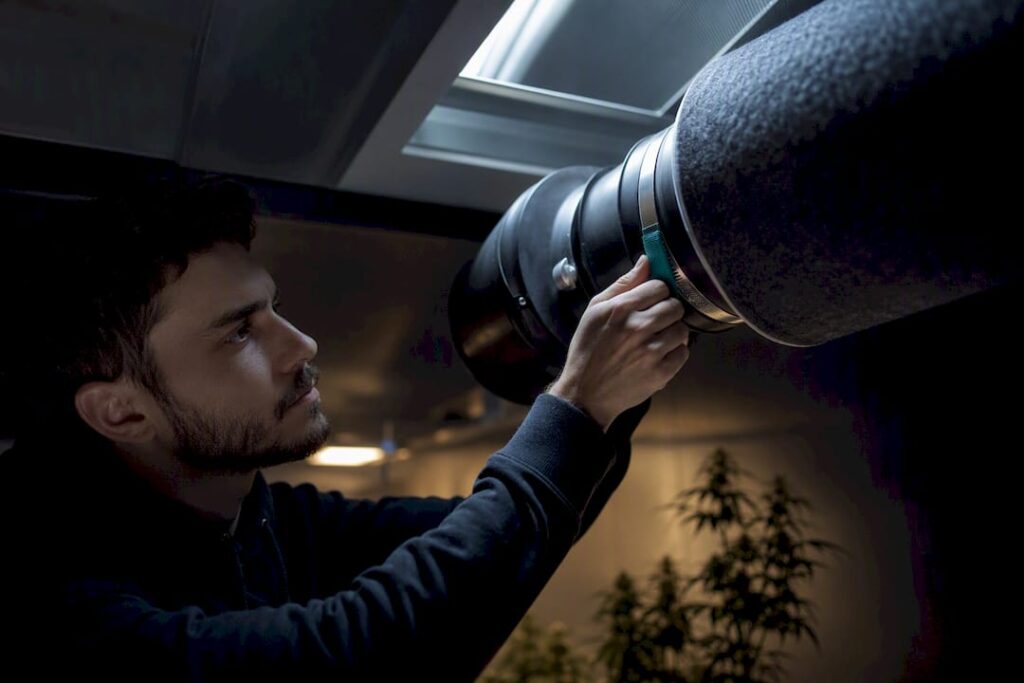
Genetics sets the starting point, but the air leaving your room is what really gives your grow away. Working under negative pressure, with the extractor pulling out more air than comes in, stops the aroma leaking through gaps and doors instead of passing through the filter.
To size the system correctly:
- Calculate the volume of your room in cubic metres and multiply it by the number of air changes per hour you need, between 20 and 40 depending on the heat load of your lights.
- Choose an extractor fan with a capacity slightly above that calculation to compensate for the pressure loss from the filter and ducting.
- Fit the activated carbon filter just before the extractor fan, never after it, so that all the air passes through the carbon before leaving.
- Keep ducts as short and straight as possible: every bend reduces real airflow and forces the extractor to work beyond its capacity.
The Colorado field study recorded low emission rates of volatile organic compounds per tonne of cannabis grown, although the smell can be noticeable locally if there is no adequate filtration., according to data collected by the EPA; although that impact is low on an atmospheric scale, it is enough for the smell to be noticeable locally if there is no adequate filtration.
Activated carbon becomes saturated with use: if you notice the smell starting to escape even though the extractor is running, or if quite a lot of time has passed since installation, it is time to check or replace the cartridge. Also seal any leaks in the tent or grow room, because a perfect filter is no use if the air finds another way out.
Neutralisers and ozone generators: why they aren’t the solution
“Odour neutralising” gels and sprays are, in practice, air fresheners: they cover the aroma with a stronger one, but they don’t remove the terpenes that produce it. Using them frequently adds secondary compounds to the air without solving the source of the problem, so at best you end up with a mix of smells instead of none.
With ozone the risk is greater. The EPA explicitly warns that ozone generators sold as air purifiers do not remove most odours at levels that are safe for people, and that at those concentrations they can produce by-products that irritate the respiratory tract.
Ozone generators are not effective at removing most odours at the levels considered safe by public health authorities.
An article on ozone treatments for household odours agrees that this method only makes sense in empty spaces with ventilation afterwards, never in occupied rooms.
The alternatives that do work are the ones you already know: properly sized activated carbon filters, negative-pressure ventilation and, in larger setups, biofilters to treat the exhaust air.
- Spray neutralisers can be used as a spot fix in passageways, never as a substitute for filtration.
- Ozone, if it is ever used, should only be applied in empty spaces, by technical staff, with nobody present during the process.
Post-harvest: when the most odour is released
The most intense aroma peak of the whole grow doesn’t come during flowering, but during trimming and curing. A study published in Environmental Science: Processes & Impacts found that terpene emissions can vary by up to 1,500% depending on the activity, with clear peaks during pruning and bud trimming. Planning that day for when your extraction system is running at full capacity makes all the difference.
- Trim and handle the material in the same ventilated room where you grew it, never in a space without extraction.
- Dry the flowers at 18 to 21 ºC and a relative humidity of 45 to 55 % to avoid excessive volatilisation of terpenes.
- Cure in glass jars, opening them briefly every day during the first week to release moisture without saturating the surrounding environment.
- Store the cured product in airtight containers in a cool, dark place so that its aroma doesn’t keep drifting through the rest of the home.
Our guide to curing cannabis after harvest goes into more detail on timings and jar rotation.
Pro tip: if you cure in a cupboard or small room, place a mini extractor with a carbon filter there too, so the smell doesn’t build up in that enclosed space.

What I learned growing in small, discreet spaces
Growing in flats and small spaces taught me that genetics is the first line of defence, not the last. Choosing low-odour phenotypes from the seed and adding properly sized ventilation reduces both the need for reactive fixes and the risk of nasty surprises. It is advisable to prioritise stable genetics over empty promises when selecting varieties. If you want to understand better how the genetic profile shapes what you get at harvest, take a look at our guide on cannabinoid profiles and cannabis varieties.
Our recommendation for your next discreet grow
If you want a grow with fewer aroma surprises, investing in stable genetics from the start saves you work later with filters and ventilation. You can select exclusive varieties that offer robustness indoors and profiles that don’t force you to double up your extraction system. Our feminised seeds offer greater phenotypic predictability, ideal if you want to reduce the element of surprise in aroma; if you prefer shorter cycles and less flowering time exposed to odour peaks, our autoflowering seeds are a solid option for small spaces.

It’s advisable to start with a small batch, observe the phenotype and consult customer service before making a purchase, so you can choose the variety that best suits your ventilation system.
Sources
- Cannabis cultivation facilities: a review of their air quality impacts (Environmental Science & Technology, 2022)
- Terpene exhaust emissions and impact ozone modeling from cannabis plants at commercial indoor cultivation facilities (CDPHE / EPA reference)
- Ozone generators that are sold as air cleaners (US EPA)
- Following the smell: terpene emission profiles through the cannabis life-cycle (Environmental Science: Processes & Impacts, 2025)
Frequently Asked Questions
Which cannabis varieties have the least smell?
There is no definitive list of “odourless” varieties, because aroma depends on the terpene profile and the specific phenotype, not just the commercial name. Genetics dominated by terpinolene or lighter terpene profiles tend to be perceived as less intense than those dominated by limonene or myrcene in high concentrations.
Do air fresheners really eliminate grow odour?
No, air fresheners and neutralising gels mask the aroma with another smell, but they do not remove the terpenes that produce it. The only way to reduce the smell at source is to filter the air with activated carbon before it leaves the room.
Is it safe to use an ozone generator in the grow room?
No, the EPA advises against using ozone generators in occupied spaces because they don’t remove most odours at safe levels and can produce by-products that irritate health. If their use is justified, it should be limited to empty spaces and carried out by technical staff.
When does a cannabis plant smell the most during growing?
The smell intensifies noticeably during late flowering and peaks when you cut and trim the buds. Planning those tasks for when your extraction system is running at full capacity helps you keep that peak under control.
How long does an activated carbon filter last in an indoor grow?
Its service life depends on the hours of use and the terpene load it processes, so it’s best to check it regularly rather than set an exact date. If you notice the smell starting to escape even though the extractor is switched on, it’s a sign that the cartridge is saturated and needs checking or replacing.