

A serious pack of cannabis seeds should come with three clear things: the exact quantity you paid for, the correct genetic type (feminised, autoflowering or regular) and packaging that guarantees those seeds arrive alive. If any of the three is missing, your harvest gets off to a lame start before it even touches soil.
Seed banks such as Bluedog Genetics usually sell in packs of 3, 5 or 10 seeds, and any professional seed should be stored in a cool, dry environment, ideally close to 6 ºC and with low relative humidity so that it does not lose viability. Before planting anything, check this:
- Count the seeds: the number must match what is stated on the packaging.
- Check that there are no cracks, soft spots or plant debris.
- Check that the label states the variety, genetic type and batch number.
- Check that the inner packaging is sealed (a bag or jar with silica gel).
In short:
- A reputable seed pack should contain the exact quantity, the correct genetic type and packaging that ensures the seeds arrive alive.
- The pack size should match your goal: 3 to 5 seeds to try out a genetic, and 10 or more regular seeds for your own breeding.
- When you receive your order, it is advisable to check the quantity, physical condition and label, and to run a germination test on damp paper if in doubt.
- Feminised, regular and autoflowering seeds call for different pack sizes depending on the sexing margin you need.
- Storing seeds in the cold (around 6 ºC) and dry with silica gel keeps them viable for approximately two years.
Key points
The contents of the seed pack determine the success of your grow as much as the genetics themselves: the right quantity, the right type and careful storage are inseparable.
| Point | Details |
|---|---|
| Check the quantity and label | Count the seeds and confirm that the variety and batch match what you bought. |
| Choose the format to suit your goal | Use packs of 3 to 5 for trials and 10 or more for breeding with regulars. |
| Do a germination test | The damp paper method confirms viability before you plant the whole batch. |
| Store cold and dry | Store the seeds at a low temperature with silica gel to maintain viability. |
| Buy with a real guarantee | Bluedog Genetics backs every order with batch traceability and a replacement policy. |
What a pack of cannabis seeds really contains
A well-made pack is not just an envelope with seeds inside. It carries layers of prior work that determine whether you get a decent harvest or a headache.
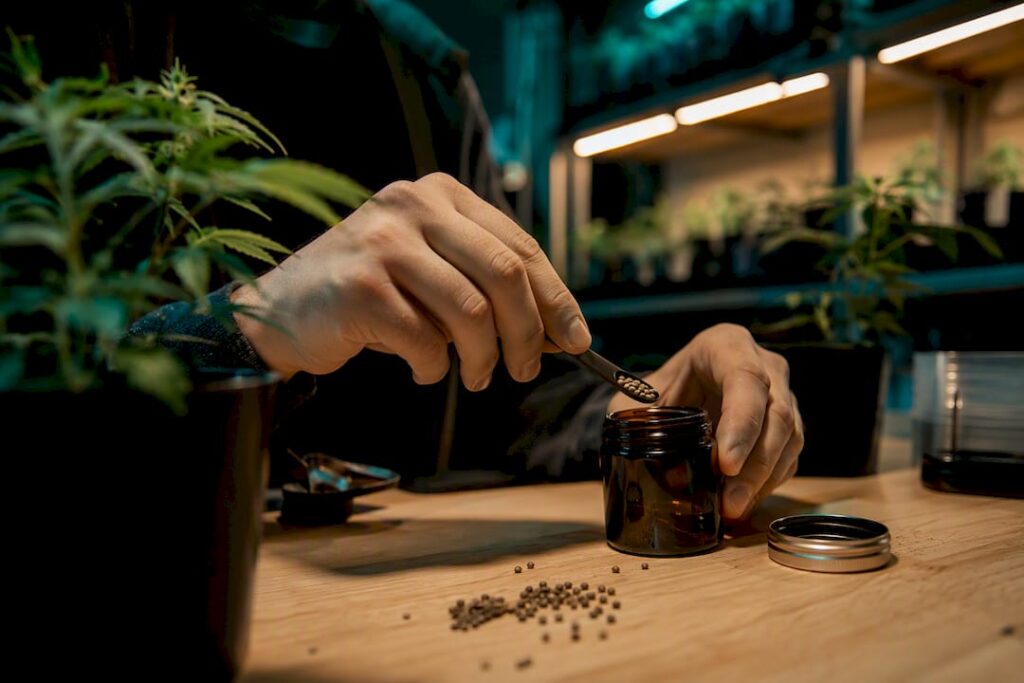
Physically, the seeds should arrive clean, with no flower residue or stem fragments, and sorted by size and degree of maturity. This sorting is not cosmetic: careful cleaning and selection by the seed bank directly affect the germination rate you will get. The inner packaging usually includes an airtight jar or bag with silica gel, and the outer packaging arrives in discreet boxes that don’t give away the contents during transport.
Then there is the part many growers ignore: the metadata. A professional pack comes with a label showing the exact variety, the declared phenotype, the batch, the harvest or packaging date and, where applicable, the expected feminisation rate. That label is your proof if something goes wrong.

And then there’s what can’t be seen at a glance: genetics. Every seed carries an embryo that acts as the blueprint of the future plant, and that blueprint determines the vigour, the cannabinoid profile and the final structure. You can have two seeds that look identical on the outside and completely different results on the inside, depending on which genotype is engraved in them. To understand this in depth, it’s worth reviewing the difference between genotype and phenotype in cannabis, because it explains why two plants of the same variety can grow differently.
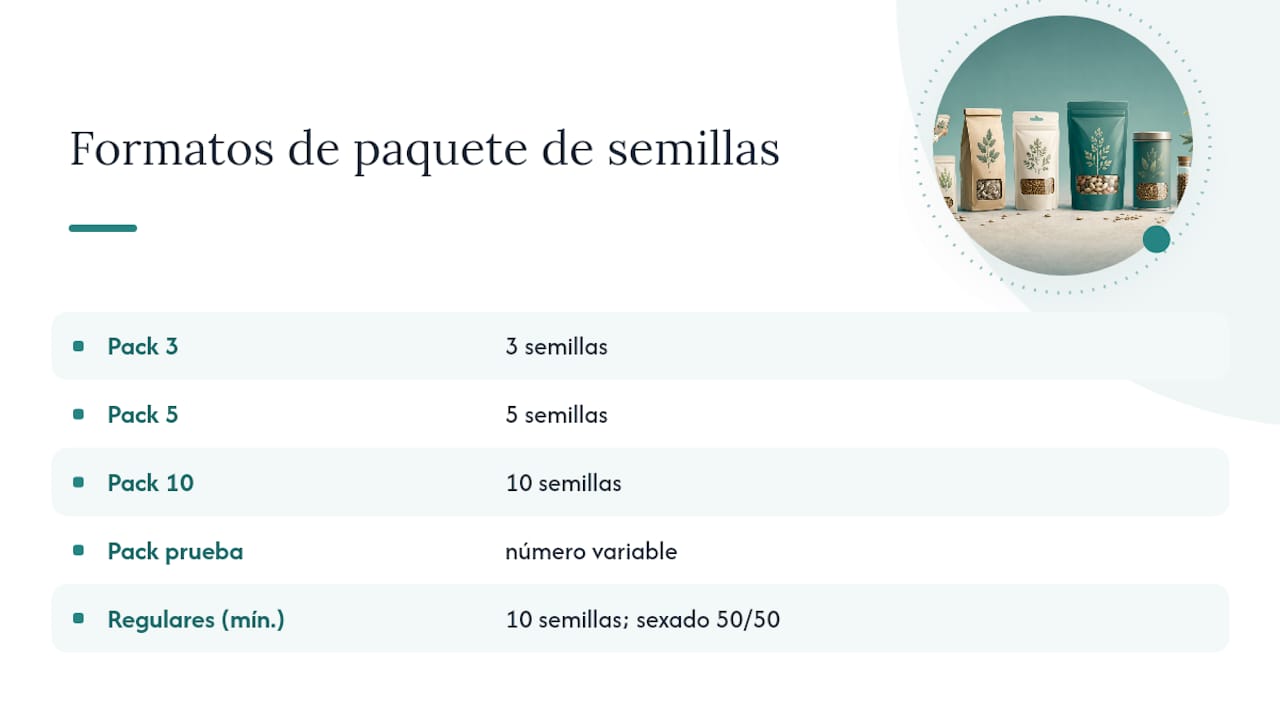
As for formats, most catalogues sell in packs of 3, 5 or 10 units, although some offer trial packs with a variable number of seeds, including options for larger quantities in some cases. Regular seeds are almost always sold in minimum packs of 10, because as they aren’t feminised you need a margin for the 50/50 sexing.
💡 Pro tip: a mature seed usually has a dark brown colour with streaks and a shell that feels hard to the touch; an immature seed is pale, greenish or soft and rarely germinates well. If you see several like that in your pack, it is a sign of a poorly selected batch.
How to choose the pack size and type for your project
Don’t buy in bulk without thinking about your real goal. The right quantity depends on whether you are trying a new genetic, setting up a stable home grow or looking for volume.
- If you just want to try a variety, a pack of 3 to 5 seeds is enough to assess flavour, effect and behaviour before investing more.
- If you want to keep 2 to 4 plants at home consistently, a pack of 5 or 10 feminised or autoflowering seeds gives you some leeway without overspending.
- If you are doing your own breeding or need to select mothers, a pack of 10 or more regular seeds gives you the volume you need to sex the plants and discard the males.
| Scenario | Recommended format | Risk/benefit |
|---|---|---|
| Trying out a new strain | 3 to 5 seeds | Low financial risk, limited information |
| Stable home growing | 5 to 10 feminised/autos | Good balance between cost and predictability |
| Breeding or genetic selection | 10 or more regulars | Higher initial cost, necessary for sexing |
Before you decide, ask yourself these questions: what is your real goal with this harvest? How much space and light do you have available? Can you afford to lose a plant without it affecting the result? Does your budget allow you to buy extra as a cushion? If you’d like to explore this decision further, take a look at the comparison between feminised and regular seeds or the guide on autoflowering seeds for beginners.
What to check when you receive the package: inspection and quick test
As soon as you open the parcel, before putting anything away, carry out this inspection:
- Count the seeds and compare with what the label states.
- Check physical integrity: colour, hardness, absence of mould or marks.
- Check that the label matches what you bought (variety, type).
- Note down the batch number in case you need to contact support.
- Keep any warranty documentation or replacement policy the seller includes.
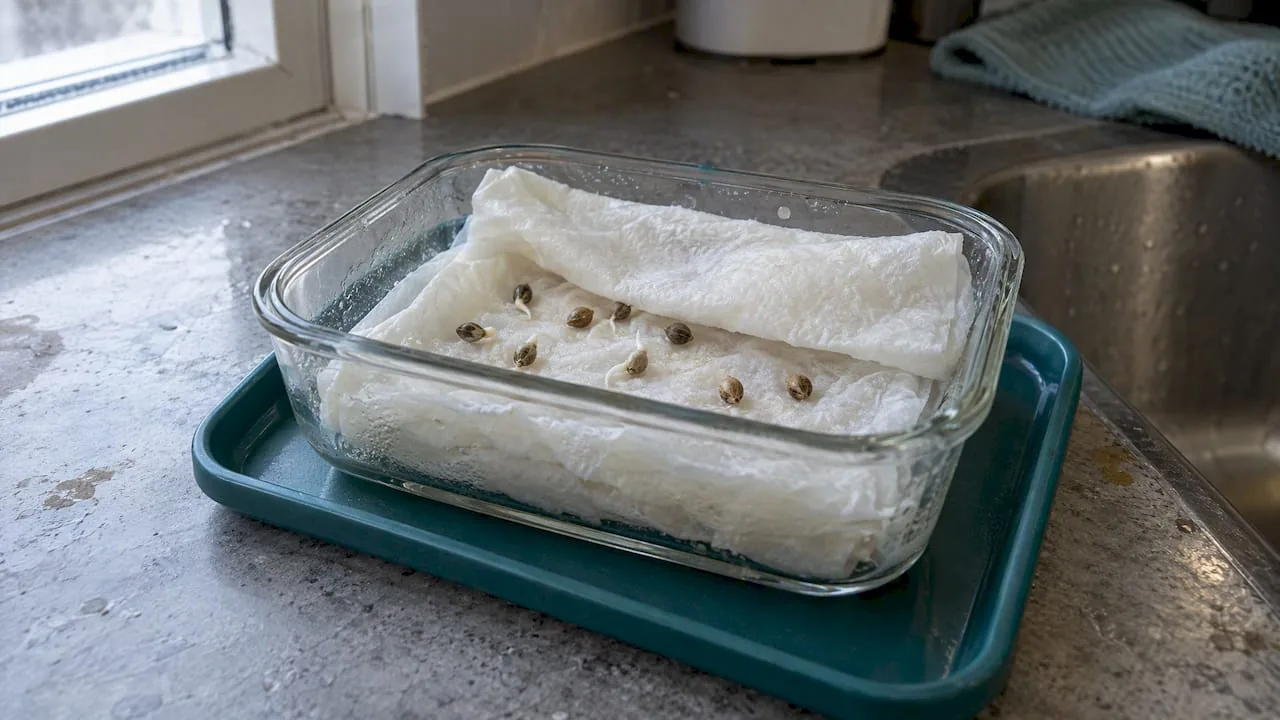
If you have doubts about viability, do a quick germination test:
- Moisten two pieces of kitchen paper, without soaking them.
- Place the seeds between the two papers and close them in a bag or container with a little air.
- Leave the set-up in a dark, mild place, checking it daily.
- Within a few days you should see the root peeking out; a damp paper test is the most accessible method to confirm viability without risking the whole batch.
- Carefully move the ones that have germinated to their final substrate.
No genetics can guarantee 100 % germination, so the occasional loss is to be expected. If the failure affects a good part of the pack, that’s when it’s worth contacting the seller and providing the batch number. To go deeper into the technique, the complete guide to germinating cannabis seeds covers variations of the method depending on the type of seed.
Feminised, regular and autoflowering: how it affects the pack you buy
Each type of seed has its own buying logic. Feminised seeds are designed to produce almost exclusively female plants, which gives you control over production without losing space to males. Regular seeds split 50/50 between males and females, which is why they are essential when you want to breed your own genetic lines. Autoflowering seeds, on the other hand, move into flowering by age rather than by photoperiod, which shortens the cycle and simplifies growing for beginners.
That difference translates directly into the pack size that makes sense to buy. A pack of 10 regular seeds barely gives you a reasonable margin to sex them and keep a few useful females. With feminised or autoflowering seeds, a pack of 3 to 5 already covers a full home grow, because almost all the plants will be usable.
- Feminised: more control, ideal for limited space.
- Regular: needed for breeding, they require larger packs.
- Autoflowering: short cycle, little room to correct growing mistakes.
💡 Pro tip: if you have never tried a genetic line, always start with the smallest pack available. Buying in bulk only makes sense once you know how that variety behaves in your particular space.
How to store the contents of the package so they don’t lose viability
Storing seeds badly is the quickest way to throw your money away. In ideal conditions, a cool, dry environment, ideally close to 6 ºC and with low relative humidity, a well-packaged seed keeps good viability for roughly two years. Temperature fluctuations and direct light break that dormancy too early, so a sudden change from heat to cold can damage the embryo without you noticing anything on the outside.
Build your own storage kit by following these steps:
- Get an airtight glass container, never porous plastic.
- Add a sachet of silica gel to absorb excess moisture.
- Label each batch with the variety and purchase date.
- Keep the container in a dark place with a stable temperature, ideally in the fridge.
💡 Pro tip: keep a simple record with the purchase date and batch of each variety. That way you avoid mixing old seeds with new ones and you’ll know exactly which to prioritise before they lose vigour.
What I learned the hard way about pack contents
I have seen packages arrive with seeds mixed from different batches, with no clear label and more than one variety jumbled in the same packet. That kind of carelessness ruins entire harvests, because plants from the same tray end up with completely different cycles and needs. That is why I value it so much when a seed bank documents every batch and backs its product with a real replacement policy, something that Bluedog Genetics applies in its packaging and guarantee process.
My routine in the first 48 hours after receiving an order is always the same: count, inspect, photograph the batch and store it in the cold. That habit has saved me more than one harvest.
Our commitment to the quality of the pack’s contents
Bluedog Genetics exists because many growers have grown tired of packs with no traceability and no support when something goes wrong. We sort by size and maturity, clean the seeds before packing and seal them with silica gel so that every seed arrives in real condition to germinate, with order tracking and discreet shipping on every order. If a seed doesn’t measure up, our guarantee and replacement policy is designed to sort it out without any hassle.
If you’re looking for something specific for your next grow, two varieties stand out depending on the buyer profile: those who want simplicity and a short cycle will find autoflowering options in our catalogue ready for small spaces, and those who prioritise total control over production will find premium feminised genetics in our seeds category. Browse the full catalogue and choose according to your harvest goal.