

Slaw: seeds-for-guerrilla-growing
For guerrilla growing, prioritise short-cycle autoflowering seeds or hardy photoperiod plants with early flowering: both require fewer visits to the site and tolerate climate uncertainty better. The reason is simple: in an isolated spot you cannot control watering or correct mistakes daily, so the genetics have to do that work for you. Below you will find the selection criteria, the approximate calendar and the minimum care that makes the difference between a harvest and an abandoned plant.
In short:
- Short-cycle autoflowering seeds are preferable for guerrilla growing, as they mature in a few weeks and require fewer visits to harvest.
- Humidity resistance, short flowering and a compact size increase the chances of survival outdoors in isolated spots with changeable weather.
- It is essential to assess the microclimate, sun exposure and the risk of pests or animals before choosing the right variety, to avoid losses.
- The legality of growing on land that isn’t yours or isn’t authorised remains a risk, so we recommend finding out about local regulations beforehand.
- To ensure good germination and growth, it is advisable to sow several seeds from the same batch to check their behaviour and genetic stability.
Varieties and seed types useful for guerrilla growing (advantages and limits)
Before choosing anything, it helps to be clear about what sets apart the three types of seed you’ll find in any serious catalogue. Autoflowering seeds go from germination to harvest without depending on the photoperiod, which makes them predictable in terms of timing. Feminised seeds guarantee female plants, so you don’t discover males halfway through the season when you can no longer react. Regular seeds keep the full genetic variability, with males and females in natural proportions, something that only interests those who want to make their own crosses.
For guerrilla growing, autoflowering plants tend to win for a practical reason: they mature in a few weeks and you don’t need to go back to the site to check the light change or worry about late flowering if autumn arrives early. Our guide on the advantages of autoflowering for beginners explains well why that short cycle reduces the margin for error so much.
That said, feminised photoperiod plants still make sense when the site gets good light and you can afford a longer season: they tend to produce more resin and offer a greater margin for recovery after a stress episode. Regular seeds, for their part, are almost never the first choice for guerrilla growing unless the grower has experience sexing plants and is prepared to remove males mid-cycle, which is hard to do in time on an isolated plot. You can review how that process works in our guide on sexing cannabis plants.
In short, this is what each type brings to an isolated grow:
- Autoflowering: short, predictable cycle, ideal when you can’t visit the site often.
- Photoperiod feminised seeds: higher potential yield if the location has good sun exposure and enough time.
- Regular: only advisable if you already know how to identify and remove males quickly.
Genetic characteristics that make guerrilla growing easier
Not all seeds within the same category behave the same way outdoors. What really determines whether a plant survives without your constant intervention is its specific genetic traits, and this is where you should look closely before buying.
Resistance to humidity and mould is probably the most important trait in temperate or coastal climates, where botrytis can ruin an entire bud in just a few days of rain. Cannabis production in Europe relies largely on varieties adapted to changing seasons and weather conditions, precisely because the outdoor climate is unforgiving to fragile genetics.
A short flowering time also acts as insurance: the sooner the plant finishes its cycle, the less time it stays exposed to the first frosts or end-of-season rain. A low or columnar habit helps for two reasons at once: it reduces the risk of wind snapping branches and makes it easier to camouflage the plant among wild vegetation of similar height.
Finally, phenotypic stability matters more than it seems. When you buy an unstable genetic line, each seed can behave differently under the same climate, which makes it impossible to plan precisely. The morphological variation between lineages confirms that phenotypic stability is a valuable trait for outdoor growing in changing conditions.
- Tolerance to mould and humidity: key in areas with night-time dew or autumn rains.
- Short flowering: reduces exposure time to early frosts.
- Compact habit: less wind damage and easier to conceal.
- Genetic stability: predictable behaviour between seeds from the same batch.
Pro tip: if you don’t know a strain’s history, always sow two or three seeds of the same variety in the same spot: it will give you a real idea of its stability before you depend on it across the whole plot.
How to choose seeds according to microclimate, season and location
Choosing well isn’t a matter of taste, but of reading the terrain before buying the seed. A sunny microclimate sheltered from the wind suits more demanding varieties; an exposed slope or an area with frequent fog calls for much hardier genetics.
- Assess the real sun exposure of the spot, counting hours of direct light rather than just the general impression of a “sunny place”.
- Identify the risks in the environment: constant wind, ambient humidity, the presence of herbivores or areas where animals pass through.
- Cross-check that data with the variety’s flowering time: the shorter the cycle, the smaller the window of climate risk.
- Check the sowing and harvest window for your latitude, as outdoor production in Europe varies considerably between warm and cold regions, as noted in the EUDA’s INSIGHTS Cannabis report.
- Check access to water near the chosen spot, without that meaning daily visits that could be noticed.
- Check the available plant cover to camouflage the silhouette of the plant during growth.
Before buying, run through this short checklist: does the spot receive enough direct light? Does the variety tolerate the humidity of the area? Does the flowering cycle finish before the first local frosts? Is there enough natural cover? If you answer yes to all four points, the seed and the site are compatible. Our guide on how to choose seeds according to your experience goes deeper into how to adjust these decisions according to the grower’s level.
Practical calendar: from germination to outdoor harvest
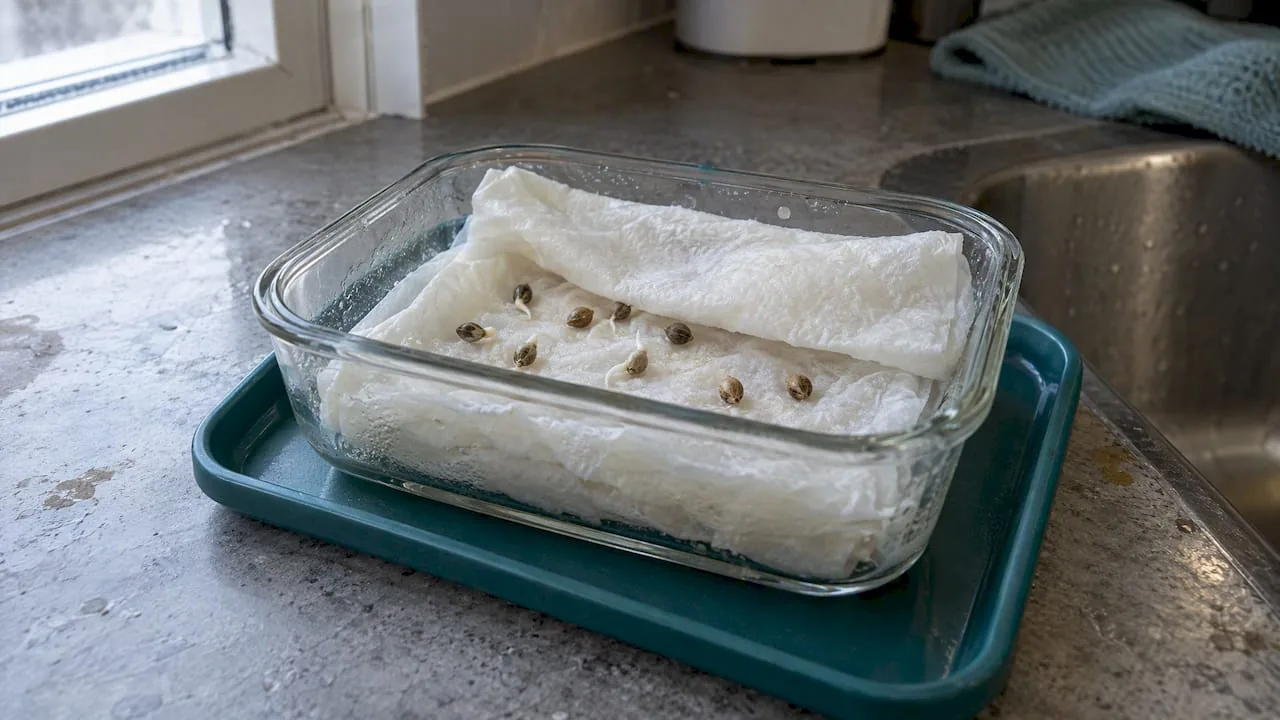
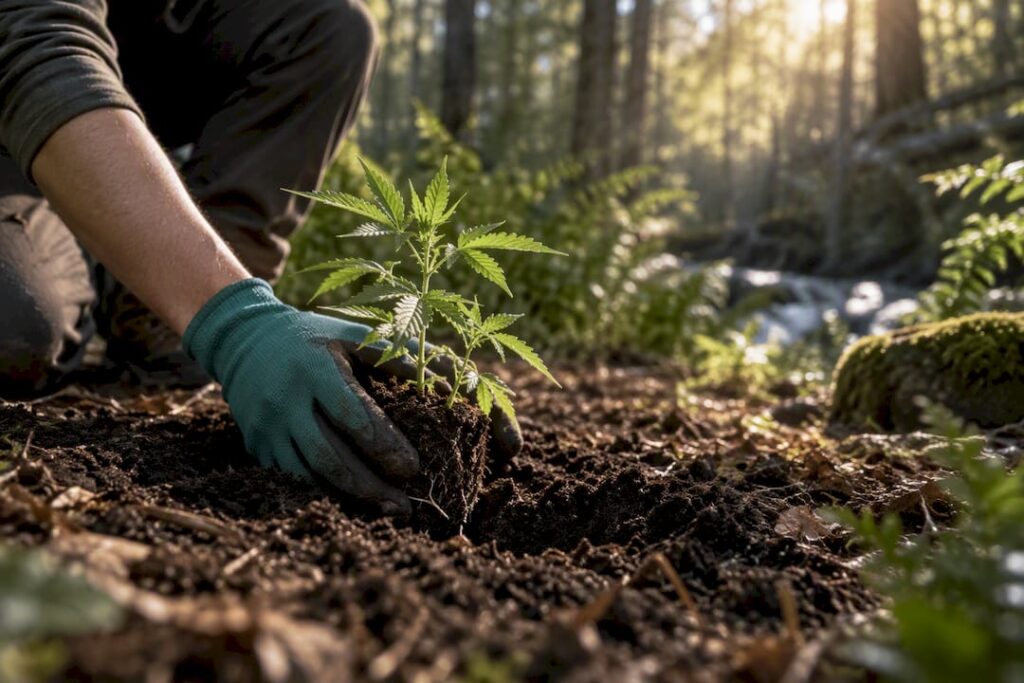
In temperate climates, direct sowing or transplanting seedlings germinated at home is usually done between late April and May, when the risk of night frosts has passed. Transplanting into the final ground is ideally done when the seedling has between three and five true leaves, the point at which it copes best with transplanting without collapsing from stress.
Autoflowering plants usually complete their full cycle, from germination to harvest, in a considerably shorter time than photoperiod plants, which depend on the shortening days of late summer to start flowering and tend to stretch the season into September or October.
The signs of ripeness are fairly clear once you know what to look for:
- Milky or amber trichomes instead of clear ones, visible with a simple magnifying glass.
- Pistils mostly curled and darkened, a sign that the plant has stopped developing new flower tissue.
- Yellowing lower leaves, a natural sign that the plant is reabsorbing nutrients before the end of the cycle.
If the season is delayed by adverse weather or late sowing, the most sensible option is to bring the harvest forward even if the result is not the best possible: a harvest with trichomes that are still slightly clear is better than losing the whole plant to the first hard frost.
Essential care in guerrilla conditions: watering, minimal nutrition, pests and camouflage
Watering is, by a long way, the care task that most limits an isolated grow. Outdoor cannabis plants have a considerable water demand, so it’s worth planning the planting spot near a natural water source without that meaning obvious daily visits. The signs of water stress are easy to recognise: drooping or inward-curling leaves during the hottest hours, and a dull green colour that recovers overnight. Our guide on how often to water cannabis explains in detail how to adjust the rhythm according to the growth stage.

As for nutrition, slow-release fertilisers or organic fertilisers mixed directly into the substrate at transplanting time drastically reduce the need to return to the plot. It’s less precise nutrition than in a controlled grow, but enough to sustain a hardy plant throughout the whole season.
Pest control in guerrilla growing relies more on prevention than on active treatment:
- Simple physical barriers, such as low mesh around the stem, against rodents and slugs.
- Yellow sticky traps to detect whitefly or aphids before the infestation spreads.
- Organic solutions such as neem oil, applied on occasional visits and not as a weekly routine.
Finally, camouflage starts with choosing the location and not with later techniques: planting among vegetation of similar height and colour greatly reduces the silhouette that can be recognised from the air. Aerial surveillance is one of the most common causes of crop detection in remote areas, and spots with irregular tree cover noticeably reduce that exposure.
Pro tip: avoid geometric patterns when planting. A perfectly straight row of plants stands out much more from the air than a scattered, irregular group among the existing vegetation.
Why trust us: resources and evidence from Bluedog Genetics and the author
This guide is signed by Omar, who has hands-on experience in low-maintenance outdoor growing. Bluedog Genetics complements this content with in-house guides on germination and seed selection, as well as discreet shipping policies, order tracking and quality guarantees designed to improve the buying experience.
Expert perspective on risks and responsibility
Resilient genetics solve the climate problem, but not the legal one. Growing on someone else’s land or without authorisation carries risks that no seed can mitigate, and detection through patrols or aerial surveillance continues to rise in several areas of Europe. Before sowing, find out about the local regulations in force and consider alternatives within the legal framework, such as recognised growing associations where the legislation allows it.
Recommended Bluedog Genetics options for resilient outdoor growing
If you are after short cycles and fewer visits to the plot, the autoflowering seeds category from Bluedog Genetics brings together varieties designed for exactly that: fast maturity and good tolerance of changeable outdoor conditions. If, on the other hand, your site has good sun exposure and you would rather remove the risk of male plants without sacrificing potency, the feminised seeds category is the most practical option.
Before you buy, take a look at our complete germination guide: a good start from day one multiplies the chances of the plant reaching harvest in one piece, even in the most demanding conditions of an isolated grow.

Frequently Asked Questions
What are the three main types of cannabis seeds?
There are autoflowering, feminised and regular seeds. Autoflowering seeds don’t depend on the photoperiod and complete their cycle quickly, feminised seeds guarantee female plants, and regular seeds keep the natural ratio of males to females.
Which autoflowering variety yields best outdoors?
There is no single autoflowering variety that is the most productive in every climate, as yield depends on the microclimate, the available light and the genetics chosen. It is best to prioritise varieties with good humidity tolerance and a short cycle, such as those in the autoflowering category at Bluedog Genetics.
What is the best autoflowering seed for outdoor growing in guerrilla conditions?
The best option is usually an autoflowering variety with short flowering and good resistance to mould and humidity, suited to the specific microclimate of the growing spot. Take a look at our guide on the advantages of autoflowering plants for beginners to choose wisely according to your level of experience.
Is it legal to grow cannabis seeds on guerrilla land?
The legality of growing cannabis depends on local regulations and varies considerably depending on the country and region. Before sowing on any land, it is worth checking the current legislation and assessing alternatives within the legal framework available in your area.
How do I know if a seed is good quality before sowing it?
A good-quality seed usually has a dark, firm, slightly shiny shell, with no green patches or soft texture. It’s also wise to buy from seed banks with quality guarantees and order tracking, such as those offered by Bluedog Genetics.