


To choose a reliable seed bank, first check four things: reputation that can be verified outside the seller’s own website, transparency about the parent lines, certificates of analysis with published germination rates, and a clear support and shipping policy. Before buying, look for independent reviews and confirm that there is a written germination guarantee. This article recommends a curated catalogue and personalised service that meet these criteria, but the method followed in this article will help you evaluate any supplier.
In short:
- A seed bank’s reputation is verified through forum reviews and years in the market, prioritising experiences with full cycles and responses to criticism.
- It is essential to confirm genetic transparency, the type of parent line and the chemotype profile, especially for medicinal or extraction uses.
- Certificates of analysis and germination rates above 90% guarantee quality and reliability when buying, documenting any failures if there are any.
- The discreet shipping policy and the legal conditions, especially within the European Union, protect the buyer in case of problems or customs holds.
- A supplier’s credibility is confirmed by real support, explicit guarantees and a legal base within the EU, avoiding seed banks with no verifiable track record or with warning signs.
Reputation and track record: how to verify it and what it indicates
A seed bank’s reputation isn’t measured by how pretty its website is, but by what people who have already germinated its seeds say about it. Look for mentions on growing forums, dated threads and screenshots, and compare what was being said three years ago with what is said today. A seed bank that has been on the market for a decade without accumulating systematic complaints about unstable genetics is usually a safer bet than a newcomer with no digital trail.
That doesn’t mean automatically dismissing young breeders. Some have spent years working specific lines in small circles before opening an online shop, and their early feedback can be excellent even if their time as a brand is short.
To carry out this check in an orderly way:
- Search for the seed bank’s name alongside words such as “problem”, “germination” or “scam” in search engines and forums.
- Check whether the reviews are dated and whether they describe complete growing cycles, not just the purchase.
- Check whether the seed bank responds publicly to criticism, and how it does so.
- Cross-check information from at least two independent sources before deciding.
The important thing is to interpret mixed signals with judgement: an old seed bank with a recent run of complaints deserves more caution than a new breeder with solid, consistent technical testimonials.
Genetic transparency: parent lines, IBL and chemotype
A serious seed bank publishes where each variety comes from, not just an attractive commercial name. Stable genetics, known as a stabilised inbred line (IBL), come from generations selected for consistent traits; real stabilisation usually requires between 5 and 7 generations of selection, so a “newly created” variety promising uniform results should raise suspicions. An F1 hybrid, on the other hand, crosses two stable parent lines and tends to show more vigour but also more variation between plants from the same batch.
The chemotype (the specific profile of cannabinoids and terpenes the plant produces) matters more than the name of the variety when the goal is medicinal or extraction, as reported by Cáñamo. To decide with good judgement:
- If you’re looking for high CBD, ask for the approximate CBD and THC percentage of the chemotype, not just “rich in CBD”.
- If you are looking for resin for extraction, prioritise lines with data on trichome production or hash yield.
- If you are after flavour and a recreational experience, check the declared terpene profile alongside the original genotype.
Pro tip: Save a screenshot of the genetics page at the time of purchase. If the seed bank later changes the description of the variety, you will have proof of what you actually bought.
COA and germination rates: the proof you should demand
The certificate of analysis (COA) is the document in which an independent laboratory confirms what the product really contains: cannabinoid profile, terpenes and the absence of contaminants such as heavy metals or pesticides, as the guide on germination under LED lights explains in detail. With seeds, a relevant COA doesn’t always certify the seed itself, but it can back up batches of flower from the same genetic line, which gives reliable clues about the real chemotype.

Key fact: reputable seed banks publish documented germination rates, and the reasonable range for fresh seeds is between 90% and 95%. If rates stay below that range consistently, something is wrong with the storage or the original genetics.
If a batch doesn’t germinate as it should, document the failure properly:
- Photograph the ungerminated seeds next to the packaging and the batch number.
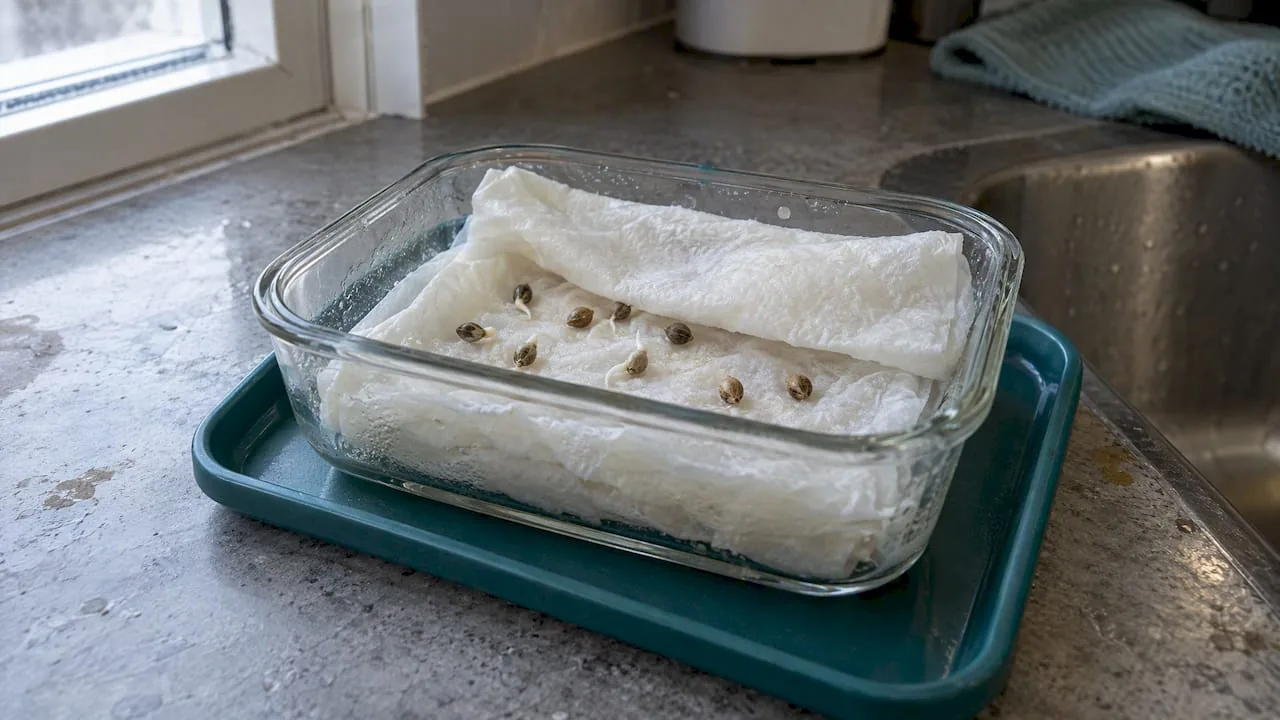
- Note down the purchase date, the sowing date and the method used (damp paper, substrate, peat plug).
- Keep the order confirmation email as proof of the purchase date.
- Contact support with this documentation before the stated guarantee period expires.
Our complete guide to germinating cannabis seeds explains step by step how to avoid handling mistakes that are sometimes mistaken for a defective seed.
Independent reviews and community testing: where to find them
The reviews that really matter are almost never on the shop’s product page. Growing communities spot systematic problems, such as excessive phenotypic variation within the same pack, before those problems reach commercial reviews. A thread following a grow over several months is worth more than twenty five-star ratings with no context.
To tell a useful review from an empty one, look at this:
- It mentions concrete technical data: germination percentage, actual flowering time, final height.
- It includes progress photos at different stages, not just one image of the finished bud.
- It describes both strengths and flaws, including the variance between plants from the same pack.
- It is dated and, if possible, cross-referenced with other growers from the same batch.
When several independent growers describe the same variety with results that are consistent with one another, the genetics are probably well fixed. When every testimonial tells a different story about the same seed, suspect high phenotypic variance or mixed batches.
Shipping, discretion and legal compliance: which policies to check
Discreet packaging is not a cosmetic detail: it is the difference between an order that arrives without incident and one held up in customs. Before buying, check these three points in order:
- Confirm that the seed bank details its discreet packaging policy and provides a tracking number for the shipment.
- Check what the seed bank does if a package is held: some reship at no cost, others only refund part of the amount.
- Check whether the seed bank operates within the European Union, because that makes it easier to enforce consumer rights in the event of a dispute.
In Spain, buying and selling cannabis seeds for collecting and private growing is legal as long as national laws and the applicable limits are respected. This does not exempt the buyer from knowing the local regulations on growing, which vary depending on the intended use of the plant.
Registered office and terms of sale: consumer rights to consider
Where the seed bank has its legal base determines, in practice, what you can do if something goes wrong. A supplier established within the European Union offers more accessible complaint routes than one based outside it, because European consumer protections require return periods and minimum guarantees that do not depend on the seller’s goodwill.
Before paying, find these clauses in the terms of sale:
- Exact deadline for returns or claims on defective seeds.
- Accepted payment methods and whether any offers additional buyer protection (such as certain payment gateways).
- What documentation the seed bank requires to process a return.
- Whether there is a direct contact channel (email, chat, phone) as well as a generic form.
If the seed bank breaks its own terms, the first step is to gather all the correspondence and screenshots of the policy as published at the time of purchase. A seed bank based in the European Union can rarely ignore a well-documented complaint without risking real legal consequences.
Customer service and germination guarantee: what to expect and how to test it
A serious germination guarantee is not a marketing phrase, it is a commitment with clear conditions: it normally covers replacement of seeds if a reasonable percentage fail to germinate, as long as the buyer has followed a standard sowing method. Some seed banks offer direct replacement, others a discount on your next purchase, and it is worth knowing that difference before buying, not after a failure.
Real support can be told apart from facade support by concrete signs:
- Replies signed by a real person, not just generic automated messages.
- Reasonable response time, ideally stated on the website itself.
- Previously resolved cases mentioned in forums or reviews.
- Willingness to ask for concrete evidence (photos, dates) rather than denying the problem outright.
Pro tip: Before sowing, photograph the whole pack with the batch number visible. If you need to make a claim later, that initial image is the strongest proof that you bought that specific batch.
To prepare a valid claim you need the purchase date, batch number, photos of the problem and a brief description of the sowing method used.
Warning signs: red flags that should make you rule out a seed bank
Some signs leave little room for debate. If they appear, it is safer to look for another supplier than to risk time, money and an entire harvest.
- No independent reviews can be found outside the shop itself, or only generic testimonials with no technical detail.
- Promises of 100 % germination rates without any data or certificate to back them up.
- Lack of a detailed shipping policy or verifiable contact information.
- Variety descriptions that change between the website and the packaging actually received.
- Prices well below the rest of the market with no explanation (old genetics, liquidated stock, badly stored batch).
None of these signs on its own is a definitive verdict, but two or more together are reason enough to close the tab and look for another seed bank.
Practical checklist: how to apply the criteria step by step before buying
The order matters as much as the criteria themselves. Follow this sequence before finalising any purchase:
- Check the seed bank’s reputation on forums and in historical searches, not just on its own website.
- Check the genetic transparency of the specific variety: parental line, type (IBL, F1) and chemotype.
- Look for COA documentation or published germination rates, ideally above 90 %.
- Confirm the discreet shipping and reshipping policy in case of customs detention.
- Contact support with a simple question before buying, to check response time and quality.
If you’re a beginner, prioritise support and a germination guarantee over genetic exclusivity: a simple variety with good backing gives better results than a rarity with no support. If you already have experience, genetic transparency and the chemotype weigh more. For a first purchase, a pack of 3 to 5 seeds of a well-documented variety is more sensible than taking a risk on a limited edition with no track record. Our quality seed selection checklist covers each point in more detail.
Evidence of experience: what Bluedoggenetics and Omar bring
The credibility of a guide to seed banks should not rest on loose claims, but on resources that readers can check for themselves. There is a library of technical articles, from step-by-step germination to selecting limited-edition genetics, designed so that any grower can verify the information before deciding.
The difference between a reliable seed bank and an opportunistic one is almost never in the marketing. It’s in whether you can check, with data and a real community behind it, what each product page promises.
We stand behind a curated catalogue with explicit quality guarantees and order tracking, and we encourage every buyer to check those claims against independent forums and the published terms of sale. The guide to limited edition seeds shows, with concrete examples, how an exclusive genetic line is documented before it goes on sale. If you have doubts about a specific batch, the support channel is the most direct way to ask for that documentation.
A practical recommendation from a reliable seed bank
Applying these criteria strictly, a reliable seed bank must meet several requirements at once: a track record that can be verified outside its own website, detailed genetic profiles, documented germination rates, and a shipping and support policy that stands up to a real complaint. Few suppliers meet all four consistently at the same time.
The proposition is built around these points: a curated selection of exclusive varieties rather than a massive generic catalogue, discreet shipping with tracking, personalised customer service and explicit quality guarantees on every order. For a grower who already knows what to look for (documented genetics, real support, clear conditions), this reduces the chance of unpleasant surprises compared with seed banks that have no verifiable track record.
This does not mean you should stop checking things for yourself. Still apply the reputation checklist, review the terms of sale and confirm the guarantee policy before your first order, whether with Bluedoggenetics or any other supplier. The difference between a useful guide and a simple list of seed banks is that the former gives you the tools to decide using your own judgement, not just a name to trust blindly.
Procedure for claiming or returning problem seeds
If an order arrives damaged, with germination below what is reasonable, or with a different variety from the one you bought, the procedure follows a logical order that is best followed without skipping steps.
First, gather the evidence: photos of the packaging with the batch visible, the purchase date, the sowing date and the method used. Second, check the claim period stated in the seed bank’s terms of sale before it expires, because many guarantees have a limited window from the delivery date. Third, contact support with that documentation, clearly and concisely, stating what solution you expect (a replacement, a partial refund or a discount).

If the seed bank operates within the European Union, European consumer protections back minimum return periods that the seller cannot unilaterally ignore. If the supplier doesn’t respond or rejects the claim without justification, keep all correspondence in writing: it’s the basis for any later complaint to a consumer protection body.
A well-documented claim from day one is almost always resolved faster than one improvised weeks later, when there is no longer a clear record of the dates or the batch involved.
What most seed guides won’t tell you
Most articles on this topic repeat the same five tips without saying which one matters most. My view, after reviewing how serious seed banks actually behave compared with opportunistic ones, is that genetic transparency is the criterion that is least often faked and the one that best predicts future problems. A seed bank can fabricate reviews or dress up its age, but it rarely bothers to invent a detailed, coherent genetic profile if there is nothing real behind it.
The usual mistake of the novice buyer is to put price or a variety’s popularity above the available documentation. The experienced buyer’s mistake, on the other hand, is usually to trust their own growing judgement too much and overlook the small print of the guarantees, until a batch goes wrong and they discover the claim period has already passed. Both mistakes can be avoided with the same discipline: ask for proof before paying, not after sowing.
How to get started with Bluedoggenetics: catalogue and next step
You can find varieties with documented genetics, explicit quality guarantees, discreet tracked shipping and personalised support to resolve questions before and after purchase. Unlike generic seed banks that bet on volume without traceability, Bluedoggenetics focuses on a curated selection of exclusive genetics, which reduces the risk of surprises in germination or phenotype.
If it’s your first purchase, head to the Bluedoggenetics shop and filter by the varieties that fit your goal (yield, chemotype, flowering time) before deciding on quantity. Check the terms of sale to learn about deadlines and guarantees, and once you are clear on your pack, complete it directly from the basket. Competitive prices and regular promotions mean that starting with serious genetics won’t blow your budget for the first harvest.
Sources
This article draws on practical industry criteria and on the legal framework in force in Spain for the sale and purchase of seeds for collecting and private growing purposes.
- Guide to choosing the best marijuana seeds | Cáñamo
- How to recognise a good seed bank: 7 criteria for buying seeds in 2026 | Hanf Magazin
- Seed Banks – Legal Advice – Abogados Cánnabis
Always prioritise sources with a date, technical detail and traceability over isolated reviews with no context.