

Yes: you can greatly reduce your exposure when buying cannabis seeds online if you check the shop’s security, pay with tokenised methods and choose discreet delivery. Privacy when buying seeds is never absolute, but three concrete actions make the difference: confirm HTTPS and a clear privacy policy before paying, use a virtual card instead of your physical one, and select locker pickup or neutral packaging so that nobody outside the order knows what you’ve bought.
In short:
- Buying cannabis seeds online can be more private if you check that the shop uses https and a valid SSL certificate.
- It is essential to check that the privacy policy clearly explains who is responsible for processing and how your data is used.
- To reduce your digital footprint, it is a good idea to use an email alias, a virtual card and to browse in incognito mode or with a VPN.
- Total anonymity in payments is impossible, but tokenised cards and traceable cryptocurrencies limit data exposure.
- Ask for plain packaging, separate addresses and pickup points so that shipments are discreet, protecting your privacy.
What a seed shop’s privacy policy should include
Before putting anything in your basket, open the privacy policy and look for five things. If you can’t find them in under two minutes, that shop has a transparency problem that probably translates into a problem with how your data is handled.
The GDPR requires any online shop to clearly identify who is responsible for the processing, include their contact details and, where applicable, those of the data protection officer. Alongside that, it must explain what it uses your information for and on what legal basis, something that changes depending on the purpose:
- Performance of the contract: the data needed to process and ship the order do not require your explicit consent; they are part of the commercial agreement.
- Marketing: sending you offers by email does require separate consent, which you must be able to withdraw at any time.
- Retention period: the shop must say how long it keeps your data and why that period and not another.
- Data minimisation: it should only ask you for what is strictly necessary to complete the purchase, never your exact date of birth or irrelevant questions.
- Data processors: if you subcontract logistics or payment to third parties, you must name them and explain whether there are transfers outside the European Union.
A policy that mentions all of this, including cookie management with a real option to refuse them, is the first sign that you are buying from a reputable site.
Technical measures that ensure website security (what to check)
The second check is technical, and it takes seconds with your browser open. Incibe recommends, as a first filter, checking that the URL starts with https:// and that the SSL certificate is valid, which you can see by clicking the padlock in the address bar.
That is not enough on its own. It is also worth looking at:
- Active SSL certificate with no browser warnings, not just present but free of errors when the page loads.
- Recognised trust seals, which indicate an initial assessment even though they are not a total guarantee of security.
- Signs of technical maintenance, such as a platform that shows no visible errors, broken forms or outdated version notices.
- Enhanced authentication on your account, ideally with two-step verification available from the user dashboard.
Pro tip: if the shop lets you create an account without requiring strong passwords or offering additional verification, assume that a security flaw in its system affects you directly, not just them.
Good cybersecurity practices for e-commerce include data encryption, regular software updates and security audits, and those audits significantly reduce the risk of your data ending up exposed in a breach.
How to buy with more privacy: the buyer’s habits and tools
The shop takes care of its part, but you take care of yours. These four habits reduce your digital footprint without the need for advanced technical knowledge:
- Use a specific email alias for each shop. Email aliases let you identify exactly which retailer leaked your data and deactivate only that alias without touching your main account.
- Generate a virtual or single-use card for payment. Many banks offer this option in their app, and it limits the damage if the card number is compromised.
- Shop from a separate browser profile or in incognito mode. This stops cookies from other sessions getting mixed up with your purchase history and building a more detailed advertising profile.
- Use a VPN and prioritise pick-up points instead of your home address. Both measures separate your real location and your physical address from the order.
None of these measures requires spending extra money, just changing the order in which you do things before clicking “pay”.
Payments and anonymity: what’s real and what isn’t
We have to be honest here: total anonymity in a legal payment does not exist in Spain. Financial institutions are required to apply identity verification procedures (KYC) to their customers, so any card or bank account is linked to your identity at some point in the chain.
What you can control is how that information is exposed to businesses and third parties:
- Virtual cards and tokenised wallets such as Apple Pay or Google Pay replace your real number with a single-use token, drastically reducing the risk if the merchant suffers a data breach, even though the issuer keeps your identity on record.
- Cryptocurrencies are not the magic solution many people think. Most public blockchains are traceable, and buying crypto usually requires KYC on the exchange, so real anonymity is limited.
- Always keep your proof of payment showing the date, amount and shop, in case you need to dispute an improper charge with your bank or a consumer association.
Shipping and packaging: what to demand so your purchase is discreet
The parcel that arrives at your door can give away more than the website itself. Before buying, check which shipping policy the shop applies and don’t hesitate to ask if anything is unclear.
Demand these four points at the very least:
- Plain packaging, with no logos or description of the contents on the outside of the box.
- Separate billing and shipping addresses, something many platforms let you set up from the checkout itself.
- Use of parcel lockers or collection points, which avoid linking your home address to the order; buyers who prioritise discretion often use PO boxes or lockers precisely for this reason.
- Clarity on what information appears on the label, because a full name and a detailed sender on the outside of the parcel undo any privacy effort made before paying.
Our guide to discreet seed shipping explains in detail what to ask before confirming an order. If the seller cannot clearly answer what information appears on the package, that is a warning sign.
Data subject rights and what to do if you think your data has been leaked
You have the right to access your data, rectify it, request its erasure and ask for it to be transferred to another platform. Any serious shop should offer a clear channel, usually an email address for the data protection officer or a dedicated form, so you can exercise these rights without hassle.
If you suspect a leak:
- Document the date, the message or the notice that flagged the problem, with screenshots if possible.
- Contact the person responsible first through the channel stated in their privacy policy.
- Remember the legal deadline: the controller must notify the AEPD of the breach within a maximum of 72 hours and inform those affected if the risk is high.
- If you get no reply, you can lodge a complaint directly with the AEPD or with a consumer body.
How Bluedoggenetics protects your privacy (verifiable practices)
Bluedoggenetics applies several of these measures directly:
- Shipping with discreet packaging, with no visible references to the contents.
- Privacy policy and conditions accessible from the my account dashboard.
- Quality guarantees and returns process with defined data handling.
- Personalised support to resolve specific questions before completing your order.
Returns policy and what data the shop collects during the refund process
A return is not just a logistical procedure, it is also a moment when the shop asks you for data again. Before buying, check what information is requested to process a refund and how long it is kept.
It is usual for the shop to ask for the order number, the reason for the return and, if the refund goes to the original payment method, no additional bank details, because the payment gateway already holds that information tokenised. If they ask for photographs of the product or the box, ask whether those images are deleted once the case is resolved or whether they are stored indefinitely.
Spain applies a fourteen calendar day right of withdrawal for online purchases, a period worth knowing about before deciding what information to share in the event of a return. Our page on cannabis seed returns in Spain details how the product seal is handled and what to expect from the whole process.
A detail that many buyers overlook: if the refund is processed through a third party (an external payment gateway, for example), that company also handles your data as a data processor. The shop’s privacy policy should explicitly mention these third parties rather than leaving it up in the air.
Risks and legal consequences of poor privacy management when buying seeds
When a shop mishandles your data, the consequences are not just theoretical. Cyberattacks on e-commerce platforms have grown steadily, and a leaked customer database with names, addresses and details of cannabis seed orders is a particularly sensitive target, because it combines financial information with data that the buyer probably prefers to keep private.
For shops, a GDPR breach can lead to significant financial penalties and the obligation to notify the AEPD of the breach within 72 hours, on top of the reputational damage that follows any public leak. For the buyer, the risk is something more everyday: targeted phishing emails, fraud attempts using real order data, or simply the discomfort of knowing that personal information linked to a sensitive purchase is circulating beyond your control.
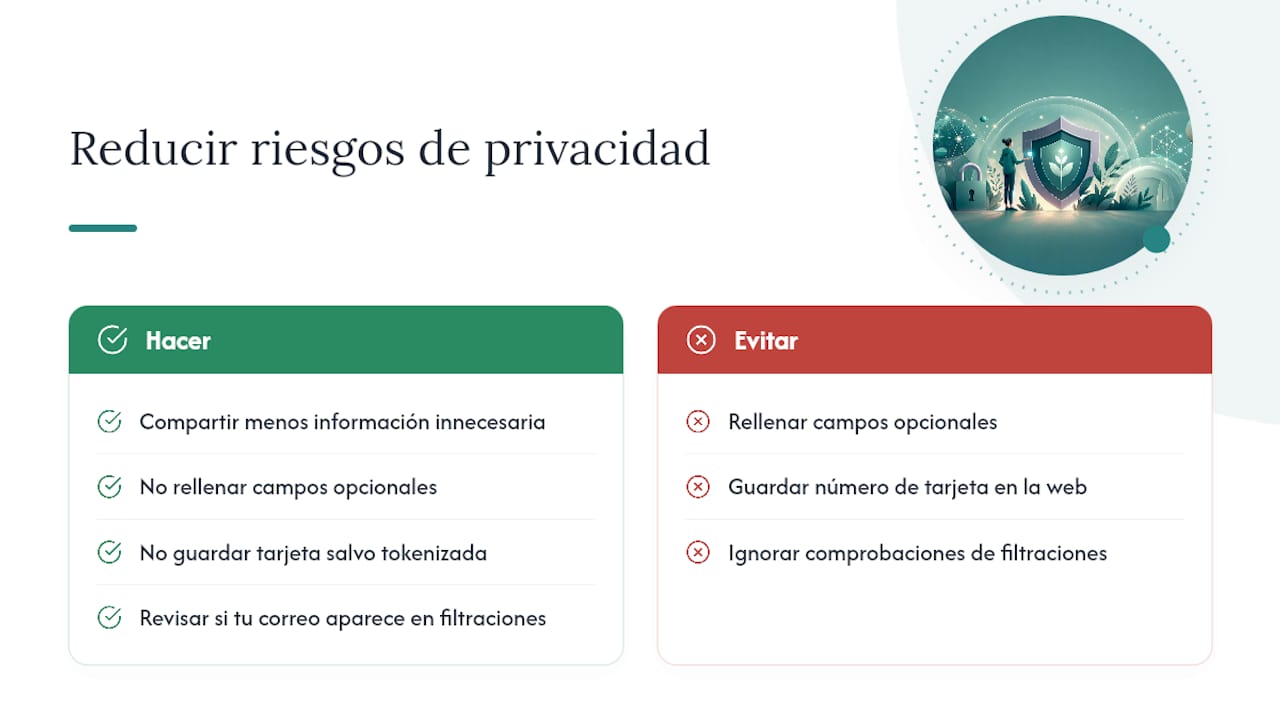
The practical lesson is simple: the less unnecessary information you share, the lower your exposure if something goes wrong at the other end. Avoid filling in optional fields that don’t affect delivery, don’t save your card number on the website unless you use a tokenised one, and check regularly whether your email appears in known leaked databases. Legal responsibility lies with the shop, but actively managing your own footprint is up to you.
Recommendations for checking the seller’s reputation and legality in order to protect personal data
Before entering a single piece of personal data, spend five minutes checking who is behind the shop. It isn’t paranoia, it’s the same standard you’d apply when choosing any business you’re going to share your address and payment method with.
Look for these specific signs:
- Domain age and a consistent presence over time, because a shop that appears and disappears every few months offers no guarantee of continuity if you need to exercise your rights later on.
- Verifiable reviews on independent platforms, not just testimonials hosted on the website itself, which are easy to fabricate.
- Real, verifiable contact details, including a physical address or at least a support channel that responds quickly.
- Clear terms of sale, with explicit quality guarantees and a defined, unambiguous complaints process.
- Consistency between what the website promises and what the purchase process demands: if a shop advertises discreet shipping but asks for excessive data at checkout, something doesn’t add up.
Our guide on how to choose a reliable seed bank goes into these criteria in more detail, which is useful if you are comparing several shops before deciding where to buy.
Legality and specific regulations on buying seeds in different autonomous communities or countries
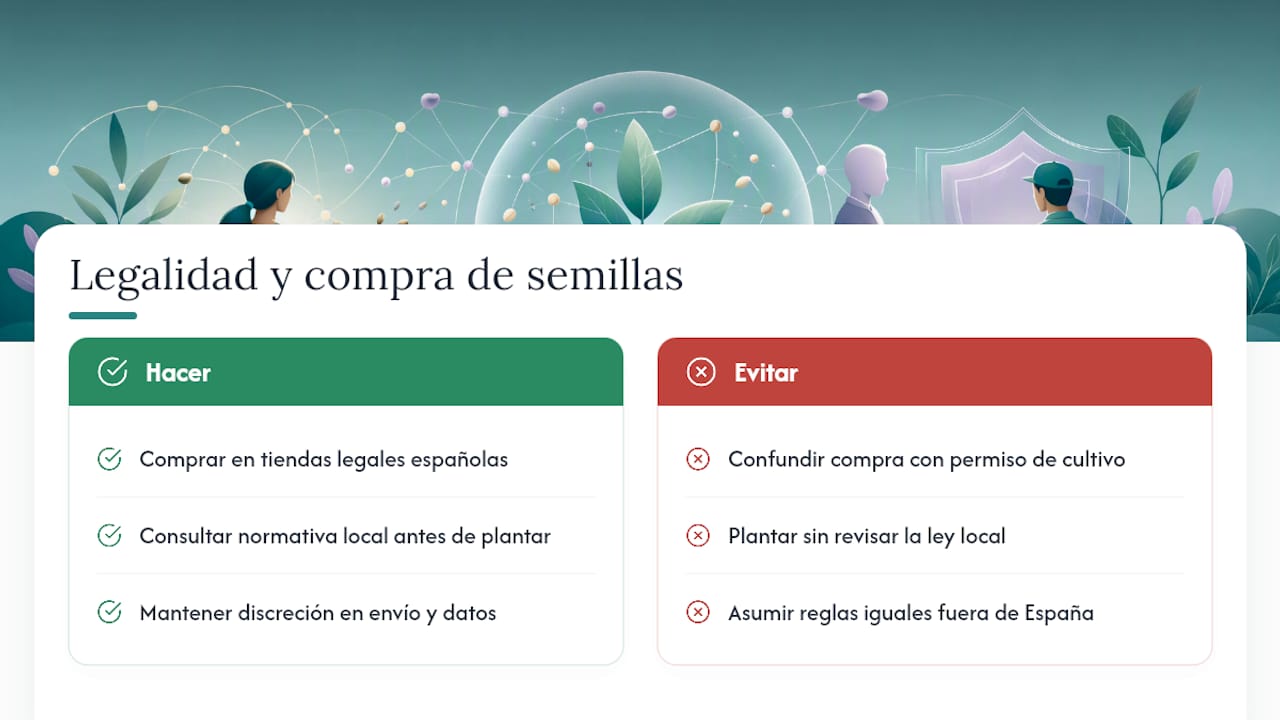
The sale of cannabis seeds is legal in Spain as a collectible item or for genetic research purposes, provided they are not marketed for the illegal cultivation of the plant. The rules on growing itself vary: while personal use in private, non-visible spaces enjoys a certain degree of case-law tolerance, the law does not offer a uniform framework and the consequences depend on each specific case, including differences of interpretation between autonomous communities.
This means that buying seeds online does not automatically equal having authorisation to grow them, and confusing the two is one of the most common mistakes among new buyers. The shop sells a legal product; what you do with it afterwards depends on local growing regulations, which you should check before planting anything, especially if you live outside Spain and the rules in your country differ.
For the purposes of this article, what matters is that the purchase itself, when made through a shop operating within the Spanish legal framework, should not automatically generate a record linking you to an illicit activity. Even so, discretion in shipping and data handling remains the best defence against any legal ambiguity, precisely because it reduces the trail that a third party could misinterpret.
The author’s reflection on privacy priorities when buying seeds
If you buy once a year, prioritise a virtual card and a collection point: they are the two measures with the greatest impact and the least effort. If you grow regularly, keep a protected account with two-step verification and check each season which aliases and cards are still active. Discretion doesn’t replace your rights as a consumer, it complements them: demand transparency just as you would demand genetic quality.
Check Bluedoggenetics’ privacy policy before your next order
There are shops that offer shipping in plain packaging, support to resolve any questions before you pay, and quality guarantees covering the whole process, from order to germination. Instead of guessing whether a shop lives up to what it promises, you can directly review its privacy policy and shipping conditions from the my account panel before deciding. If you already know which variety you’re looking for, the Bluedoggenetics shop brings together the full catalogue, and the purchase process lets you set the shipping address and billing details independently from the basket itself.
Sources
To delve deeper into legal and technical aspects: Incibe explains how to verify the technical security of a website, Comercio Conectado details GDPR obligations for shops, the AEPD’s Safe Shopping Guide covers complaint procedures, and Privacy Guides offers a technical analysis of private payments.
- Comercio Conectado — GDPR: guaranteeing the security of your customers’ data
- Proton — how to shop online privately
- Privacy Guides — Private payments
Frequently Asked Questions
Is it safe to buy cannabis seeds online?
It is reasonably safe if the shop uses HTTPS with a valid certificate, publishes a complete privacy policy and offers shipping in discreet packaging, as Bluedoggenetics does with every order.
Where can I buy cannabis seeds online with privacy?
Look for shops that detail their privacy policy, allow payment by virtual card and offer discreet delivery or collection from a pick-up point; the Bluedoggenetics shop meets all three criteria.
How can I pay for seeds without exposing my bank details?
Use a virtual card or a tokenised wallet such as Apple Pay or Google Pay, which replace your real number with a single-use token for the merchant.
What do I do if I suspect my data leaked when buying seeds?
Document the evidence, contact the shop’s data protection officer and, if there is no reply, file a complaint with the AEPD within the legally established deadlines.
If you already know which genetics you are after, Bruce Banner Feminised from Bluedoggenetics combines potency and good yield for anyone starting to grow discreetly, while White Widow Autoflowering is a solid option if you prefer a short cycle and less handling before harvest.