


Dein Warenkorb ist gerade leer!
Role of selfing in cannabis breeding: a grower’s guide
Most home growers assume that selfing a cannabis plant is basically cloning by seed. It is not. The role of selfing in cannabis breeding is far more complex and far more useful than that misconception suggests. Selfing, or cannabis self-pollination, forces a female plant to pollinate itself, producing seeds that carry doubled-up genetics from a single parent. The result reveals hidden recessive traits, increases genetic uniformity, and makes feminized seed production possible without a male plant in sight. If you want to move beyond buying seeds and start shaping your own genetics, understanding selfing is where that journey begins.
Table of Contents
- What is selfing in cannabis breeding?
- Genetic effects and trait stability from selfing
- How selfing influences seed and plant variation
- Using selfing to select and stabilize cannabis traits at home
- Why selfing remains an essential yet nuanced tool in cannabis breeding
- Explore premium feminized seeds and advanced breeding resources
- Frequently asked questions
Key Takeaways
| Point | Details |
|---|---|
| Selfing definition | Selfing is a breeding method where a single female cannabis plant pollinates itself to produce feminized seeds. |
| Genetic effects | Selfing reduces genetic variability and increases homozygosity, fixing traits but potentially exposing recessive negatives. |
| Seed uniformity | Self-pollinated feminized seeds show more uniform shape and traits than seeds from traditional crosses. |
| Selection process | Growing many S1 seeds and selecting top phenotypes is crucial before advancing selfed generations. |
| Essential tool | Despite risks, selfing is vital for producing feminized seeds with predictable cannabinoid and terpene profiles. |
What is selfing in cannabis breeding?
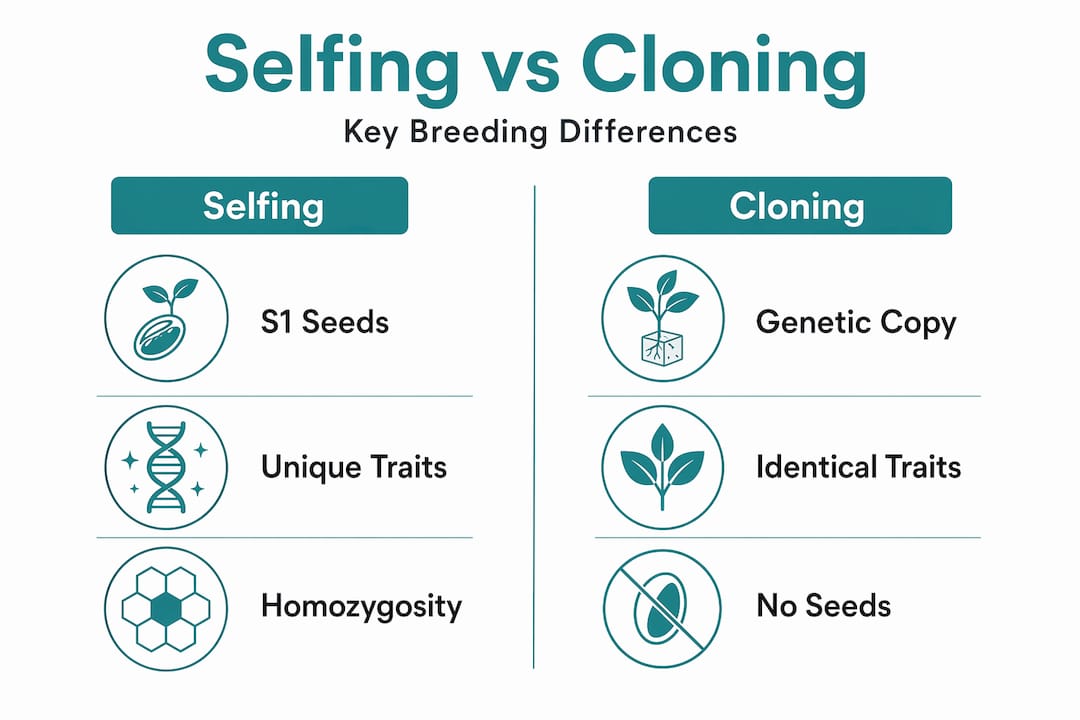
Selfing is the process of inducing a female cannabis plant to produce male flowers, then using that pollen to fertilize her own female flowers. The resulting seeds are called S1 seeds (first selfed generation). Selfing is self-pollination where one plant provides both genetic parents, increasing homozygosity and revealing recessive traits.
Cannabis is naturally dioecious, meaning it produces separate male and female plants. That makes selfing unusual compared to most crops, where self-pollination happens easily. To self a cannabis plant, you need to trigger hermaphroditism in a healthy female using one of several cannabis self-pollination methods:
- Colloidal silver spray: Applied to developing buds, it blocks ethylene production and forces male flower development on a female plant.
- Gibberellic acid: A plant hormone that can stimulate male flower production when applied during early flowering.
- Rodelization: A natural method where a stressed female plant produces male flowers late in flowering. Less reliable, but chemical-free.
One critical distinction: S1 seeds are not clones. A clone is a genetic copy. S1 seeds are siblings, each carrying a unique combination of the mother’s genetic material. You can explore the differences between cannabis seed type definitions to understand how S1 fits alongside F1, F2, IBL, and backcross seeds. That distinction matters enormously when you plan a breeding program.
Genetic effects and trait stability from selfing
When you self a cannabis plant, you are not just making more seeds. You are reshuffling the same genetic deck and dealing a hand where certain cards appear far more often. Selfing reduces heterozygosity roughly by half each generation, increasing homozygosity and trait fixation but revealing recessive deleterious alleles.
Here is how that plays out across generations:
- S1 generation: Heterozygosity drops by approximately 50%. You see a wide range of phenotypes, some excellent, some problematic.
- S2 generation: Heterozygosity drops again by half. Traits begin to stabilize, but inbreeding depression can appear as reduced vigor or stunted growth.
- S3 and beyond: Plants become increasingly homozygous. Trait expression becomes predictable, but the genetic pool narrows significantly.
Self-pollinated feminized seeds guarantee the parent’s cannabinoid and terpene profile but come with less genetic variability and risk of unfavorable recessives. That is the trade-off you accept when you choose selfing over crossbreeding.
The benefits of selfing cannabis are real: you get feminized seeds, predictable chemistry, and a pathway to true-breeding lines. But the risks are equally real. Inbreeding depression can reduce yield, slow growth, and make plants more susceptible to stress. You need to monitor every generation carefully.
💡 Pro Tip: Use S1 seeds to evaluate your mother plant’s full genetic range, not to assume you have an instantly stable line. Think of S1 as a diagnostic tool first, a breeding tool second.
How selfing influences seed and plant variation
One of the clearest signs that selfing is working as intended shows up in the seeds themselves. Self-pollinated feminized cannabis seeds show significantly less morphological variation in shape compared to seeds from male-female crosses. Seed shape uniformity is not just aesthetically satisfying. It is a measurable indicator of genetic consistency.
Here is a practical comparison of what you can expect:
| Metric | Selfed feminized seeds | Regular cross seeds |
|---|---|---|
| Seed shape uniformity | High | Lower |
| Genetic variability | Reduced | Higher |
| Phenotype range in seedlings | Narrow | Wide |
| Risk of recessive trait expression | Higher | Lower |
| Feminized rate | Near 100% | ~50% female |
What this means for you as a grower:
- If you want consistency: Selfed seeds give you a narrower phenotype range, which is ideal for growing uniform crops.
- If you want diversity: Regular cross seeds or F1 hybrids offer a wider genetic pool to select from.
- If you want feminized seeds without a male: Selfing is your most direct path.
The reduced morphological variation in selfed seeds also improves germination rate predictability. When you follow a complete seed germination guide, uniform seeds tend to germinate more evenly, giving you a more consistent seedling start.
Using selfing to select and stabilize cannabis traits at home
Selfing is not a one-and-done technique. It is a multi-generation selection process. The impact of selfing on yield and trait quality depends almost entirely on how well you select and cull at each stage. Here is a practical framework for home growers:
- Start with a strong mother. The quality of your S1 seeds is capped by the genetics of the plant you self. Choose a phenotype with the traits you most want to preserve: potency, structure, terpene profile, or yield.
- Grow a large S1 population. S1 seeds reveal the mother’s full genetic range; selecting top phenotypes from 50+ plants helps in trait fixation before progressing to S2 and beyond. Smaller populations increase the chance that you miss the best expressions.
- Select the top 10 to 20% of phenotypes. Look for plants that express the traits you want most strongly, while showing no signs of inbreeding depression like slow growth or unusual leaf morphology.
- Self the selected plants again. Move into S2 with your best performers. Repeat the selection process.
- Evaluate for inbreeding depression at every generation. Watch for reduced vigor, lower resin production, or unusual sensitivity to environmental stress. Cull aggressively.
💡 Pro Tip: Patience and large sample sizes are the two most underrated tools in selfing-based breeding. Rushing to S3 with only five plants is how promising genetics get lost. Work with numbers, not hope.
Selfed cannabis strains that reach S3 or S4 with consistent trait expression represent a genuine breeding achievement. That kind of stability is what separates a casual grower from a real cultivar developer.
Why selfing remains an essential yet nuanced tool in cannabis breeding
Here is the perspective that most articles miss: conventional wisdom in cannabis breeding circles often treats inbreeding depression as a reason to avoid selfing. That framing is incomplete. Selfing is not a shortcut to disaster. It is a spotlight.
When you self a plant, you are not weakening it. You are revealing what was already there, hidden in the heterozygous background. The recessive traits that surface under selfing were always present. Selfing just makes them visible. That visibility is valuable. It tells you whether your mother plant is carrying genetic liabilities before you build an entire breeding program around her.
Despite inbreeding risks, self-pollination is essential because feminized seeds guarantee cannabinoid and terpene profiles, vital for commercial and home breeding. That is not a minor benefit. For a home grower who has found a phenotype they love, selfing is the only way to preserve those chemical characteristics in seed form without introducing a male plant’s genetics.
The real skill in selfing is not avoiding the risks. It is managing them. Grow large populations. Select hard. Monitor every generation. If you treat selfing as a selection spotlight rather than a cloning shortcut, it becomes one of the most powerful cannabis breeding techniques available to you.
Explore premium feminized seeds as your starting point, because the quality of your foundation genetics determines how far your selfing program can go.
Explore premium feminized seeds and advanced breeding resources
Your selfing breeding program starts with the right genetics. At Bluedog Genetics, you will find a wide selection of premium feminized cannabis seeds suited for home breeders who want a reliable foundation for selfing work. Whether you are starting your first S1 run or pushing into S3 territory, the quality of your source genetics shapes every generation that follows.
Browse our curated cannabis seed banks to find stabilized lines and advanced genetics from trusted breeders worldwide. Pair that with our cultivation guides covering germination and early plant care, and you have everything you need to move from theory to practice.
💡 Pro Tip: Starting with a well-stabilized feminized variety shortens your path to a true-breeding selfed line considerably.
Frequently asked questions
What does selfing mean in cannabis breeding?
Selfing means pollinating a female cannabis plant with pollen from male flowers induced on the same plant, producing seeds with genetics from one parent. Selfing is self-pollination where one plant provides both genetic parents, increasing homozygosity.
Are S1 cannabis seeds clones?
No, S1 seeds are not clones but a sibling group revealing genetic diversity from one mother line with increased homozygosity. S1 seeds reveal the mother’s full genetic range; they are not genetic photocopies.
Why do breeders use selfing despite risks of genetic defects?
Breeders use selfing to fix desirable traits and create feminized seeds that reliably express the parent’s cannabinoid and terpene profiles. Self-pollination fixes traits and yields feminized seeds but can expose recessive deleterious traits, making careful selection essential.
How many generations of selfing are needed to stabilize a cannabis line?
Multiple generations combined with careful selection are required; S1 seeds are only the first step. Producing homozygous lines typically requires multiple generations of inbreeding and selection before true breeding stability is achieved.
Can selfing improve uniformity in cannabis plants?
Yes, selfing reduces genetic variability, resulting in more uniform seed morphology and plant traits. Self-pollinated feminized seeds show less morphological variation and improved classification accuracy, though uniformity still depends on the mother plant’s underlying genetics.
Recommended
- Cannabis blog – Your cannabis garden – BLUEDOG GENETICS Seeds
- Guía completa para germinar semillas de cannabis – BLUEDOG GENETICS Seeds
- Premium feminisierte und selbstblühende Cannabis-Samen
- Guía definitiva para el autocultivo de cannabis en Alemania – BLUEDOG GENETICS Seeds
Schreibe einen Kommentar
Du musst angemeldet sein, um einen Kommentar abzugeben.